









Sustainability in civil engineering
Sustainability is playing an increasingly important role in civil engineering. Sustainability requirements are being written into contracts, or contractors need to set themselves apart on sustainability to improve their chances of winning tenders. They must then demonstrate that projects have indeed been delivered as sustainably as possible, for example using Environmental Cost Indicator (MKI) calculations, CO2 calculations and the CO2 Performance Ladder.
But what does sustainability in civil engineering actually mean? To answer that question, let’s take a step back and consider exactly what sustainability is. We’ll then return to the broad definition and explore its impact on civil engineering projects, and the impact of those projects.
What is sustainability?
Ask ten people what sustainability means and you’ll probably get ten different answers. Sustainability is a broad concept, and everyone has their own interpretation of it. For some, it is about circularity and reuse; for others, it is more about ecology and nature. Some immediately think of greenhouse gas emissions, while others take a social or societal perspective. And they are all right: sustainability encompasses all these aspects.
A widely used definition of sustainability is the one given by the UN’s Brundtland Commission in 1987: “Sustainable development is development that meets the needs of the present without compromising the ability of future generations to meet their own needs.”
This definition clearly highlights an important aspect of sustainability: the balance between the interests of the present and those of the future. In other words, ensuring our children are at least as well off as we are. This balance is increasingly being disrupted, throwing the Earth off balance and making it uncertain whether we will be able to meet the needs of future generations.
The balance under threat
To maintain a healthy balance on Earth, we need to stay within 9 planetary boundaries. We should try to remain within these boundaries because if we exceed them, we cannot be sure what will happen to the planetary system or what risks we will face. However, at least 5 of the 9 boundaries have already been exceeded. This puts the balance on Earth at risk, as illustrated in the image below.
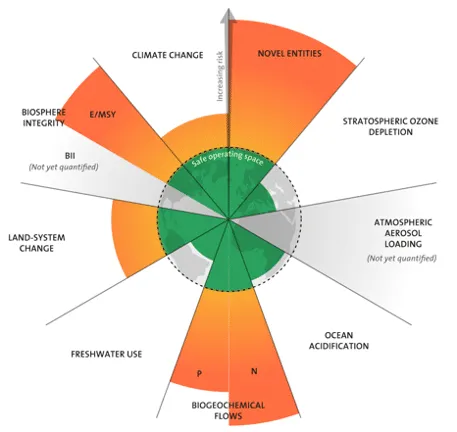
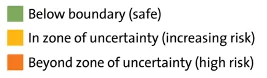
Source: Azote for Stockholm Resilience Centre, based on analysis in Persson et al 2022 and Steffen et al 2015
The risks we face as a result of exceeding the boundaries:
- Loss of biodiversity and extinction of plant and animal species
- Climate change caused by global warming
- Deforestation caused by changes in land use
- Excess nitrogen and phosphorus in the biosphere and oceans
- New entities that are difficult to break down in nature
Impact of civil engineering
How does civil engineering contribute to the breaching of planetary boundaries?
- Infrastructure projects alter the habitats of plants and animals, affecting the various species in an area. The extraction of raw materials can also affect their habitats. Without mitigation measures, for example, a road through a forest will split an animal’s habitat in two. Lighting can also affect the behaviour of nocturnal animals such as bats.
- Greenhouse gas emissions contribute to climate change. Many of the raw materials needed for civil engineering have a high greenhouse gas footprint, particularly in terms of CO2. Concrete and steel extraction and production are examples. Our machinery also runs mainly on fossil fuels.
- Infrastructure often changes how land is used. For example, several road projects have turned green space into grey infrastructure.
- Machinery emits nitrogen oxides. Nitrogen and the policies surrounding it have become a notorious issue in civil engineering, with major impacts on projects and their surroundings.
- Increasing amounts of toxic or polluting substances that are difficult to break down are being found in our environment. These substances are often not found naturally, but are man-made. In civil engineering, PFAS are the best-known example of these new entities. Soil contaminated with PFAS cannot be reused and therefore affects construction projects.
Understanding the impact of civil engineering on planetary boundaries also helps us find targeted solutions to reduce that impact and contribute to a sustainable living environment. Policies have been drawn up at global and national level to restore the balance. These include the Paris Climate Agreement, the United Nations Sustainable Development Goals and the Dutch target of becoming fully circular by 2050. Every civil engineering project must and can contribute to these goals, for example by optimising designs, material use and the deployment of zero-emission machinery. Together, we can work towards a civil engineering sector that operates within the planetary boundaries.
Find out more
The one-day course Sustainability in civil engineering gives you and your organisation a solid foundation for getting started with sustainability.
Need help with a tender? We can put you in touch with the sustainability experts at We-Boost for advice on sustainability and insight into environmental impacts, helping you find suitable solutions.
Question about this story? Ask your question
Keep following this
Get an email when a new story is published. No account needed.
- SubjectNews







