









Large-scale redevelopment requires more than a design
Text Thijs RaaijmakersImage Iv-Infra
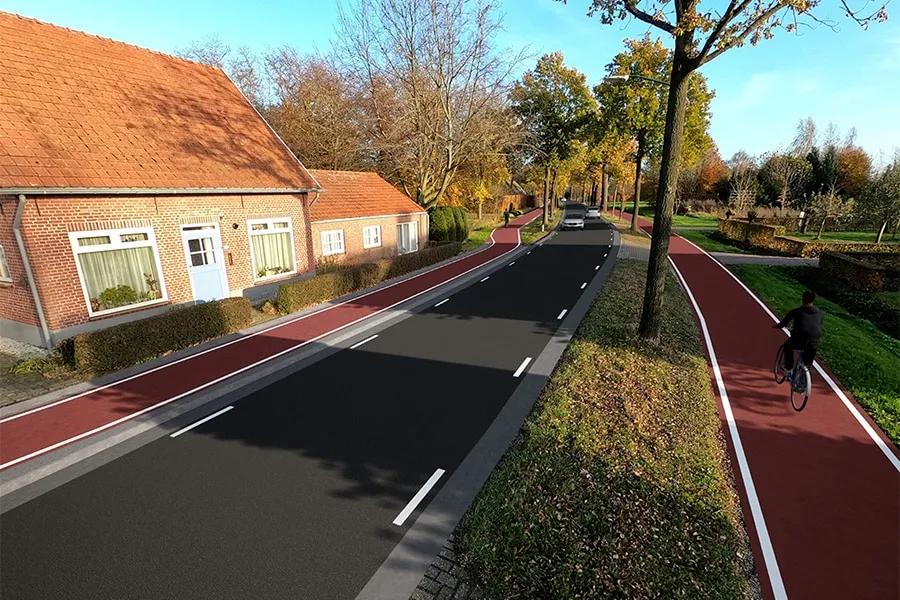
The Ollandseweg in Sint-Oedenrode is set for a major overhaul. The European tendering procedure has now started. Commissioned by Gemeente Meijerijstad, Iv-Infra has produced the complete redesign, organised public consultation meetings and developed the technical preparations. This means Iv-Infra has been involved from A to Z, right through to the tendering stage. This approach is becoming increasingly common.
The Ollandseweg is a road approximately 3.5 kilometres long between the village of Olland and Sint-Oedenrode, in the municipality of Meijerijstad. The original road consists of a cycle path and a carriageway for cars. The cycle path in particular, however, has been in poor condition for years. It has deteriorated to the point where cyclists increasingly choose to ride on the carriageway, creating dangerous situations. In addition, the carriageway no longer meets current road safety requirements. These factors led the municipal council to decide to redevelop the Ollandseweg.
Extensive public consultation
Iv-Infra has been closely involved in the redevelopment since the plans were drawn up around a year and a half ago. A substantial section, 1.5 kilometres, of the route lies within the built-up area of Sint-Oedenrode. Many homes and businesses are located along the Ollandseweg, both within and outside the built-up area. A thorough, comprehensive and clear public consultation process is therefore essential. The final redevelopment design was developed together with local residents and stakeholders, an essential part of the participation process.
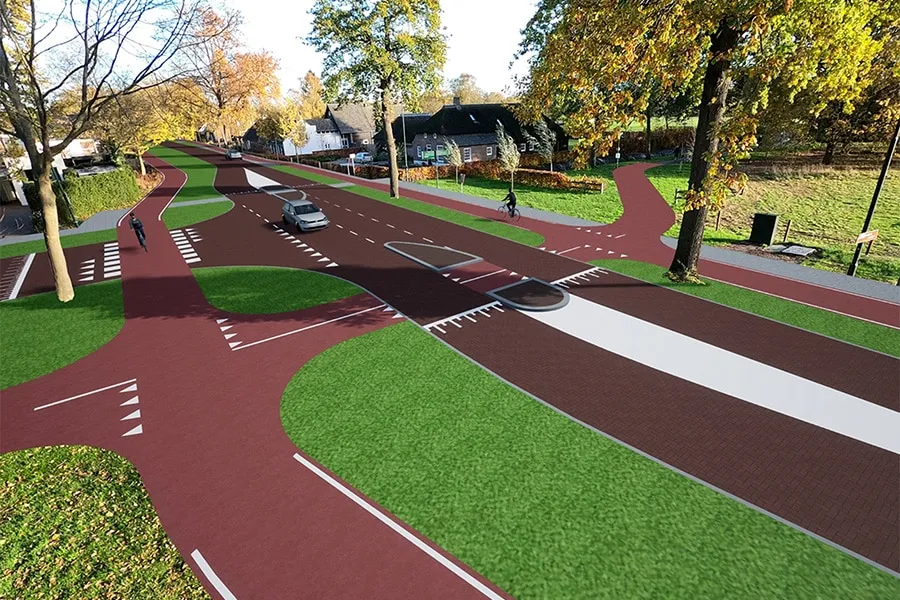
The public consultation and information meetings, together with the expertise of Iv-Infra and Gemeente Meijerijstad, have led to a complete reconstruction of the Ollandseweg. On both sides of the road, inside and outside the built-up area, the cycle path will be laid with interlocking concrete slabs to improve riding comfort. Within the built-up area, the carriageway will be surfaced with noise-reducing paving bricks to reduce nuisance. Outside the built-up area, it will have a new asphalt surface.
Improving safety
New connections to residential streets will be created along the cycle paths, and safety measures will be implemented at three crossing points to improve safety for cyclists, pedestrians and other road users. The road will be designed to appear narrower than it actually is, which generally encourages drivers to slow down.
Climate adaptation
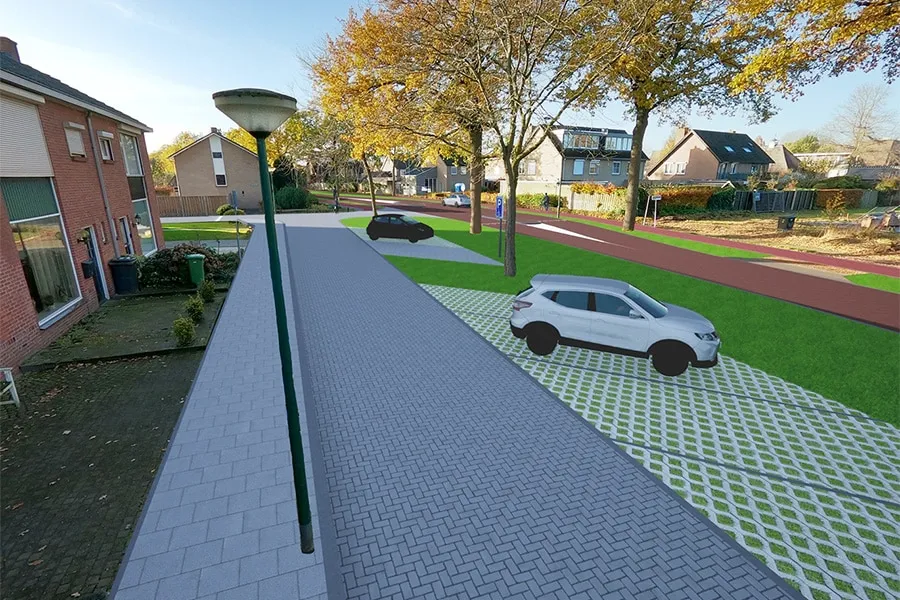
The design takes the changing climate into account as far as possible. More intense rainfall can overwhelm ageing infrastructure, preventing rainwater from draining properly and potentially creating dangerous traffic situations. Drainage will be improved along the entire route, and parking areas along the parallel roads near Koninginnelaan and Laan ten Rode will be redesigned. They will be made permeable so that rainwater can be properly absorbed.
A reconstruction such as the one on the Ollandseweg always has an impact, not only on local residents but also on the area's flora and fauna. The local road is lined by approximately 480 oak trees. One of the key design principles is to preserve as many of these trees as possible. Although the road will be partially realigned or altered in some places, the vast majority of the trees will be retained.
Replacement planting
New trees will be planted to replace those that have to be removed. The trees were mapped using a detailed 3D scan, and a Tree Impact Assessment was carried out to establish the condition of the flora. During the works, the contractor will need to take the area's flora and fauna into account. Iv-Infra has drawn up a working protocol for this purpose, to ensure that, among other things, birds and bats are not disturbed.
In addition to the design, the working protocol and the organisation of residents' meetings, Iv-Infra has drawn up a diversion and phasing plan. As the works will take just under two years, they will be carried out in several phases, which are detailed in the phasing plan. This is intended, among other things, to minimise disruption caused by the works.
The best plan
With the detailed design for construction now complete, contractors can submit tenders for the project. Price is not the only deciding factor: the main consideration is which plan best fits the design and the wishes expressed by local residents and stakeholders during the participation process. This also includes limiting nitrogen emissions.
For the Ollandseweg redevelopment, Iv-Infra is involved from start to finish, through to the start of construction. It is responsible not only for the design, but also for quality, stakeholder communications, budget monitoring and scheduling.
An integrated approach
Improving the accessibility, traffic flow and road safety of municipal infrastructure, while also making it climate-resilient, is becoming an increasingly prominent item on political agendas. Many municipalities face a wider range of challenges, and are increasingly opting for an integrated approach. Iv-Infra provides services in areas including spatial planning and mobility, surveying and monitoring, risk management, asset management, contract management, and site supervision and inspection.
Question about this story? Ask your question
Keep following this
Get an email when a new story is published. No account needed.
- ProjectOllandseweg
- SubjectRoad construction







