









Keeping the excavation dry
Text Roel van Gils Beeld Bertels Fotografie
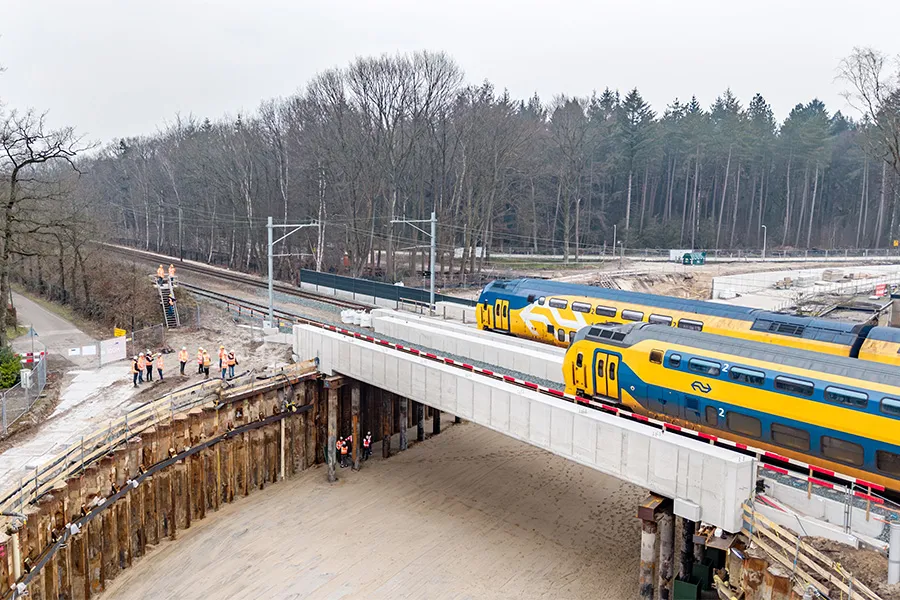
In Maarsbergen, the level crossing on the busy Utrecht–Arnhem railway line is being replaced by no fewer than two underpasses: one for motor traffic and one for pedestrians and cyclists. The first is now under construction and reached its deepest point in early February. Thanks to a carefully designed dewatering system by Theo van Velzen, part of Van Tongeren Watertechniek, the contractor is keeping the excavation dry.
The level crossing in Maarsbergen has caused frequent traffic queues and unsafe situations for years. The problems affect not only the village centre itself, but also the nearby N226 and even the A12, which has a full interchange with the N-road. Cyclists are also severely affected by closures caused by regular rail traffic, compounded by traffic congestion. With more and more trains set to run on the line in the coming years, the disruption will only get worse. This prompted ProRail, the province of Utrecht, the municipality of Utrechtse Heuvelrug and the government to join forces to improve road safety, traffic flow and liveability.
Fourteen wells
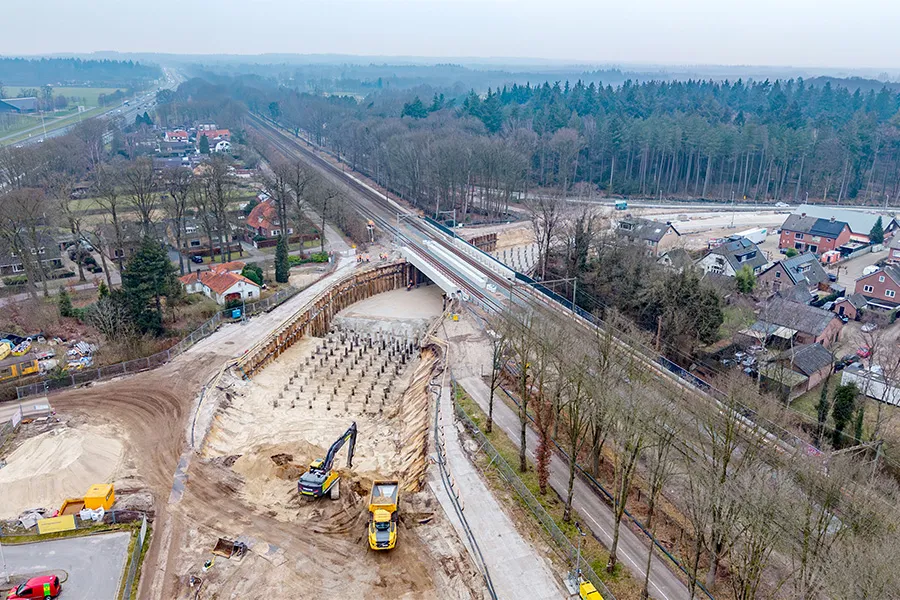
Two underpasses are being built in Maarsbergen to carry traffic safely beneath the railway. At the same time, the N226 is being rerouted to the west. Motor traffic will pass beneath the railway through a new underpass, which connects to a new roundabout. This underpass is currently under construction and is due to be completed in early 2026. The contractor will then start work in May 2026 on the underpass for pedestrians and cyclists, at the site of the current level crossing. “Hegeman Bouw & Infra brought us in during the preliminary phase to design and install the dewatering system,” says Frans Glorie, operations director at Theo van Velzen. “For the first underpass, for motor traffic, we drilled fourteen wells in stages.”
Impediment layer
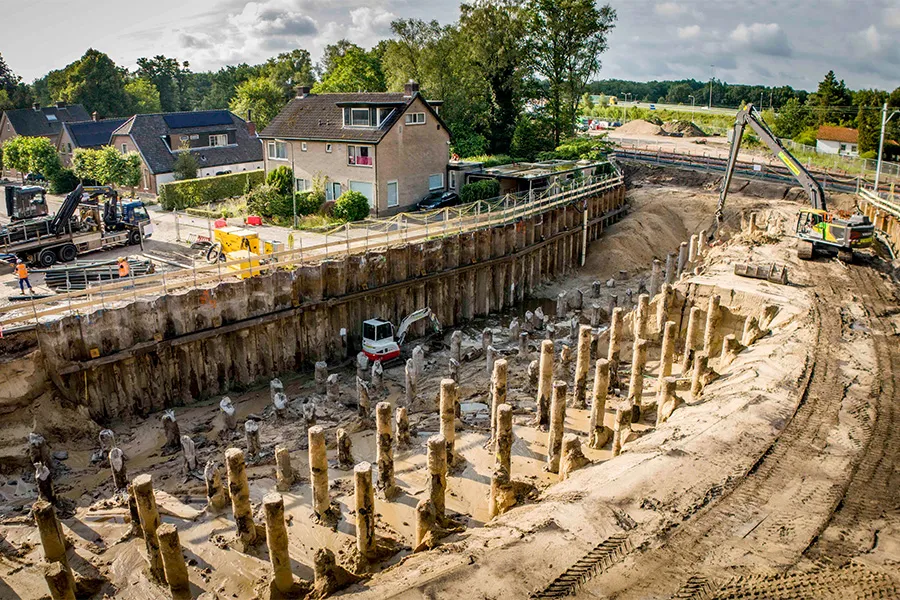
The underpass excavation has now reached its deepest point. “The lowest point is the pump sump, at 1 metre below NAP. The average ground level here is 9 metres above NAP. So the excavation is about 10 metres deep. Our wells, however, were drilled through the clay layer to a depth of 17.5 metres below ground level,” Frans explains. The excavation is nice and dry, but getting it there took some effort. Literally. “In the first phase, we encountered an ‘impediment layer’ of peat rather than sand. This meant that water remained above the layer, while the ground below it was dry. At first, we didn’t know this, so we installed additional vacuum wellpoints. In the next phase, we milled through the peat layer.”
Variable-speed pumps
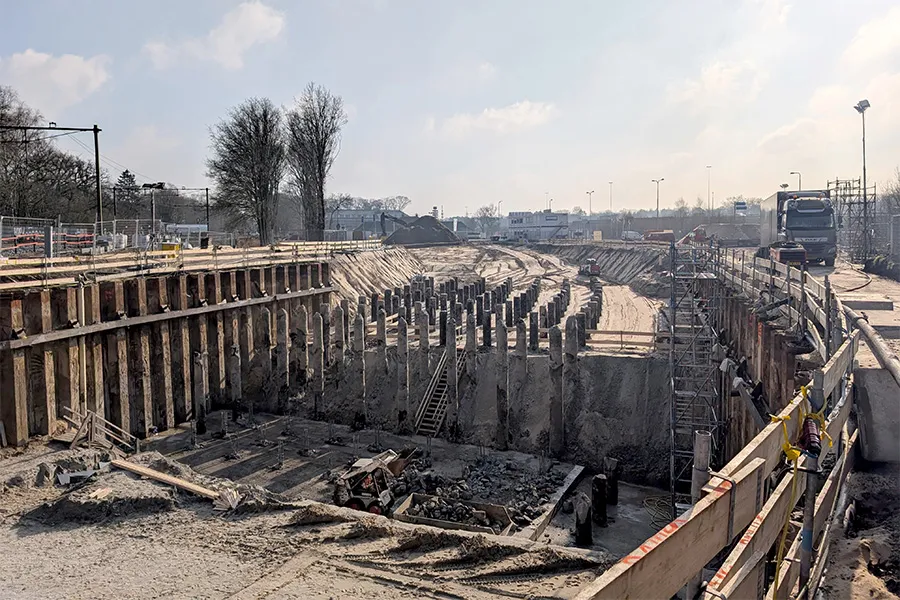
The dewatering system has a maximum flow rate of 250 m3 per hour. All the pumps are variable-speed, which, according to Frans, helps optimise power consumption and the total volume of groundwater abstracted. “The water is conveyed over the motorway access road via a jumper, or pipe bridge, then routed beneath the motorway and discharged on the south side of the project. Motorists drive underneath the discharge pipe. We have also installed a groundwater cut-off wall on the north-east side, using a recharge system to keep the contamination present there in place. The entire dewatering system is monitored using standpipes, and the contractor can view all the parameters online. The monitoring is carried out by one of our other companies, Tjaden Adviesbureau voor Grondmechanica.”
Theo van Velzen’s dewatering system is currently operating at full capacity and, according to Frans, without any problems. “Our site manager, Edwin Klok, visits about once a week to check everything. If needed, a team is brought in to make adjustments, so the contractor can continue without delay. If all goes to plan, the dewatering system can be removed at the end of this year. In 2026, we will drill another five wells for the second underpass. These will not go as deep, however, and the excavation will require a considerably smaller dewatering system, with a maximum flow rate of 120 m3 per hour.”
Een zakelijke vraag aan Henk van Tongeren Water & Techniek? Get in touch
Who worked on it
Maarsbergen underpass in Utrechtse Heuvelrug
- dewateringVan Tongeren Watertechniek
- contractorHegeman Bouw & Infra
- monitoringTjaden Adviesbureau voor Grondmechanica
Keep following this
Get an email when a new story is published. No account needed.
- ProjectMaarsbergen underpass
- SubjectBridge construction
- CompanyVan Tongeren Watertechniek
- CompanyHegeman Bouw & Infra
- CompanyTjaden Adviesbureau voor Grondmechanica
- CompanyHenk van Tongeren Water & Techniek







