Optimising foundations at an early stage with software
Text Roel van Gils Image CEMS

Time-consuming, costly and still prone to errors: determining the optimum design parameters for different foundation configurations. It is a challenging task, but there is another way: let CEMS Microservices do the work. They combine geotechnical and geohydrological expertise with modern programming skills, helping to build scalable, automated design processes.
CEMS is part of the CRUX Groep, which also includes consultancy and engineering firm CRUX Engineering and specialist consultancy BouwRisk. “The idea for CEMS emerged more than eight years ago, when digitalisation was becoming an increasingly important topic within our group,” says director Jacco Haasnoot. “We were taking measurements in the field and doing calculations in the office, and wanted to connect those two worlds more efficiently. At CEMS, we speak the language of geohydrologists and geotechnical engineers, and translate it into software and automated design processes. Third parties can also use that software.”
Foundation Suite
CEMS builds what it calls Microservices, known as Cores: small programmes that run in the cloud and perform calculations at high speed. “The main product is the Foundation Suite,” says Haasnoot. “It comprises a number of Microservices providing digital services for the design of both shallow and piled foundations, as well as tension anchors, vibration predictions and the interpretation of cone penetration tests using classification methods. The latter converts all your CPT data into a soil layer profile in no time, which you can then use as the basis for your calculations.” According to Camille Luichies, Sales Coordinator at CEMS, the advantage of Microservices is that they can be deployed flexibly and at scale. “That means they can be integrated into each customer’s unique workflow. You save a great deal of time and also arrive at a more effective foundation design.”
More efficient foundation design
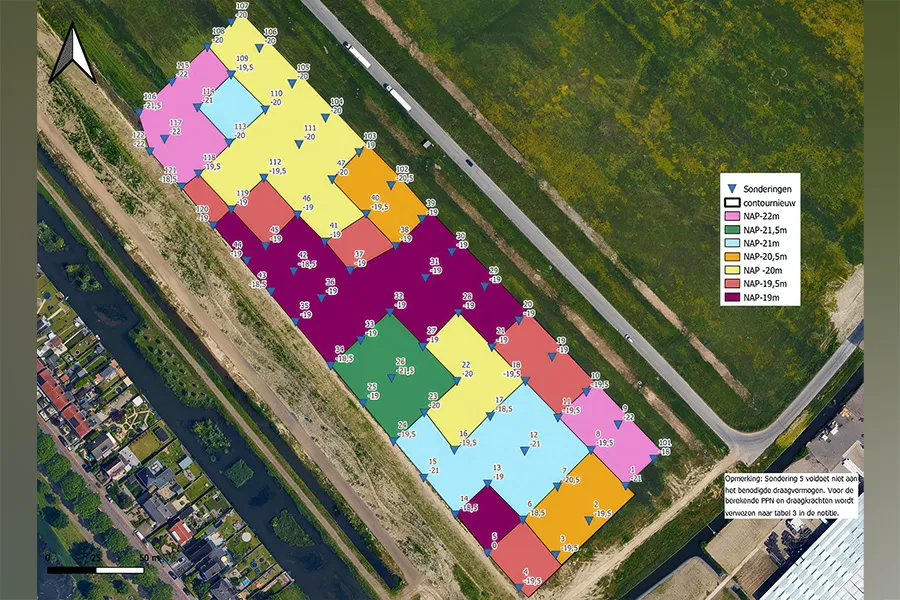
Using Microservices allows you to calculate scenarios at an early stage of a project, says Haasnoot. “Previously, an indicative design would be issued at the preliminary design stage. With our Microservices, that is no longer an issue. With just a few clicks, you can reach detailed-design level, so you know exactly where you stand at a very early stage of a project.” He gives the example of a pile mattress, which generally requires a very large number of piles. “Our Microservices enable you to calculate the highest possible load-bearing capacity at every pile location you define. That is because the software intelligently groups the CPT calculation results, allowing safety factors to be reduced and making optimum use of the leeway in the Eurocode. Users tell us that the Microservices enable them to produce a much more efficient foundation design. There are also significant gains to be made for companies building foundations for large industrial buildings. We recently had a customer save more than €100,000 on the foundation works alone, using our calculation method.”
Haasnoot believes engineers and structural engineers need to start thinking in terms of data. “Everything that is calculated can be reproduced and is ready for the next step in a process. So once the geotechnical engineer has done their ‘bit’, the structural engineer can take it from there. Design activities are becoming data flows rather than PDFs that we pass back and forth.” To bring traditionally trained engineers along in the digital transition, CEMS is currently developing a graphical user interface, so there is virtually no barrier to getting started with the Foundation Suite.
Question about this story? Ask your question
Keep following this
Get an email when a new story is published. No account needed.
- ThemeUnderground construction
- SubjectDigitalisation & software