Platform on civil engineering, underground infrastructure, energy, construction equipment & construction machinery
Rapid mobilization of dredging equipment
Late last year, Bell Dredging Pumps was unexpectedly called in for an urgent job in Antwerp. During the construction of the new Scheldt Tunnel, it became apparent that nearly two meters of sand had accumulated between the last two tunnel segments—numbers 7 and 8. Due to the strong current, the sand had ended up exactly in the wrong place: on the steel plate supporting the segments. The result? The closure joint could not be filled with concrete, and construction of the tunnel came to a standstill. Swift action was needed to prevent delays.
The Scheldt Tunnel is a key link in the Antwerp ring road and connects the new Sint-Anna Interchange on the Left Bank with the Oosterweel Interchange on the Right Bank. Commissioned by Lantis, the TM COTU construction consortium—a partnership between BESIX, DEME, Jan De Nul, and Stadsbader Contractors—is working on this 1.8-kilometer-long tunnel, which consists of eight separate segments. The precise alignment of these segments is essential for the watertight integrity and structural soundness of the entire structure. That is precisely where things went wrong when sand accumulation blocked the final joint.
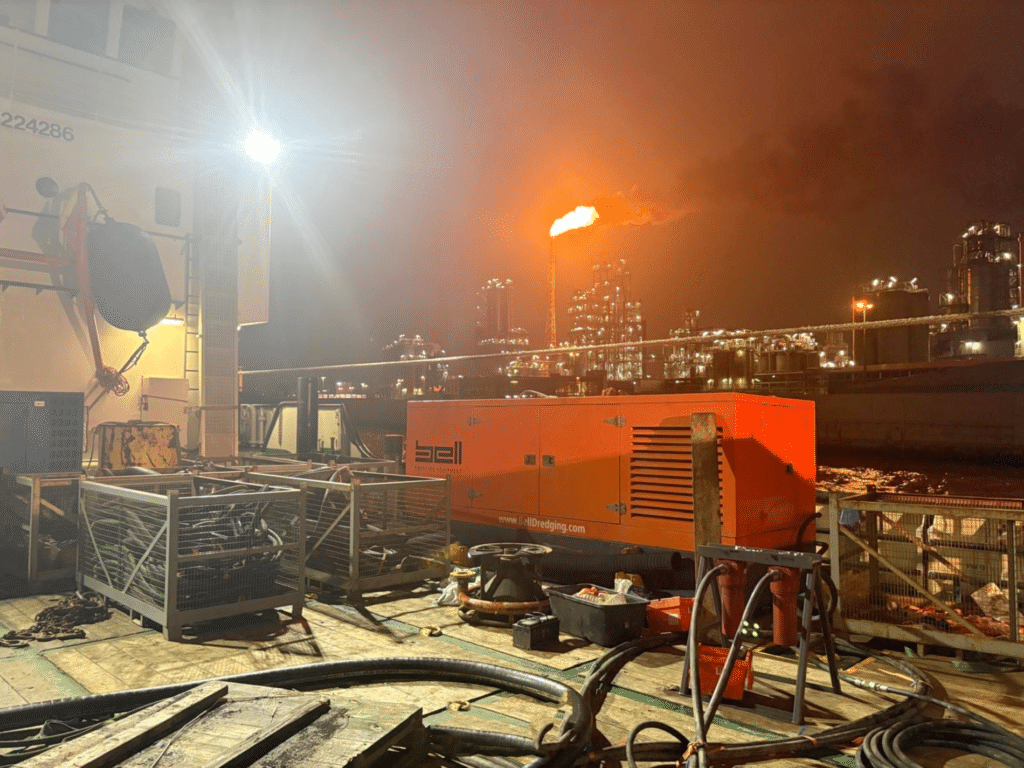
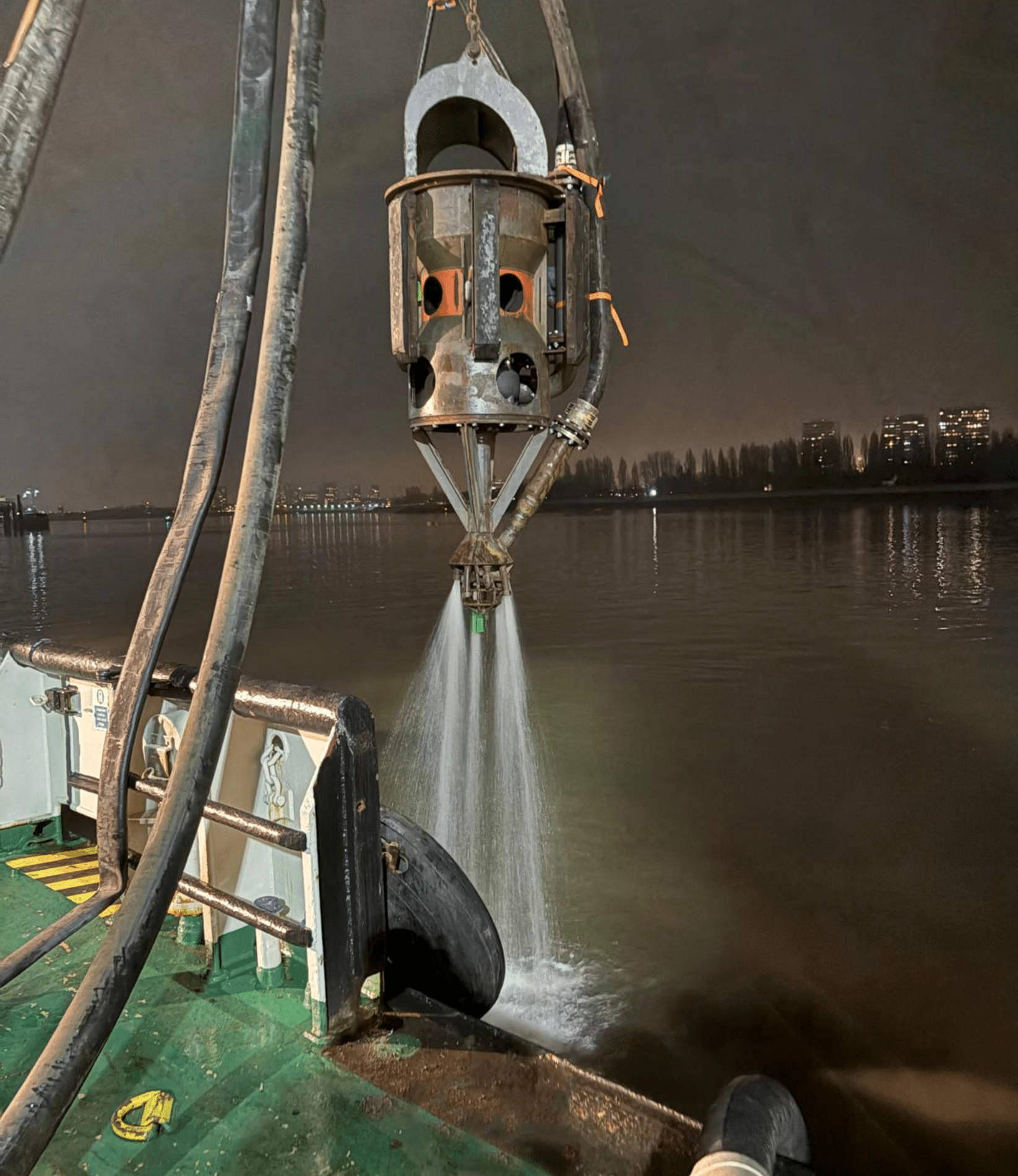
Bell Dredging Pumps was called in to tackle this challenging problem. The Winkel-based company is known for its practical approach and ability to adapt quickly. “Within five days, we were able to mobilize a team with a suitable solution on site,” says Stef van der Bel, who is in charge of rentals at Bell. “We deployed a complete package consisting of a Bell hydraulic power pack, a Bell water jet, and the compact Bell 100 dredging pump. Because continuity was essential, the system ran 24/7, and we also provided a backup setup. Two of our technicians were on site at all times to ensure the operation ran smoothly.”
Although the scope of the job was relatively limited, the challenge lay primarily in its complexity. The workspace was extremely cramped, and the tolerances were minimal. The pump had to accurately remove the sand without touching the tunnel sections or the upright trusses. “That’s precisely why we chose the smallest pump in our lineup, the Bell 100. The work was quite time-consuming, but after a week, the sand had been completely removed and construction of the tunnel could resume.”
This project demonstrates what Bell Dredging Pumps does best: delivering customized solutions under tight deadlines, without compromising on safety and quality. As an international specialist in the rental and sale of dredging equipment, the company offers a broad and versatile product range, ranging from amphibious excavators and cutter suction dredgers to heavy-duty dredging pumps.
In the coming years, Bell will focus on the further development of, among other things, power packs in various power classes. These are available in diesel-hydraulic and electric-hydraulic versions, in both standard configurations and fully customized designs. In doing so, the company is responding to the growing demand for flexible and sustainable solutions within the dredging and offshore sectors.