Platform on civil engineering, underground infrastructure, energy, construction equipment & construction machinery
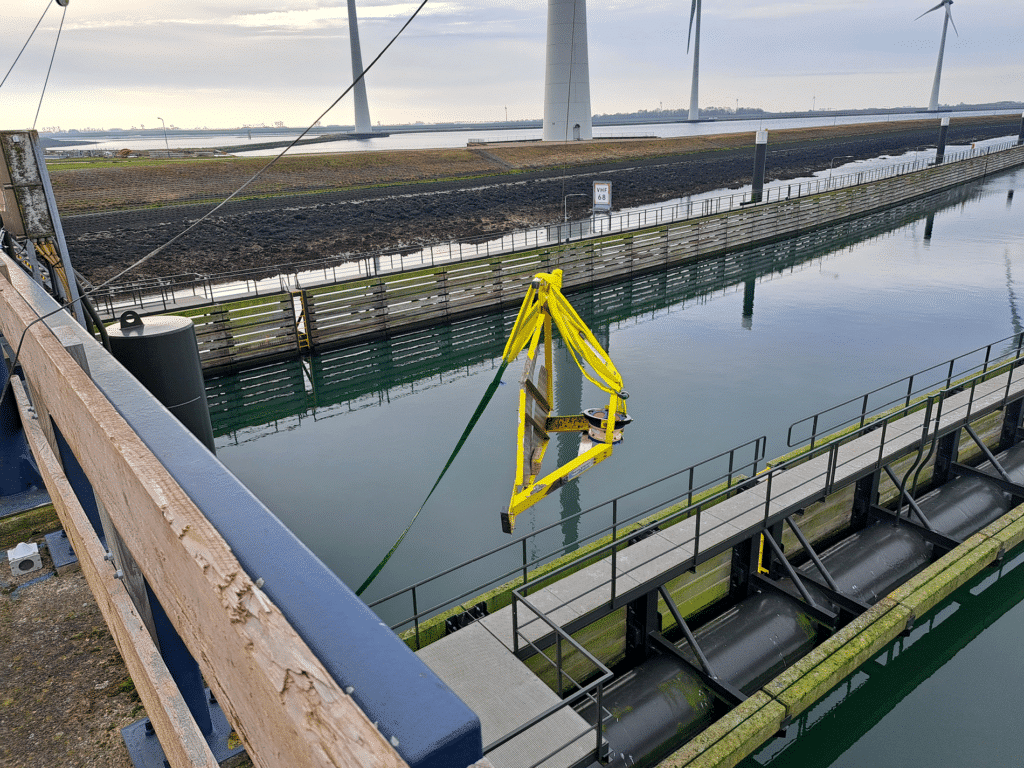
How safe is it to perform diving operations right next to the entrance of a heavily trafficked lock chamber? That question was central to the ZEEKR consortium, because divers had to install a steel connecting plate for a future construction caisson. To objectively assess the risks, Aqua Vision, a specialist in water column measurements, conducted an extensive measurement campaign.
For nearly thirty years, Aqua Vision has specialized in measuring currents in the water column using acoustic Doppler equipment. “For this project, we installed a measurement frame at three strategic locations,” says Jeroen van Dam, sales manager at Aqua Vision. “The goal was to determine the flow velocities caused by the boats and whether additional safety measures were necessary to ensure safe diver operations. At flow velocities above 0.5 meters per second, divers must work from a protective diving cage.”
A diving cage protects the diver from suction and strong currents, but at the same time significantly restricts freedom of movement. “That’s why it was important to objectively determine whether this (expensive) measure was necessary,” says Almar Bijlsma, project manager at Aqua Vision. “To that end, we installed three bottom frames equipped with an Acoustic Doppler Current Profiler (ADCP) to measure the current velocity throughout the water column. This equipment emits sound waves into the water that are reflected by small particles, such as air bubbles, sand, or algae. By analyzing the distortion of the returning signal—the so-called Doppler effect—we can determine very precisely how fast and in which direction the water is flowing.” Measurements were taken every twenty centimeters throughout the entire water column.
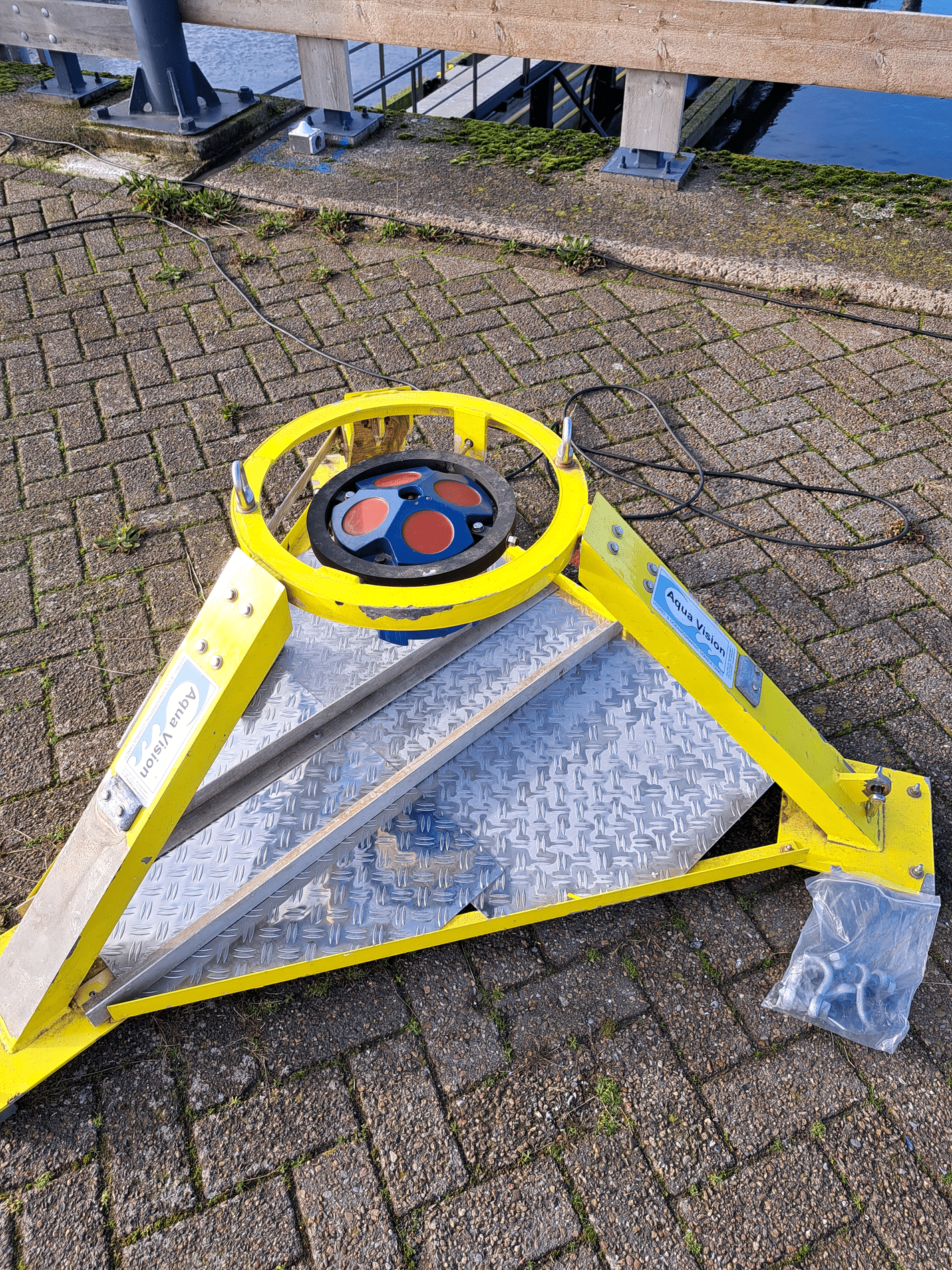
The measurement frame was connected to the bank via a data and power cable. “This makes it possible to verify, while installing the frames, whether the frame is positioned correctly and whether the ADCP is measuring valid data. Because measurements were taken close to the quay, the beam directed toward the quay was deliberately disabled. It would have produced poor data due to interference with the quay,” said Almar. “We then linked the measurement data to the AIS data from passing vessels. This allowed us to determine exactly which currents were created by boats entering and leaving the harbor, and that data was interpreted by the ZEEKR consortium to determine management measures for safe diver deployment.”
Aqua Vision’s measurements showed that passing ships create strong currents in the upper part of the water column, particularly near the shipping channel. “In this zone, divers must therefore work from a diving cage,” says Wouter Sloven of the ZEEKR consortium. “However, the current caused by shipping rapidly decreases with distance from the navigation channel. As a result, work in the middle of the seawall can be carried out safely without a diving cage. Based on these results, markings have now been installed to indicate the safe work zone.”