Platform on civil engineering, underground infrastructure, energy, construction equipment & construction machinery
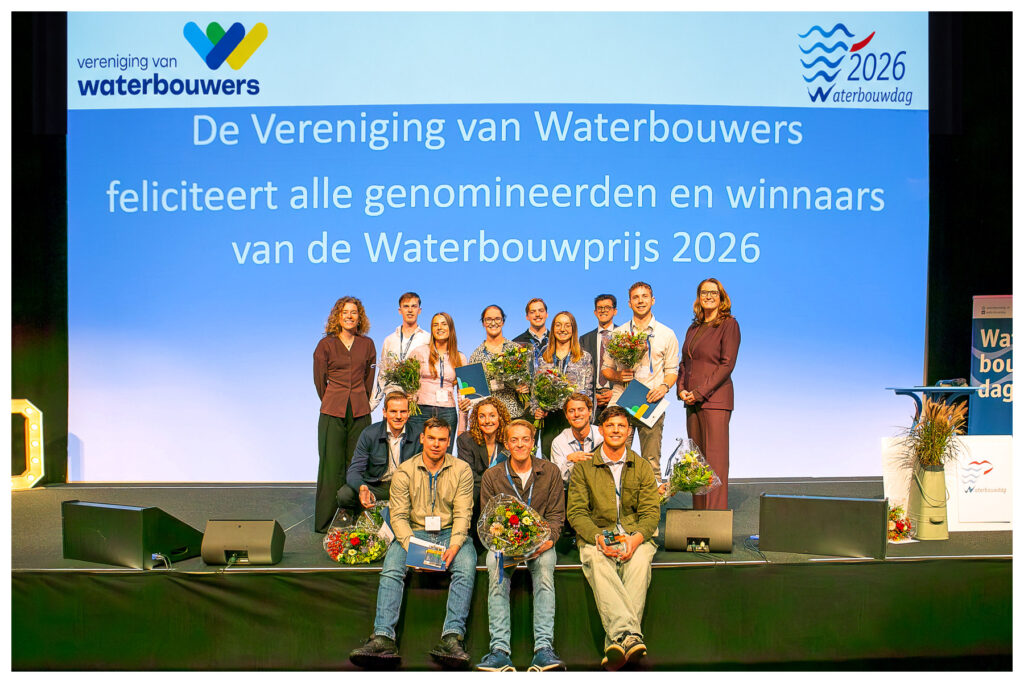
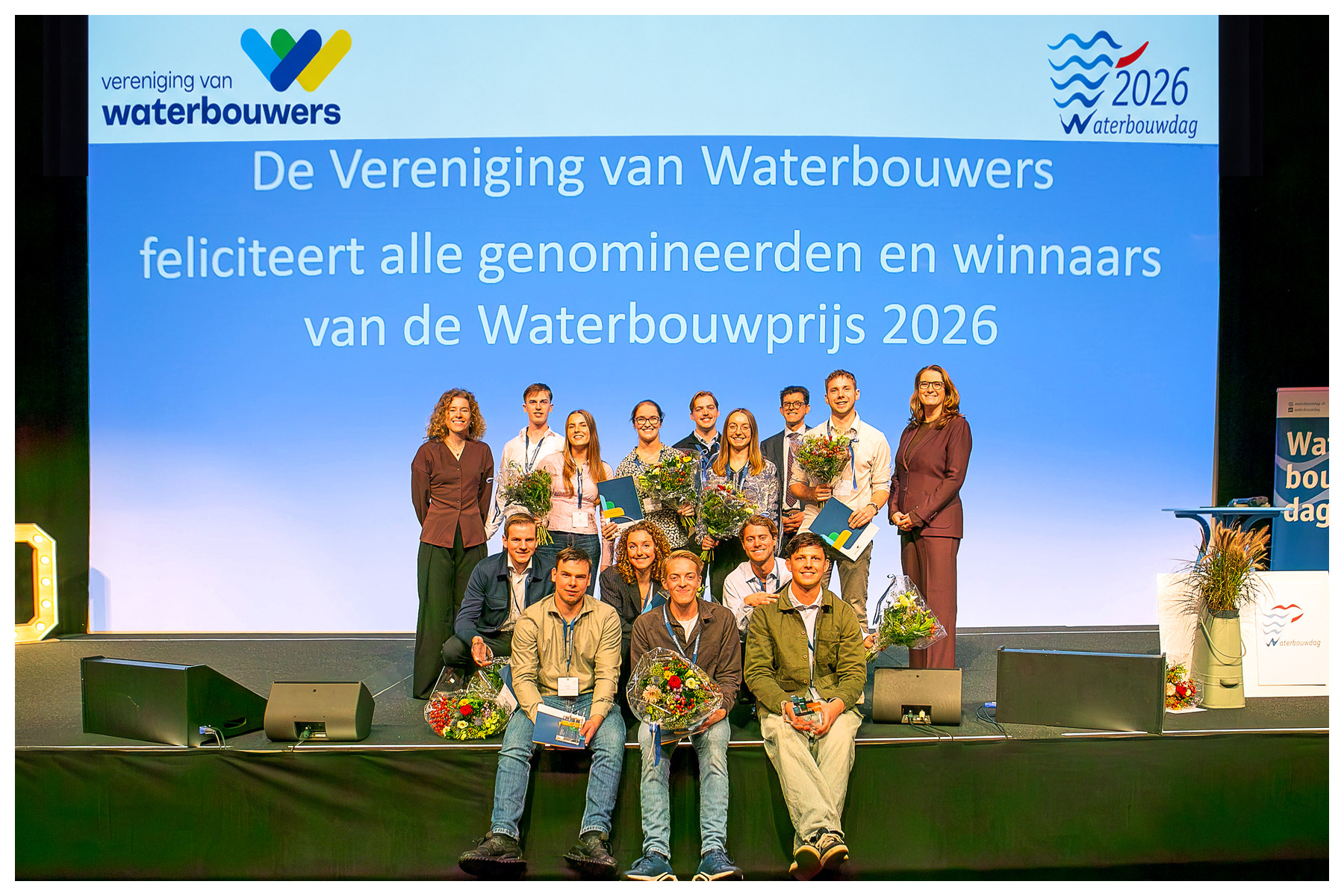
During the annual Hydraulic Engineering Day at the Jaarbeurs in Utrecht, Andrea Vollebregt (director of the Association of Hydraulic Engineers) and Mathijs van Ledden (jury chair) presented the annual Hydraulic Engineering Award. The winner in the 2026 WO category is Wouter Waasdorp. The jury found Waasdorp’s thesis (Assessing Unaccounted Events and Their Possible Impact on the Maeslant Barrier’s Non-Closure Probability) to be “outstanding in terms of approach, content, results, self-reflection, reporting, and relevance” . Erik ter Maten and Robin Jager won first prize in the HBO category for their thesis, “Monitoring of Historic Amsterdam Quay Walls Reinforced with Buoycrete.” In the jury’s view, this thesis “contributes significantly to the issue of extending the service life of historic quay walls, not only in Amsterdam but throughout the Netherlands.”
Since 2000, the Association of Hydraulic Engineers has been offering students graduating with a degree in Hydraulic Engineering (or related fields) at the university and applied sciences levels the opportunity to submit their graduation projects for consideration for the annual Hydraulic Engineering Award. The purpose of this award is to raise awareness of hydraulic engineering among young people.
The Water Engineering Award jury evaluates the graduation projects based on criteria such as innovation—the extent to which new elements are added to existing knowledge, the practical applicability of the results, and a multidisciplinary approach. The extent to which the project contributes to the sector’s sustainability also plays an important role. The 2026 jury found this year’s submissions to be of a high standard. “It was a challenge to make a selection—both for the nominations and for the final award winners. We read many theses that were often strong in terms of both content and methodology and were also well-written and beautifully presented.”
First-prize winner Wouter Waasdorp, a graduate student at Delft University of Technology, conducted research on the reliability of storm surge barriers at TNO as part of his thesis. Waasdorp focused his research on the Maeslant Barrier, a crucial component of the Netherlands“ coastal defense system. ”Building storm surge barriers for flood protection is one thing, but maintaining the structures and providing training and continuing education for staff is the biggest challenge when it comes to meeting legal standards. Transparent oversight of maintenance and a traceable implementation in the probability of failure analysis are essential to continuing to guarantee the Netherlands’ water safety.”
Waasdorp advocates for a more transparent and flexible framework for evaluating the reliability of the flood barrier. A new approach could not only improve the reliability analysis for the Maeslantkering but also serve as a blueprint for other critical infrastructure.
The jury commends this outstanding thesis for its incisive technical analysis and strong non-technical skills, which were used to gather expert knowledge and incorporate it into the failure scenarios and risk calculations. “This work provides concrete, compelling recommendations for improving the reliability analysis of the Maeslant Barrier and other critical infrastructure.”
Learn more about Wouter's research here.
Erik ter Maten and Robin Jager investigated whether monitoring is possible for quay walls reinforced with Buoycrete. Based on an analysis of the deformation behavior and known failure mechanisms, the duo—both graduates of Windesheim University of Applied Sciences—identified critical parameters, such as structural displacement, rotation, and wood and water pressure. The study concludes that the deformation behavior can be accurately measured. The study resulted in a concrete, practical, and reliable measurement method for monitoring and substantiating the positive impact of Buoycrete on service life. The pair recommends further research into limit values for wood stress and the translation of monitoring data into service life estimates.
The jury’s comments on the thesis: “In-depth technical research resulting in a practical and reliable measurement method—a concrete outcome that represents a huge step forward for the use of Buoycrete in quay walls in Amsterdam and beyond.”
Check out and read more here about Erik and Robin's research.
Second and third prizes
In addition to the first prize, the jury also awarded second and third prizes. In the WO category, the second and third prizes went to Eliane van Boxtel (Estimating Wave Attenuation through Diverse Floodplain Forests in the Netherlands) and Rowan Sonnemans (Exploring Relationships among Megaripple Geometry, Pipeline Exposure, and the North Sea), respectively.
For the higher professional education (HBO) category, the second- and third-place winners are: Alysia Tessels (Microbiologically Induced Corrosion in Structural Steel Structures) and Tycho Mulder (The Effect of Deviations on the Stability of Stone Retaining Walls).
Click here to see and read more about the winners.
Nominees
The nominees for the 2026 Hydraulic Engineering Prize were Silke Baltussen (An Experimental Study of the Natural Sedimentation-Erosion Patterns in the Nieuwe Waterweg), Stephan van Eps (“Satellite-Based Enhancement of North Sea Wave Models: Capturing Infragravity Waves and Spatial Sea State”), Lucas van Ham and Noud van der Weijden (“Stabilization of Cable Protection Systems with Rock Berms”), and Eva Kuiper (The Effect of a Breakwater in the IJsselmeer on Wind-Driven Waves in the Ketelmeer).
Click here to learn more about the nominees.
Association of Hydraulic Engineers
The Association of Hydraulic Engineers is the employers' and business association for contractors and service providers in the hydraulic engineering sector.
It represents approximately 100 member companies in the Netherlands, which account for about 80% of the total hydraulic engineering volume. The member companies operate both domestically and internationally in fields such as land reclamation, dredging, coastal and shoreline engineering, structural hydraulic engineering, port development, soil remediation, and land-use planning. The hydraulic engineering sector is distinguished, among other things, by its sustainable, capital-intensive, innovative, and international nature. www.waterbouwers.nl ————————————————————————————————————— Note to the Editor
For more information, photos, or an interview with (one of) the award winners, please contact Tamara Stoet at t.stoet@waterbouwers.nl or +31 6 34 52 46 57.
The attached photo may be used exclusively for communications related to this press release.