[00:01] AI, Data, and Automation in Transportation
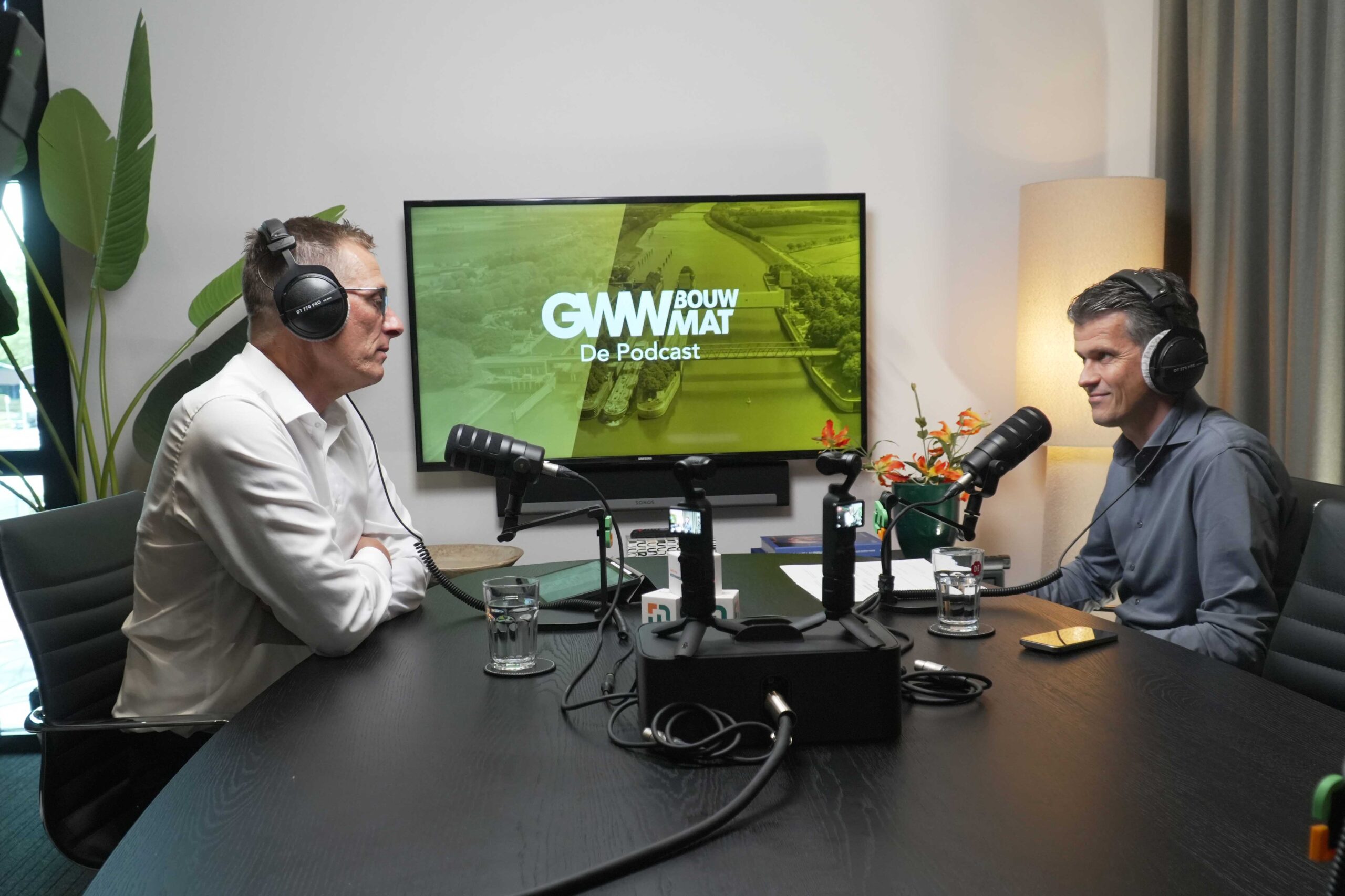
Roel van Gils: Welcome to another new episode of GWW Bouwmat, the podcast. Joining me today is Marcel Vermeulen from Millenaar & Van Schaik Transport. Today we’re going to talk about a topic that pretty much everyone knows something about and has an opinion on by now: AI. But when we talk about AI, data, and automation in the transportation industry, what exactly are we talking about? Marcel, welcome.
Marcel Vermeulen: Thank you.
Roel van Gils: Please introduce yourself briefly.
Marcel Vermeulen: I’m Marcel Vermeulen, operations director at Millenaar & Van Schaik in Oude Meer. “The yellow-and-black cars,” as we always say. We’ve been in business since 1923—over 103 years. That’s quite a long time. And we still do it with great pleasure, passion, and dedication.
Roel van Gils: And have you made significant progress, especially in recent years?
Marcel Vermeulen: Yes, the world doesn’t stand still. And the traditional construction industry isn’t standing still either. So we’ve shifted from diesel to electric cars. And then the next developments naturally follow. You’re talking about charging stations, charging poles, and software that interacts with each other and that you have to interface with. So it all happens in quick succession, and it’s moving very fast.
[01:19] Making the Fleet More Sustainable
Roel van Gils: Can you give us a glimpse of what you're currently working on?
Marcel Vermeulen: In our line of work, we provide asphalt and milling services for our four largest clients, who also happen to be our co-shareholders. We operate in 50 percent of the Netherlands—the western and central parts of the country. We operate in a number of niche areas. For example, all our employees are authorized to access Schiphol Airport beyond customs. Our vehicles are equipped for that purpose. We have electric vehicles. A large portion of our fleet has already been made more sustainable—more than 25 percent. And every year, we add a number of new vehicles. But this also brings new challenges. And that, in turn, requires software to help with planning. Planners, in turn, need software that gives them better insight into forecasting how long a vehicle can operate. All these developments are coming in naturally. And as I just mentioned, they’re happening in rapid succession.
[02:22] AI as a Digital Coach for Drivers
Roel van Gils: We mentioned this at the beginning, in the introduction: AI. It’s not an end in itself for you, of course. But how can AI help with that?
Marcel Vermeulen: The latest application we've launched helps our drivers prevent and learn from tachograph violations.
Roel van Gils: Yes.
Marcel Vermeulen: So, incorrect operation of a tachograph triggers a message from Alex. Alex is the digital assistant. And he engages the driver in a conversation like this: “Hey, at such-and-such a time, you committed such-and-such a violation or made that mistake. Are you aware of that? That was in this vehicle. It’s equipped with this model of tachograph. Here’s a video. If you weren’t aware of that, do you now have enough information to prevent it?” Well, that sparks a whole conversation. The driver gets to work on it. So we no longer need to bring in someone who isn’t based at our location but works remotely to ensure that the driver is corrected and coached within 24 hours: this is what went wrong, and here’s how you can fix it. Do you understand how this works? All of that happens, and it happens completely autonomously with AI.
Roel van Gils: So it's a digital coach?
Marcel Vermeulen: Actually, just like Alex.
Roel van Gils: But that's not the only thing, is it?
Marcel Vermeulen: No. The next development we’re currently working on with AI will really be a game-changer for our administrative processes. Our logistics administration is very burdensome because milled asphalt is a waste stream. Waste streams are heavily regulated in the Netherlands, and that comes with a significant administrative burden. This administrative burden requires a great deal of coordination with all parties involved in the supply chain. And that, in turn, demands a lot of work from the logistics administration team. Unfortunately, our TMS environment doesn’t support that. So we’re currently handling it outside our TMS environment and have hired someone who is writing AI agents specifically for us to ensure this is automated outside the software.
[04:24] Tomorrow's Planner
Roel van Gils: So is that what tomorrow's planner will be like, too?
Marcel Vermeulen: Tomorrow’s planner will go one step further. Under our current business model, it’s a deployment schedule. A vehicle is assigned to a job on a given day. We do see that changing. We see that vehicle productivity in the civil engineering sector is simply low, remains low, and isn’t increasing any further, because there are all sorts of developments creating obstacles. There isn’t a surplus of asphalt plants. A vehicle always has to wait. There are production schedules. There’s always some kind of disruption. There’s always a reason somewhere why a vehicle is idle. But if you map it out properly and take a close look at where the revenue models lie—and you can do that very effectively now using our own data—you’ll see that there really are opportunities. If you shift to a different business model, a different approach, you can make excellent use of AI to create a kind of distribution network with a denser network. I could talk a lot about that.
Roel van Gils: We might come back to that later. Maybe I’d like to clarify it with a concrete example.
Marcel Vermeulen: Here’s an example. Normally, we drive from Amsterdam, where we’re based, to pick up asphalt at an asphalt plant, and we drive there empty. These days, with water levels so low, you see tons of material being transferred from the ship to the road. But there aren’t any more trucks available. So here’s what we’re doing now: from Amsterdam, we’re transporting the gravel to the asphalt plant in Deventer. In Deventer, we load asphalt. We take that to the A6. On the A6, after unloading the asphalt, we load milled asphalt back onto the barge, heading to a location in the middle of the country. We dump it there. Then we load construction materials onto the barge again and take them back to the asphalt plant.
Roel van Gils: Are we all driving the same car?
Marcel Vermeulen: All using the same vehicle. And traditionally, that would never happen. Because traditionally, that truck would only drive back and forth carrying either asphalt or milled asphalt. It would be dedicated to that specific job. And now we’re seeing that the shift of those metric tons from water to road construction opens up a lot of possibilities. We actually want to take advantage of that. However, a planner can’t do that with the tools currently at their disposal. That’s why we’re now actively searching the market for a TMS with AI that will take that burden off the planner.
Roel van Gils: So tomorrow's planner is actually more like a director?
Marcel Vermeulen: Yes.
[06:58] A denser transportation network and fewer empty kilometers
Roel van Gils: So the example you just gave—that’s not possible yet?
Marcel Vermeulen: Actually, that’s not happening right now, because we don’t know those flows, because we don’t have that infrastructure, and because we don’t yet have that monitoring in place. In the distribution sector I come from—retail distribution—there’s a control tower. There, dedicating a vehicle to a single customer for an entire day isn’t the norm. Instead, you’re talking about delivery runs that are scheduled one after another. And AI is incredibly good at that.
Roel van Gils: So you're talking about making the network denser. So, essentially, driving with fewer empty trips?
Marcel Vermeulen: That's right.
Roel van Gils: So, we need to take a more efficient look at the changes that are already taking place.
Marcel Vermeulen: Absolutely. We have a shortage of drivers in the Netherlands. Not a shortage of work, but a shortage of drivers—of available hours. This is a great way for us to fill those gaps. And the next step is on the horizon and is already making its way across the country. We’re talking about the announcement DAF made this week. DAF and Einride are going to collaborate on autonomous driving. That’s a topic in and of itself.
Roel van Gils: We'll get to that in a moment. But can you give us an idea of how many are currently running empty?
Marcel Vermeulen: As a percentage? Over 50 percent.
Roel van Gils: Seriously? Really over 50 percent?
Marcel Vermeulen: The truck travels empty from the depot to the first job site. And then it drives back and forth. Nine times out of ten, it’s empty.
Roel van Gils: Anyway, you do need to know that, for example, the milled asphalt is stored there. So all parties in the supply chain need to have that data as well.
Marcel Vermeulen: Yes. The verbs that fit here are: collaborate, collaborate, and collaborate. And then there’s transparency, followed by courage and commitment. Those are the words that describe a collaboration. I’m very pleased that we’ve already made significant strides in this area within our company, together with our four shareholders: BAM, Heijmans, Dura Vermeer, and [inaudible]. They’ve already allowed us to collaborate extensively with one another. You can see that they’re also collaborating on major construction projects, but that can be expanded even further.
[09:06] Sharing data requires trust
Roel van Gils: In your opinion, what is the biggest challenge when it comes to data sharing?
Marcel Vermeulen: That people need to let go. People in the field now view a truck as a piece of their own property. I’ve rented that truck for the whole day, and it belongs to me for the whole day. At some point, they need to develop the belief and confidence that if you order a load of asphalt through a dispatch center or control tower, it will arrive on time.
Roel van Gils: That it's there at that moment, too.
Marcel Vermeulen: That’s exactly the point. We always refer to the concrete industry. After all, they’ve been working exactly this way for years. In the distribution sector where I come from, that’s how it’s always been done. There’s also a spot at the dock at ten past seven. You think it’s your dock, but it turns out to be a dock where another truck was parked at half past six. And at [unintelligible], there’s yet another truck. That’s a supply chain approach that hasn’t quite been implemented in the construction industry yet. There, we see other factors at play: trust, courage, and commitment.
Roel van Gils: So what's in it for customers?
Marcel Vermeulen: The driver’s craftsmanship—because that’s really what we need to talk about. All the drivers I see in the Netherlands are true professionals. They’re people who love diesel, who love a nice car, who love driving. And above all, they want to focus on that. They definitely don’t want to be administrators. So keeping that work environment attractive for the driver—that’s key. That’s number one. Safety is also number one. They share the top spot. The people have to be pleasant, and the work environment must be—and remain—safe. You won’t find enough drivers in, let’s say, other less developed foreign countries. Because language is truly essential in our line of work. It simply has to be possible to speak Dutch. People need to understand each other with just a hint of what’s being said. “Stop” means “stop.” “Up” and “down” mean “up” and “down.” Because there are far too many serious accidents happening in our work zones. Especially in the work zone. I don’t want to dwell on that, because it’s just terrible.
Roel van Gils: So safety is really top-notch.
Marcel Vermeulen: Safety is paramount. So you need skilled professionals. And we have those skilled professionals here in the Netherlands. But we do need to make good use of them. We need to make sure they don’t make two trips in a day and that they only drive four hours a day out of the ten hours available. We need to make sure those people do their work in a way that makes them feel comfortable and that allows us to make full use of their expertise. Let them drive. Client A, Client B, or Client C—it really doesn’t matter that much.
[11:56] Autonomous transportation
Roel van Gils: And we'll always need those drivers, too.
Marcel Vermeulen: Drivers will always be needed. Yes, there are developments in autonomous driving.
Roel van Gils: That's actually where I'm heading. Perhaps the most spectacular aspect of it all: autonomous driving.
Marcel Vermeulen: Our Minister of Infrastructure and Water Management, Vincent Karremans, said a few weeks ago that he expects to be able to issue the first permits in 2029. I think a lot is already happening in Europe, the United States, and China that points in that direction. And if you want to remain relevant as a transportation provider in the future, you have to identify your added value. That added value isn’t just getting a car on the road, but getting it on the road in the best possible way—with the greatest effectiveness and efficiency—and ensuring it stays running. An electric vehicle costs us nearly three times as much as a diesel vehicle. I’d prefer to have it working day and night, with a skilled driver at the wheel. But if it can operate without a driver—that is, autonomously—then that’s the option we’ll choose. And if that requires a major investment—which it certainly does—then Millenaar & Van Schaik wants to be and remain a leader in this field. We want to commit to this and express our interest in it. And that’s exactly what we’re doing. We see that our parent company, Heijmans, is already working with autonomous asphalt rollers. [Inaudible], with perhaps a safety driver at the very least.
Roel van Gils: How close are we to that in the transportation sector—in terms of autonomous driving, for example?
Marcel Vermeulen: In Europe, the first small steps have already been taken. And from the U.S., you can simply extrapolate those or apply them here. Because in the U.S., it’s already commonplace. Between Dallas and Houston, for example, there’s a scheduled service run by an operator. It covers 230 miles every day with driverless vehicles, delivering packages for a major parcel carrier. And in Texas, a very large mining operation is already underway. Incidentally, those very large trucks have been driving autonomously there for years. Volvo in Norway has a fleet of autonomous vehicles operating 24/7 in a mine there.
Roel van Gils: Yes, but isn't all of that still closed off?
Marcel Vermeulen: There are also projects taking place on public roads—in Antwerp. At the Efteling, and recently with an autonomous bus. So you can already see developments in the Port of Antwerp. And I see now that DAF and Einride are going to collaborate. I’ll be visiting them soon. I hope to hear from them what they themselves expect will be relevant here for public roads. And I hope Vincent Karremans is listening and that he [inaudible].
Roel van Gils: To be a leader in that area, really.
Marcel Vermeulen: And permits. The permitting process—I find that quite exciting.
[15:01] Autonomous Transportation in Civil Engineering
Roel van Gils: Why is that particularly interesting for infrastructure, specifically civil engineering?
Marcel Vermeulen: People really want work to be done during inconvenient hours so that drivers on the road are inconvenienced as little as possible. You see that people in road construction would rather work during convenient hours and would prefer not to work during those inconvenient hours. [Inaudible] during the day shift. Last Monday, we closed the A1 [inaudible], which had been closed for six weeks. That’s when you see that this approach works best and is most efficient.
Roel van Gils: Yes, but you can't close all the roads for six weeks.
Marcel Vermeulen: That’s just not going to happen. It’s not realistic, either. So I think there’s definitely a place for autonomous transportation in the Netherlands during difficult times and for certain types of work. I truly believe that. And in infrastructure, too. I’m convinced of that.
Roel van Gils: Do you think we're really ready for that?
Marcel Vermeulen: We’re in the early stages of digitizing our operations and transitioning to a new business model for leasing and deploying trucks. And I think that once we reach that level, we’ll also have achieved the scale necessary to deploy autonomous trucks by 2029.
Roel van Gils: Yes.
Marcel Vermeulen: Millenaar is very committed to horizontal collaboration—that is, collaboration within the industry. [Inaudible] might be interested in joining us and contributing their ideas, because this involves software that you have to install or design.
Roel van Gils: Actually, autonomy doesn't start with the vehicle, but really with the processes behind it.
Marcel Vermeulen: Of course, that’s the whole story. We can’t bear those development costs on our own. Because we’re very large contractors, yes, but it does have to be a sound business case. And I think it will benefit the entire industry if we go ahead with this. And again: no drivers will be laid off.
Roel van Gils: There aren't enough of them already.
Marcel Vermeulen: There aren't enough of them already. And this deserves a spot right here, next to it and in between.
[16:59] Safety and Autonomous Driving
Roel van Gils: And what does that mean for safety?
Marcel Vermeulen: If I’m to believe the figures from the U.S. and the reports, autonomous driving on public roads is safer than having a truck driver behind the wheel. The incident rate is lower than what they normally experience. The car drives autonomously, finds its own lane on the road, and nothing unpredictable happens to your car. And if we think that’s just because it’s all still new, so there aren’t enough statistics yet… Autonomous cars have already driven a few million kilometers in the U.S. That’s on busy highways.
Roel van Gils: What else does this require of you internally as an organization?
Marcel Vermeulen: Our organization works with the models we have today, on vehicles and for the types of work we do today. There’s absolutely nothing wrong with that. But GPS, geofencing, AI, data sharing, and Basic Data Infrastructure—these are all terms used every day at Millenaar & Van Schaik. So we’re working with them every day. The Top Sector Logistics supports us in this regard when it comes to data sharing. People still find that a bit intimidating. Because data is gold. That could very well be true—that data is gold. But for us, data sharing is primarily about learning. It’s about ensuring that other parties can work with our data and that we can turn that into models that are useful to us. I have no secrets. For a trip that’s been taken, you can see the x and y coordinates. You can also see the temperature during that trip. All of that is stored. We offer all of that through BDI. Of course, there is one issue: NIS2. We do have to safeguard security, and we’re doing just that. But within those boundaries, within that framework, we’re preparing our organization for all the aspects that go along with it.
Marcel Vermeulen: It’s a shame that our industry is characterized by a higher average age. Not everyone is ready for it yet. Not everyone automatically [unintelligible], and not everyone is interested in it. At home, we’re all on ChatGPT; we all take fun photos and create fun images. But when it comes to work, it feels threatening, unfamiliar, or confrontational. Or it stirs up emotions you’d rather not feel. Yet it’s being introduced precisely to take the burden off people, to help them. To move us as an organization a step forward, toward the future.
Roel van Gils: So that mindset really needs to be part of the process.
Marcel Vermeulen: Yes. And once again, I’ve been saying this for a few years now: come take a look at logistics. See what’s happening there. A lot of development is taking place there. People are always amazed and leave in awe after visiting us—amazed at how much data flows through our company and what we’re doing with it. And then there are all the developments that can still be made and implemented.
[20:20] The Construction Site of the Future
Roel van Gils: And if we take all these developments into account, what will a construction site look like in about ten years?
Marcel Vermeulen: I think that same driver also comes to the construction site. The same finisher is still working there. [Inaudible] will then be replaced by a digital alternative. And whether that’s on the planning side, the execution side, the billing side, or the delivery slips. Soon, a driver will simply be able to follow instructions to a work area he hasn’t been to yet today and do his job safely there. From the control tower, the foreman can see, down to the minute, when each truck will arrive and what it’s carrying. Is that sand? Is that soil? Is that gravel?
Roel van Gils: Yes.
Marcel Vermeulen: Those are all practices that are commonplace in certain industries, but not yet in our field of road construction. And they need to come together. We can easily incorporate them into our operations.
Roel van Gils: Of course, you shouldn't try to reinvent the wheel. Look at other industries and see what's already there and what's working well.
Marcel Vermeulen: Yes. So the construction site of the future is one where people—skilled workers—can work comfortably and enjoyably. But also just for the fun of it. Because that’s very important, too.
[21:44] Collaboration as a Prerequisite for Innovation
Roel van Gils: It’s been nice to get a glimpse into your company, Millenaar & Van Schaik. As a final question: if you could offer one piece of advice to companies operating in the transportation sector or in civil engineering in general, what would it be?
Marcel Vermeulen: Above all, seek out collaboration. You may move faster on your own, but you’ll go further together. That’s still true today. Above all, seek out collaboration. It can be about the smallest things. A simple example for Millenaar: no matter how big we are, we once had 105 diesel cars. Now we only have 80 left. That means the amount of diesel we have to purchase—every month, every week—is getting smaller and smaller. That means our bargaining position in the market is getting weaker and weaker. So I need someone else to collaborate with to maintain economies of scale. That doesn’t have to be formalized on paper or anything like that right away. But first, just sit down and reach out to your competitor. Because your competitor is facing the same challenge and dealing with the same problems.
Marcel Vermeulen: You can’t stop progress. The truck toll is here to stay. And not everyone is paying the full cost of the truck toll. Maybe that means you’ll have to start sharing trips with each other. Maybe that means you’ll have to reach out to clients to find a solution together. Seek collaboration—that’s the message.
[23:11] Electric, diesel, and future powertrains
Roel van Gils: Electric and diesel—isn't that a non-issue for you guys anymore?
Marcel Vermeulen: No. We see diesel and electric vehicles coexisting. And a third option may be added in the future. Whether that’s hydrogen, and whether it happens in ’28 or ’38, we’ll have to wait and see. You can’t roll out unlimited power and charging stations throughout the Netherlands, so that’s definitely going to be a problem.
Roel van Gils: Diesel isn't a panacea either.
Marcel Vermeulen: No, it will be a combination of both. And if one of our competitors calls and needs electric transportation for their customer, we always accommodate those requests. We’ll never take advantage of that. We always work together in those situations, because we’re partners. That’s actually the call I want to make to everyone for the future.
[24:04] Is the organization ready for autonomous trucks?
Roel van Gils: So, autonomous trucks might be right around the corner. But the question is: Is your organization ready to let those trucks go?
Marcel Vermeulen: We're working hard on that right now. I hope he's not already at the door. I hope he's on his way.
Roel van Gils: Oh, right, he's already on his way.
Marcel Vermeulen: But you do have to prepare your organization and your culture for that and incorporate it. Because people think that when you show those images, it’s AI. And that’s not AI. They’re just real images of real trucks driving on public roads. I ran into Johnny Nijenhuis the other day. He’d been to China. There, you hop into an autonomous taxi and see autonomous trucks driving down the road. That’s already quite common.
Roel van Gils: Still here for now.
Marcel Vermeulen: You're welcome.
Roel van Gils: And listeners, thank you for listening.