Platform on civil engineering, underground infrastructure, energy, construction equipment & construction machinery

The battle against water is a familiar phenomenon. Especially now that the effects of climate change are increasingly manifest. The flooding and evacuations in Limburg in the summer of 2021 are telling and recent examples of this. Since 2012, three family businesses from Brabant (Wetering, FPH Ploegmakers and Vissers Ploegmakers) have entered into a partnership to carry out dike reinforcements. As a combination, works have been realized at various locations that contribute to making the Netherlands safer and future-proof.

One of the projects that stands out is Priority Dike Reinforcements 1 where dike rings were constructed around the cores of Mook, Afferden and Bergen-Aijen. By upgrading clay, applying a CSM wall and using structural mats, innovations were applied here that contributed to the most sustainable realization possible.
Thinking in practical solutions, coupled with decisiveness, are the connecting factors of these three family businesses. This is driven by an entrepreneurial vision in which they are always looking for innovation. The request from Water Board Rivierenland in 2019 for the innovation partnership for the application of the coarse sand barrier as dike reinforcement in Gameren dovetailed perfectly with this.
After a funneling step in 2019 and a successful execution of the manufacturability test in 2020, delivery of the coarse sand barrier is now scheduled for the end of 2021. This is the culmination of a five-year development trajectory; from the very first idea at Deltares, through a number of intermediate steps (lab tests, Delta flume trial, manufacturability trial), to a mature technology that has been applied in a primary barrier. The coarse sand barrier is therefore ready for wider application in dike reinforcements where piping plays a role.

For the last two years, the combination has been intensively involved in the further development of the coarse sand barrier. The contribution of this combination of companies consisted of testing whether all design modifications were feasible and practicable. The cooperation and coordination in the innovation partnership was stimulating, so that the Rivierenland Water Board, Deltares and the combination as a market party could come up with not only innovative but also feasible ideas in a short period of time.
Many innovations fail or have a (too) long development process before they are applied in practice. One of the reasons for this is unfamiliarity and lack of confidence on the part of managers. To prevent this, a Monitoring Think Tank, set up separately, considered from the outset with all parties involved how the coarse sand barrier could be monitored after construction. Ultimately, the choice was made to apply tracer material, which is discussed in more detail later in this article.

The GZB is a trench of coarse sand at the transition from the clay layer to the sandy subsoil, at the bottom of the inner side of the dike. It acts as a filter that allows water to pass through and prevents seepage water from carrying away the fine sand present under the dike. This prevents the formation of through channels toward the river, a process called piping. Eventually, a dike can fail due to the hollow spaces created as a result.
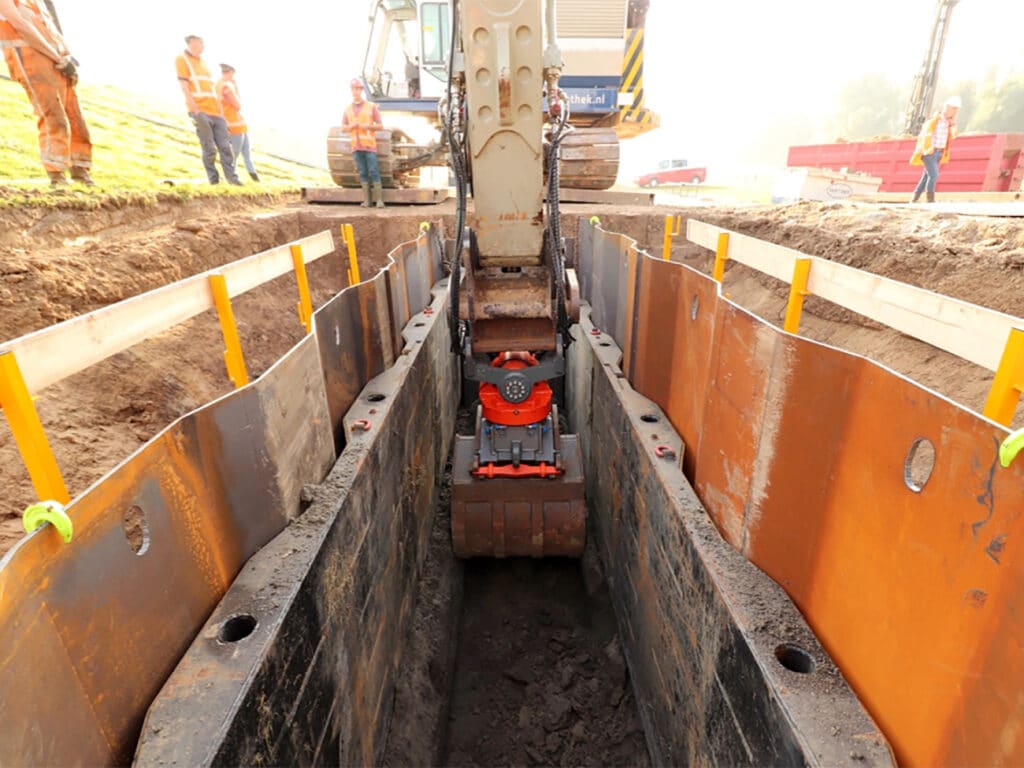
Contractor combination Wetering - FPH Ploegmakers - Vissers Ploegmakers has further developed a sheet pile box specifically for the construction of the coarse sand barrier. The sheet pile box provides an enclosed compartment and features an ingenious closed groundwater management system. The sheet pile box is partially excavated dry, then water is set up to prevent uncontrolled soil erosion and groundwater inflow. Further excavation and backfilling takes place in the wet after which the upper side of the coarse sand barrier is briefly dried to finish and apply the sealing clay layer. The pumped off water is reused to raise the water level in the next sheet pile box. By overlapping the sheet pile boxes, there is a guaranteed continuous barrier, with only short segments of the dike section open each time during construction. The advantage of a sheet pile box is that no relaxation occurs in the dike body and there is visibility of the work done with direct quality control (sevings, compaction, height measurements). The GZB construction consists entirely of natural materials (sand and clay). Due to the narrow trench, excavation and backfilling is limited. In addition, due to the low water load when working with the sheet pile box (wet working method and limited surface area), no intensive and lengthy drainage is required. All this contributes to a sustainable construction method with low CO2 and NOx emissions per kilometer.
The major advantage of applying tracer material is that no additional management effort and/or complicated data collection is required; the material is 100% natural and fits within the sustainable nature of the coarse sand barrier. The red sand layer as a tracer ensures that the coarse sand barrier is visible under all outdoor conditions, including at high tide. The red sand layer signals the coarse sand barrier at high tide; washout of the upper surface is part of the mechanism. When the red sand is detectable at the outflow of a sand-maintaining well, additional measures can be taken (in time). Also, the red sand layer as a tracer easily and effectively indicates where the coarse sand barrier really lies along the embankment. In this way, it can also be prevented from being damaged during excavation work.
Wetering has had a clear mission from its beginnings in 1955: to work for a legacy to be proud of! We always create space for something new. For nature, for water but also for people when we prepare an area for building, for example.
Our slogan is not for nothing: Space for Man and Nature. Our focus here is on the extraction and reclamation of raw materials.
FPH Ploegmakers is considered the specialist in the field of earthworks, road construction and hydraulic engineering, landscaping and cultural engineering. For over 35 years, we have been working with passion, craftsmanship and inventive solutions on projects including dyke reinforcement, water management and climate adaptation. We make sustainable use of people, materials and resources to achieve the best end result for our clients.

Vissers Ploegmakers is a multidisciplinary contracting company in civil engineering. A flat organization with committed and decisive people. Broadly deployable through expertise in various fields. Strong in tightly organizing complex and integral tailor-made solutions. Because no assignment is the same. We think along with you or implement what you as client have already completely thought out. Better still, we take the entire process off your hands and relieve you of all your worries.