Platform on civil engineering, underground infrastructure, energy, construction equipment & construction machinery

‘Prevention is better than cure.’
Within its sector, Special Industrial Repair (SIR) is one of the leading specialists in waterproofing. “We combat moisture that can cause significant damage in various places,” says Hans Bos, manager of the Belgian company SIR. “From underground structures and tunnels to leaking cable penetrations. To expand our services, we have acquired the company Polyproof.” As an expert in industrial and special coatings, Polyproof strives to eliminate maintenance problems such as leaks and corrosion. “This is a watertight marriage.”
“In fact, we have become our own competitor,” laughs Arno van Balen, general manager at SIR. “Where Polyproof provides preventive waterproofing to prevent leaks, SIR comes into play when leaks occur.” So why take this step? “We encounter a lot of problems on construction sites that we know could have been prevented in many cases. And that is exactly what we can now offer with Polyproof.”

SIR is known for its willingness to enter into partnerships: with suppliers, engineering firms, and customers, for example. “But even with this acquisition, we are sticking to the idea that 1+1=3,” says Bos. “There are so many areas where the expertise of SIR and Polyproof intersect: think of roofing, where you always face challenges in terms of adhesion, corners, and penetrations, but also when spraying vertical and horizontal surfaces, there is a lot of overlap.” Van Balen: “These are such familiar issues for us, so it is an absolute added value that we can now offer an optimal, preventive, and widely applicable solution.”
Polyproof is the applicator and founder of the coating product Polyurea. “The product has been around for quite some time,” says Van Balen, “but its applicability and possibilities are not yet widely known. Polyurea protects concrete and metal against water, acids, salts, and chemicals, making it extremely versatile. Polyurea Hotspray is applied at a temperature of 70-80 degrees Celsius. Thanks to its exceptional chemical properties, it is highly reactive and therefore an extremely fast-curing spray with strong adhesion as the end result. This makes this technology ideal for large-scale and sensitive applications involving water. It is ideal for infrastructure because this property allows you to see immediate results during application and the surface is ready for use after just a few minutes. Polyproof focuses on the infrastructure, civil engineering, and industrial sectors. Tunnels, bridge piers and (steel) bridge decks, parapets, enclosures, sewers, and wells—it can all be done. In the field of civil engineering, the hot spray technique is perfectly suited to many applications: the product has a layer thickness range of 0.50 to 10 mm and the coatings follow the substrate seamlessly, giving you a perfect seal between wall and floor connections or at edges. Because the product is root-resistant, it is also particularly suitable for green/sedum roofs. In industry, the major advantage of polyurea coatings is that their chemical and mechanical properties are of a particularly high standard compared to most other coatings in this field of application. This makes the product suitable for tank lining in the chemical and petrochemical industries, as well as for floor, wall, and gutter cladding in the food industry. It is also very strong, permanently elastic up to 400% (so that it can also absorb settlements), impact-resistant, shock-resistant, and crack-bridging. Vapor-permeable, but completely liquid-tight.
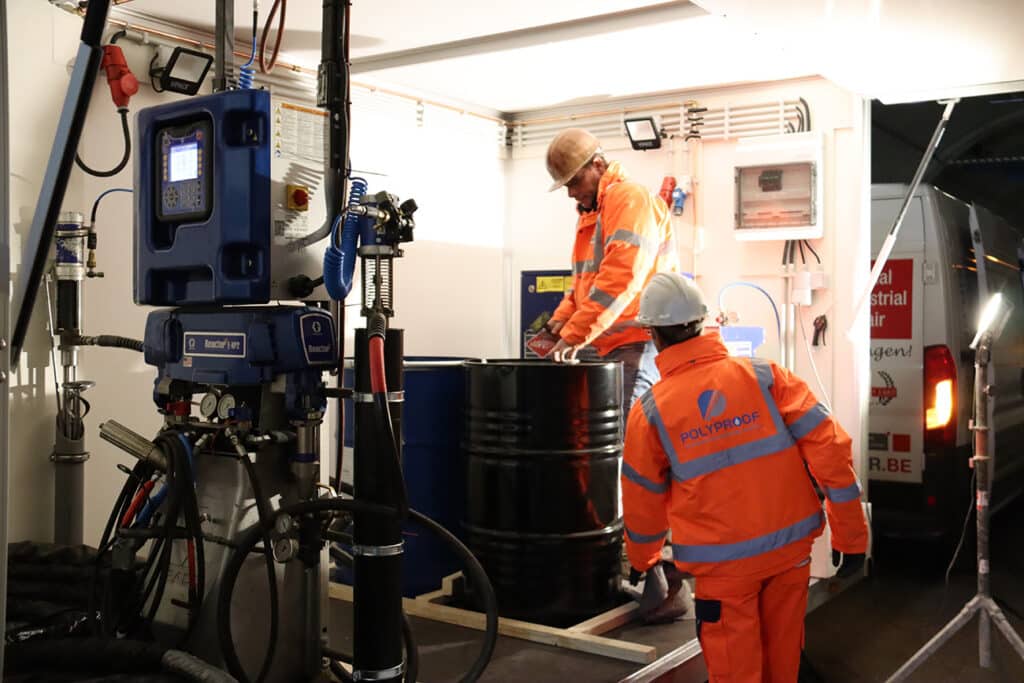
Technically speaking, polyurea is a polymer formed by two components that create a 100% solid with excellent adhesion to metal, concrete, and foam. “A continuous, waterproof coating with no harmful effects on the environment,” emphasizes Van Balen, “because it is free of volatile organic compounds.” Polyurea is becoming increasingly popular in the aforementioned sectors because it is a robust and extremely durable product. Bacteriologically stable, extremely resistant to wear and tear, and highly tolerant to damage caused by acidic and alkaline solutions and hydrocarbon-based products such as oil and grease. “With an extremely long service life, it is very interesting in terms of warranty against waterproofing,” says Bos. He emphasizes that it must be applied correctly. “Applying Polyurea is a skill in itself and must therefore be done by specialized professionals using specialized equipment. We had a specially equipped trailer built for this purpose, in which the hoses and the product can be heated, so that we arrive at the site fully prepared. We have also acquired the specific product knowledge that Polyproof has,” says Bos. “It's great that we can now offer a complete waterproofing package, both before and after installation,” concludes Van Balen.