Platform on civil engineering, underground infrastructure, energy, construction equipment & construction machinery
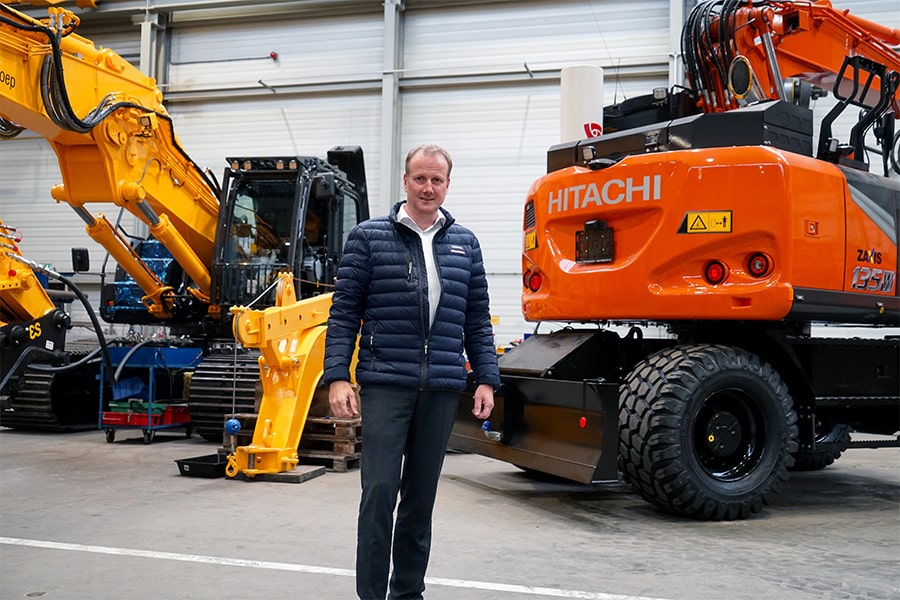
For this GWW-Bouwmat Yearbook, we sat down with Joris Hoogenboom, who has been director of Hitachi Construction Machinery Netherlands since the beginning of last year. It was a fascinating conversation about how a leading brand anticipates trends, innovations, and other movements in the market.
After an international career that took him to seven countries, Hoogenboom decided in 2022 to move back to the Netherlands with his family and soon after joined Hitachi Construction Machinery Netherlands. This was not a random decision. “I wanted to work for a premium brand, one that has grown by delivering quality,” he says candidly. That could have been a company in agribusiness, but the construction equipment sector feels most like home to him: “This is the industry where I can add the most value.”
That much is clear. Within just a few sentences, it becomes apparent that Hitachi Netherlands is anything but an average supplier. Based in Oosterhout and Hoogeveen, the Dutch importer works seamlessly with the European headquarters and the factory in Amsterdam. “We form a single entity, with short lines of communication as an essential foundation. Not to maximize profits, but to provide optimal service to customers. We are here to make the customer successful; that is the starting point.”
A quick glance around the workshop confirms this story. Most machines do not leave the factory and go straight to the customer. “Every delivery is a project in itself,” Hoogenboom emphasizes. Modifications are the rule rather than the exception: from boom extensions or tiltable cabs to modified undercarriages and ballast weights. Whatever is needed is built. By centralizing more and more modifications in Amsterdam in the short term, such as the installation of overpressure systems, rotating tilt pieces, 3D control, or central grease lubrication, the Oosterhout branch can concentrate on truly customer-specific work. Efficiency and quality go hand in hand.
The strong bond between the locations is palpable. “There's still a real family feeling here, but with a corporate twist,” he says with a smile. “The link with Japan is undeniable. I've been there many times and their focus on quality is unmatched – down to the smallest detail.” While the Japanese stand for perfection, the Dutch bring entrepreneurial spirit to the table. This combination of uncompromising quality and an eye for what the market wants makes the Hitachi organization in the Netherlands particularly powerful. “We may be more expensive than other brands, but we offer a lot in return.”
A clear trend in the market is the shift from ownership to usage. Rental is growing, and Hitachi is responding to this trend in a smart way. “We have an extensive rental fleet, suitable for both short-term and long-term use. We can even provide customized solutions or machines in company colors.” In doing so, the company is not only anticipating market demands, but also creating opportunities to distinguish itself. Not on the margins, but at the core of its business operations.
Another development is electrification. Emission-free working is no longer a luxury, but a necessity. “Our new mobile excavator is a good example, with an electrically powered undercarriage and numerous innovations to increase efficiency.” Electric models now form a significant part of the rental fleet, despite the fact that this investment is loss-making in the short term. “But it is essential to be prepared for the future. This is an investment in relationships, not in margins. The transition is continuing, and we as a brand and dealer are convinced of that.”
According to him, it is a misconception that customers are unwilling to invest in sustainable equipment. “The willingness is certainly there, but people want more clarity from the government. At the moment, policy is still too haphazard. There needs to be a pool of zero-emission projects so that investing is also worthwhile.” Without structural direction, it remains difficult for companies to take action. According to Hoogenboom, this applies not only to the purchase of electric construction machinery but also to investments in charging infrastructure.
At the same time, the sector is grappling with a classic triangle: sustainability, quality, and safety versus cost efficiency. “For us, the first three are our top priorities. Of course, we try to keep prices manageable, but the cheapest provider is rarely the market leader. Our customers are professionals who themselves set high standards in terms of quality and safety. We invest in knowledge regarding CE certification and other regulations to deliver on that.”
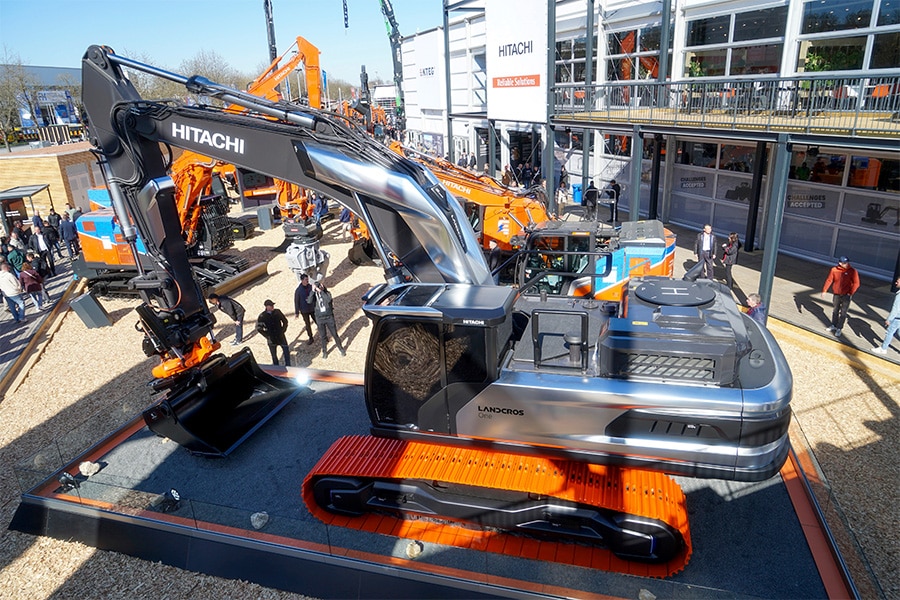
In addition to sustainability, technology is another important theme. The introduction of the LANDCROS One concept model at bauma 2025 is proof of this. It is an umbrella concept that brings together all the latest developments in telematics, connectivity, and artificial intelligence. “The Japanese are global leaders in the field of hydraulics. They want to be just as leading in terms of innovation and digitization, in order to stay ahead of other and also new manufacturers. It's good that there is more competition from China,” says Hoogenboom. “That keeps everyone on their toes and encourages further improvement. The LANDCROS One is a good example of this. The machine looks futuristic, but underneath it all is very realistic.” In the coming years, Hitachi Netherlands wants to get even closer to its customers. The goal: an organization where everyone has customer contact and where regional service employees are the permanent point of contact for after-sales, in order to make that relationship more personal.
And what about the product range? “In addition to being a Hitachi dealer, we are also a distributor of HSC Cranes and Bell articulated dump trucks, but we are open to expansion. It has to be a quality brand. Only then can we really add value for the customer. We are not looking for short-term profits, but for lasting relationships.” The close ties with the factory in Amsterdam offer Hitachi Netherlands unique advantages. Customers can test a machine there on the demo site, and the short distance is also invaluable for product development. “Feedback from the market is fed back directly to the engineers so that structural changes can be implemented quickly.”
Neem dan rechtstreeks contact op met Hitachi Construction Machinery Netherlands.
 Contact opnemen
Hitachi Construction Machinery Nederland has been a leading supplier of earthmoving machinery in the Netherlands for more than 50 years. We offer a wide range of machines suitable for demolition, recycling and earthmoving work. These include mini excavators, mobile excavators, crawler excavators and wheel loaders. In addition, the range includes 4 electric excavators in [...].
Bekijk Bedrijfsprofiel