Platform on civil engineering, underground infrastructure, energy, construction equipment & construction machinery
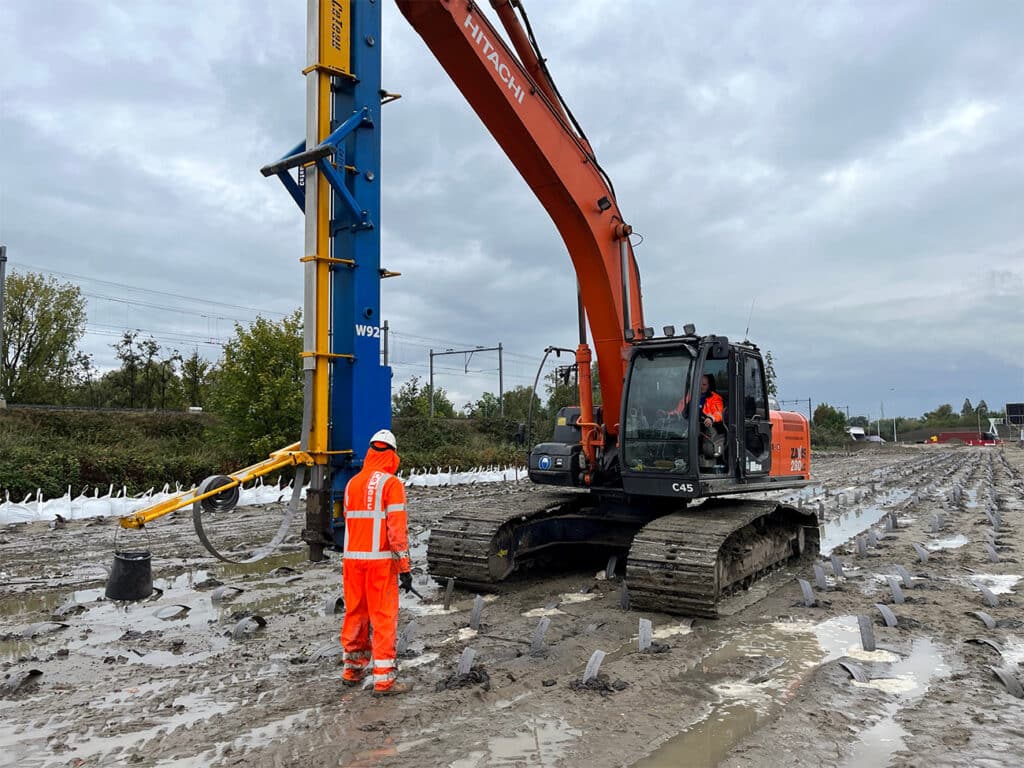
CeTeau BV likes to present itself as an innovative and thinking partner. Always busy and driven towards finding the right solution. Because by far the majority of companies in the Netherlands the company is mainly known for the production and installation of vertical drainage, it wants to use InfraTech to present some innovations in the field of this consolidation technique. In addition, CeTeau is also known worldwide for its compaction techniques. These are not missing from the fair either.
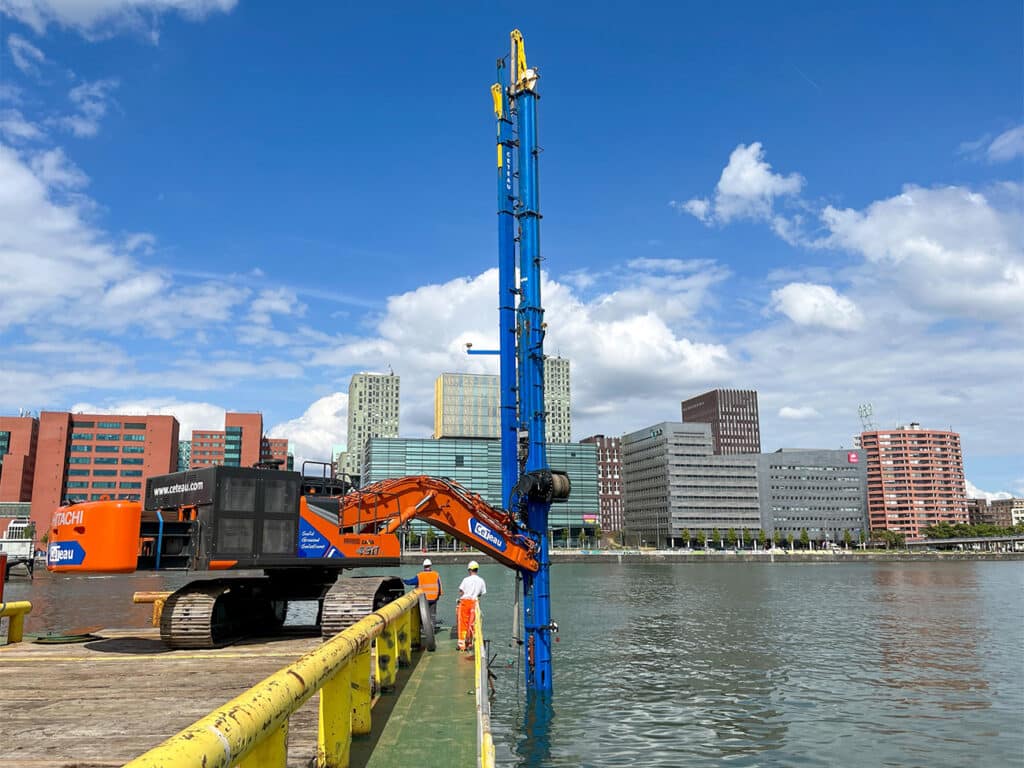
DuraDrain is CeTeau's new biodegradable drain. "For many years, we've seen the same question come back again and again about what happens to the drains we install," says Gatze van der Meer, General Manager of CeTeau BV. "The answer, unfortunately, is nothing. These drains remain in the ground. This while the operation of the drains is only needed for a limited time. Once the final settlement is reached, the drains lose their function. For this purpose we have developed a biodegradable drain called DuraDrain. This product has a degradation time that is always longer than the duration of the longest settlement required. The DuraDrain product is completely degraded after the passage of about 12 years."
Ceteau now performs many soil consolidation operations in Asia using a Vacuum Drainage System. "Here, the underpressure required to accelerate settlement is generated using vacuum," Van der Meer explains. "The great advantage of this is that practically no pre-loading needs to be applied. That makes a huge difference in the supply and removal of soil flows. Vacuum drainage also offers a good solution if there is a danger of undesirable soil displacement, due to the high weight of a pre-load. But the biggest advantage is that vacuum can speed up the settlement process even more in combination with pre-loading. As a result, a site is ready for construction faster and lies unused for less time."
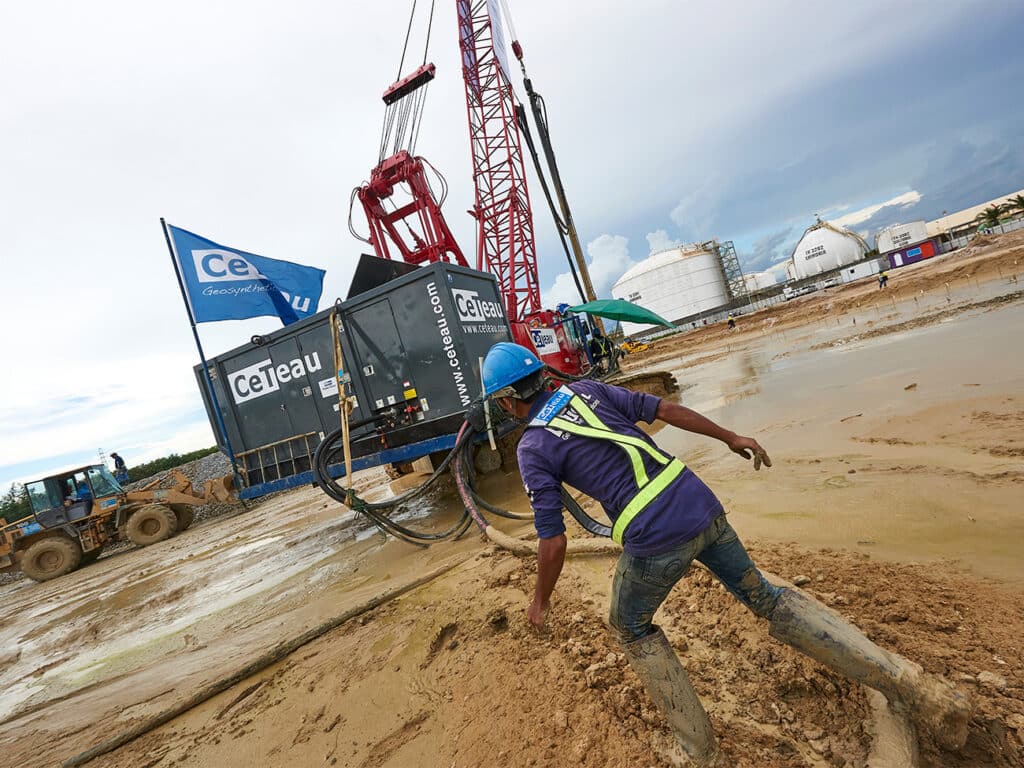
Also consider CeTeau for compaction techniques. "We have various methods at our disposal to compact suitable soil types and generate the maximum bearing capacity," says Van der Meer. A small summary.
Using the so-called High Energy Compaction technique (HEIC), the surface roller compacts dry sand and loamy soils to a depth of about 3.0 meters by impact, continues Van der Meer. "The roller consists of 3 or 5 planes and hits the soil hard by means of a shock absorber. This improves and compacts the structure of the sand grains. The roller is mounted behind a tractor and drives at a speed of about 10 km/h over the surface to be treated. After inspection, it can be decided to repeat this exercise should insufficient settlement still be achieved."
CeTeau now has extensive knowledge and experience in working with RIC compaction hammers. "By means of a heavy (pile-driving) hammer, the (sand) soil is hammered into a fixed pattern," Van der Meer clarifies. "These hammers are attached to an excavator and strike a compaction foot with a weight of up to 15 tons from a predetermined height and in a fixed time frame of several minutes, thus creating the dynamic compaction movement. Because of the resulting settlement, a sand surface can handle a much heavier load without much further action."

Sand layers can be compacted to great depths with the Vibro(flot) technique, also known as Vibro Compaction, Van der Meer knows. "A vibro unit with an eccentric is vibrated into the soil using water and air. This results in a restructuring of granular soils creating a compacted column. This compacted column forms around the vibro-unit and can be done in a pre-selected pattern." CeTeau has gained extensive experience with the technique on large projects in Asia.
The technique is applied when soil conditions permit. This means less than 10% fines (small sections) and less than 2% clay. The intention is to ultimately achieve higher subsoil bearing capacity and a reduction in settlement.
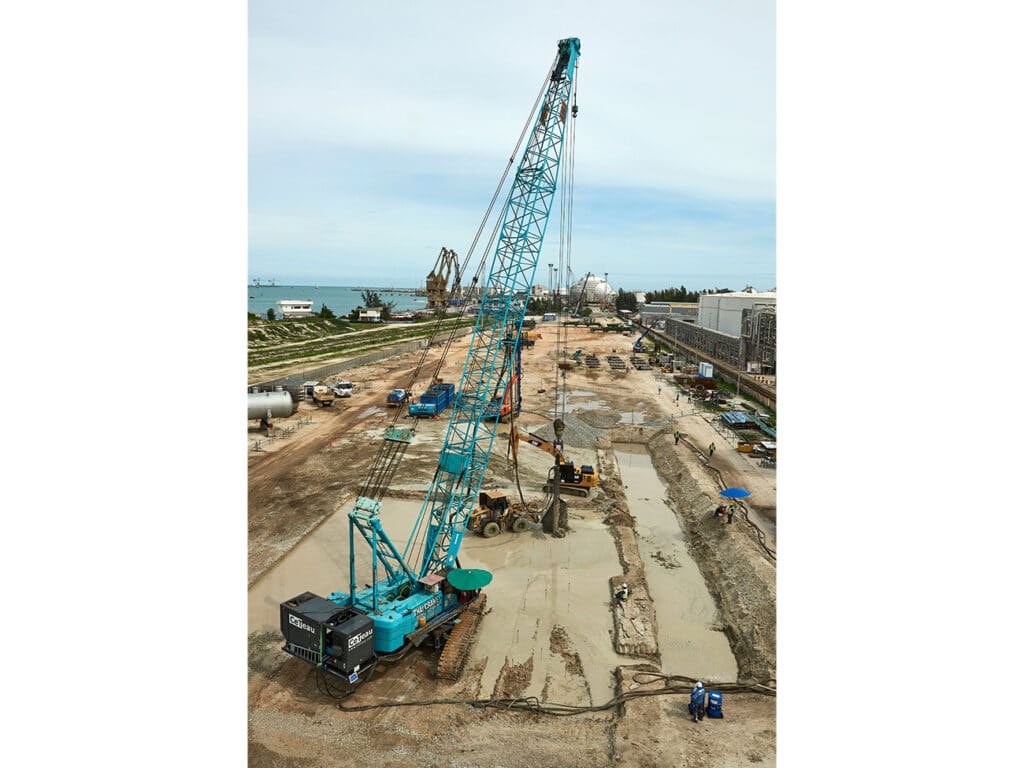
Vibro(flot) technology from Vibro Compaction can also be used to create a Gravel Pile. "A Gravel Pile is installed by means of a Vibroflot. Fine to medium gravel and crushed rubble up to a thickness of about 4 cm can be inserted and pressed in using the Vibroflot. This creates a solid column through which groundwater can still escape but, depending on the soil conditions, also generates some bearing capacity. Our Vibroflots are deployed at various locations worldwide."
At InfraTech 2023 all the ins and outs of these unique consolidation and compression techniques from CeTeau.