Platform on civil engineering, underground infrastructure, energy, construction equipment & construction machinery
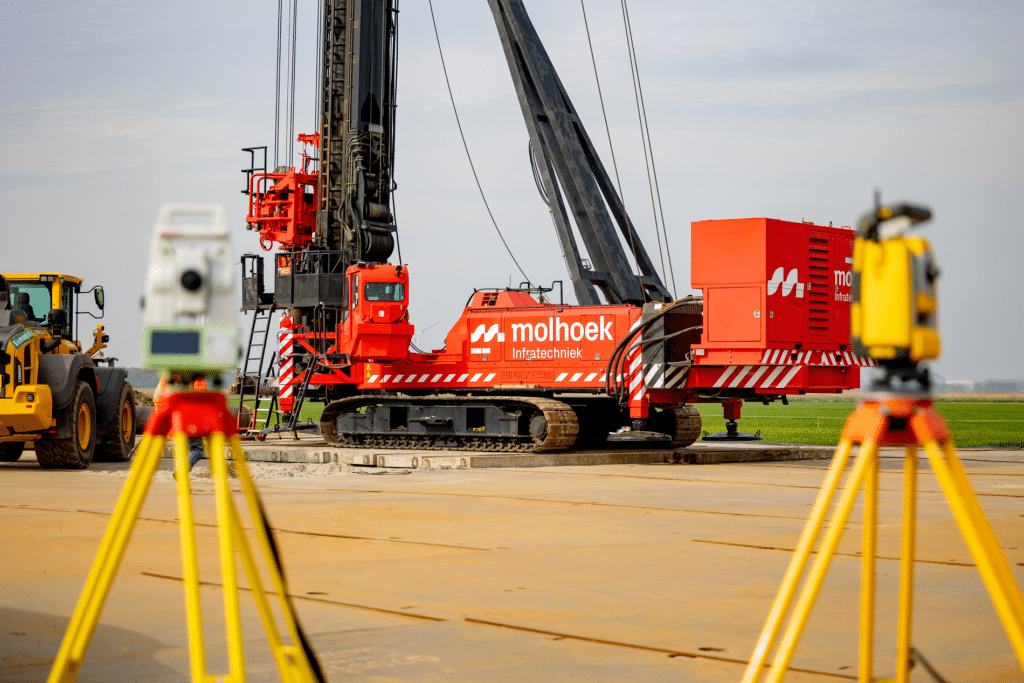
Foundation piles under 95 high-voltage utility poles
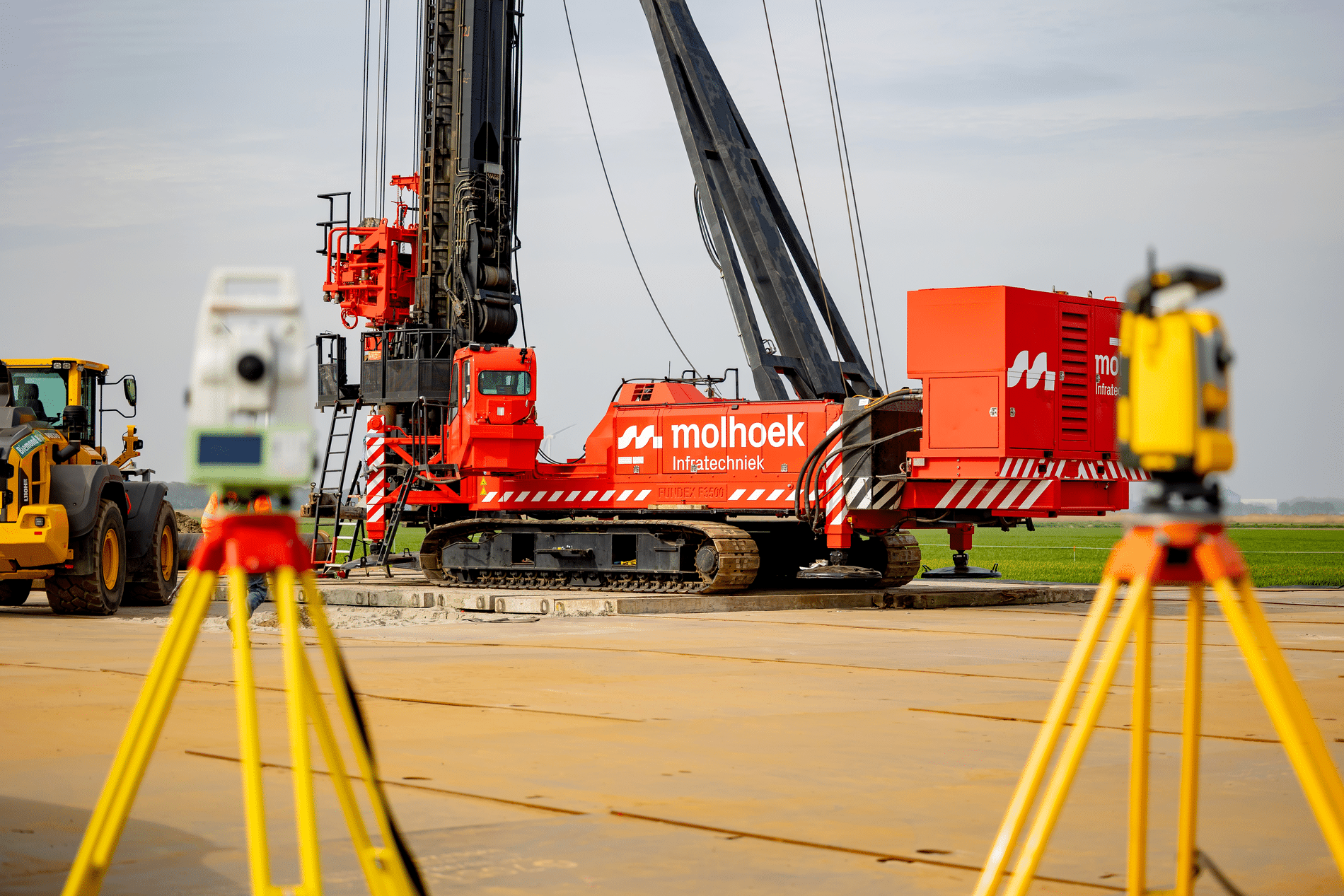
Along a route of more than 40 kilometers between Rilland and Klundert, 95 high-voltage transmission towers are being built for the new TenneT connection from Zeeland to Tilburg. Commissioned by Strukton Civiel, Molhoek Infratechniek is handling the pile foundation work, which at some points requires a high degree of precision.
The towers are spaced an average of 400 meters apart. “We distinguish between two types of foundations on this route,” explains Leendert van de Graaf of Molhoek Infratechniek. “The corner and tension poles, which bear the heaviest loads, rest on twelve Fundex piles with a diameter of approximately 610 millimeters and lengths ranging from 20 to 30 meters. The standard line poles are founded on four piles with a diameter of approximately 813 millimeters and the same length.”
According to Leendert, the four-post masts in particular require extreme precision in their construction. “The mast structure is placed directly into one of the foundation piles, without an intermediate pier. The permitted deviation is therefore a maximum of ten centimeters.” This poses no problem whatsoever for Molhoek Infratechniek. “In practice, we drill the piles with an accuracy of just 25 millimeters,” Leendert says proudly. An impressive achievement, especially since the pile inclination can reach up to 3.5 to 1.
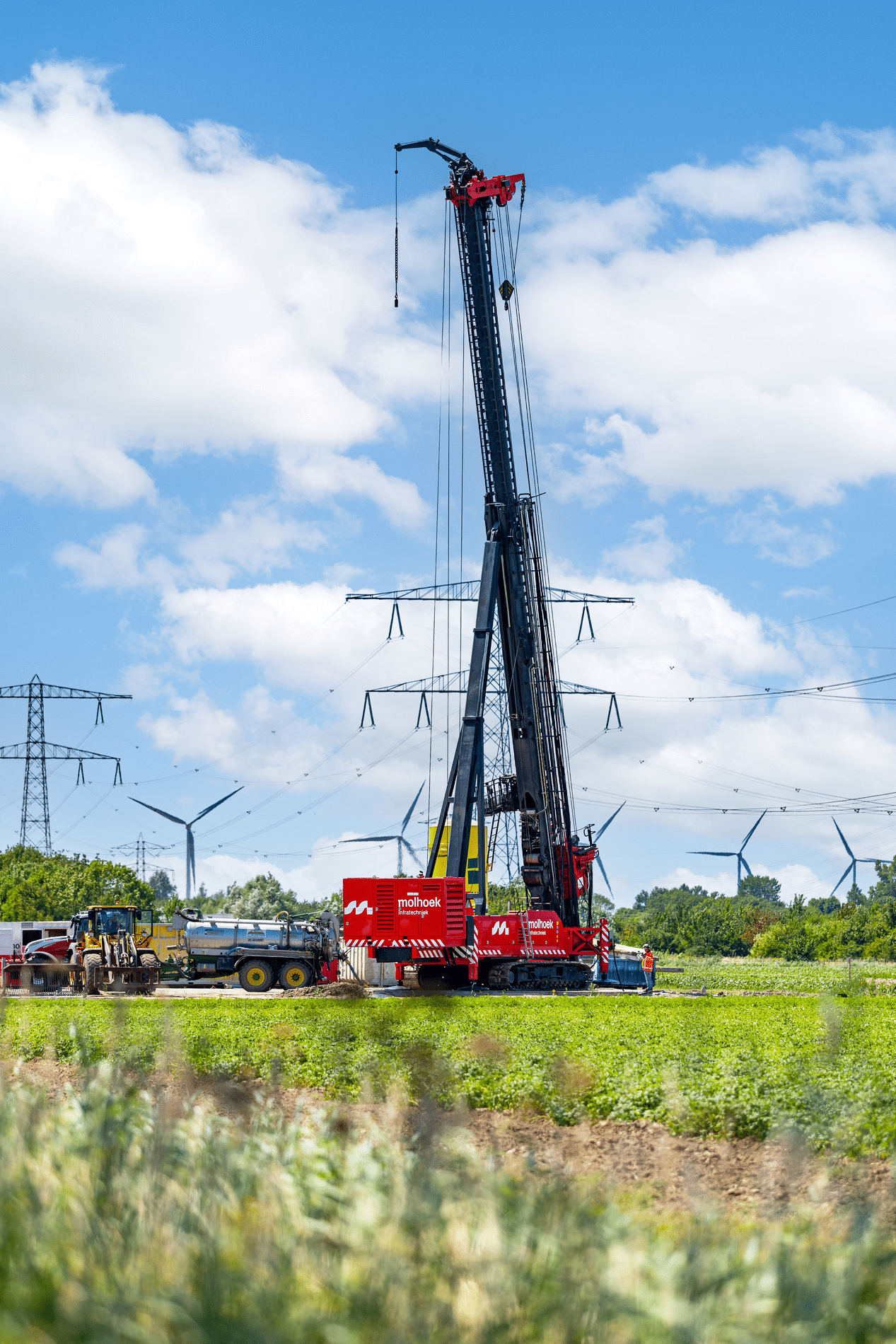
Molhoek Infratechniek began using the first Fundex 3500 machine on the project in March 2026, followed by a second machine two weeks later. “Together, they’ll be working along the route until the end of the year,” Leendert explains. For each tower location, the drilling, relocation, and reassembly take about one to one and a half weeks. “Once the concrete work is complete, the lattice tower will be installed, after which the high-voltage cables will be laid.”
The biggest challenge, however, lies not in the drilling itself, but in the logistics. “We constantly move the entire drilling rig, grouting system, and auxiliary equipment from one location to another. That requires transport permits, escorts, and precise coordination with the preparatory work along the route,” says Leendert. “The delivery of cement and pipe piles is also done entirely on a just-in-time basis, because workspace is limited.”
On other sections of the new high-voltage transmission line, where there is a height restriction, Tubex machines are being used, along with tubular piles that are installed in sections. “On the section between Rilland and Klundert, a conscious decision was made to use one-piece foundation piles. This eliminates the need for welding, speeds up construction, and contributes to the efficient construction of this important expansion of the Dutch power grid.”
●
Neem dan rechtstreeks contact op met Molhoek Infratechniek.
 Contact opnemen
With years of experience in infrastructure and foundation engineering, we add value to every project. Our broad expertise enables us to realize reliable and sustainable solutions not only above but also below ground. We think along with you from design to execution and provide a solid foundation under every project, literally and [....]
Bekijk Bedrijfsprofiel