Platform on civil engineering, underground infrastructure, energy, construction equipment & construction machinery

In the physical domain, reliable information provision is indispensable. Municipalities manage thousands of objects, from trees and lampposts to street furniture and works of art, all of which must be recorded somewhere in a management system. Yet in practice, much of this valuable information is still lost. That is precisely the issue Unafact focuses on: improving information provision within the physical domain, so that data actually becomes valuable for design, construction, and management.
Jochem Mollema, founder of Unafact, has been the spiritual father and driving force behind the Public Space Management Information Model (IMBOR) commissioned by CROW since 2014. “It is the national standard that describes how we record objects in the Netherlands,” he says. “IMBOR forms the basis for object-oriented working and integrated management. An approach in which information is not lost, but passed on like a baton. From the moment an object is designed to the moment it is managed, the same information must be reusable. Information that, as it were, ‘travels’ with the object throughout the entire chain, without data being lost or having to be re-entered.”
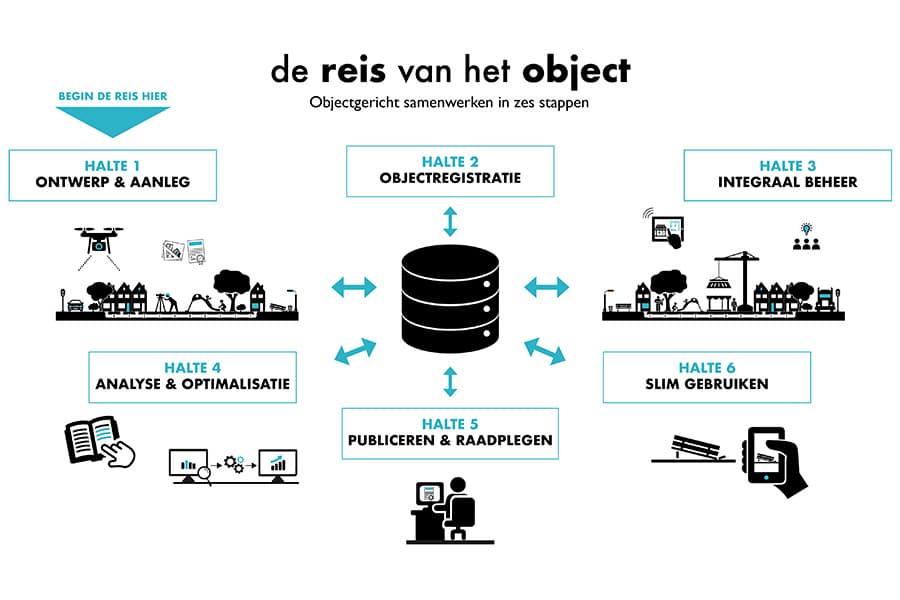
In theory, according to Mollema, 50 percent of the necessary information is already known during the design phase, and another 30 percent can be added during the construction phase. “Provided you use your ‘tools’ wisely,” he adds. “That would leave only 20 percent for the management phase. However, that is the theory. In practice, more than 70 percent of the information is often lost, mainly because standards and systems are insufficiently aligned. Not because suppliers are unwilling, but because clients often underestimate the importance of that alignment. Technologically, this is not rocket science. The tools exist to bring clients and contractors together to tackle this loss of information. In my role, I help municipalities improve their information management, work on national standards, and encourage collaboration within the field.”
A municipality such as Utrecht demonstrates what is possible when data is organized: a single reliable source of truth that focuses on up-to-date, complete, and consistent information. “With such a repository of information, a municipality can save millions. The municipality of Utrecht even calculated a cost saving of 7% on project costs, simply because information does not have to be collected over and over again,” says Mollema. His mission is therefore clear. “Ensuring that municipalities know what they are responsible for, so that their environment remains clean, safe, and intact, and that they can make decisions based on reliable data. Once every source holder records objects in the same way according to the IMBOR 2025 standard, you can also create filters for the Environment Act, for the WIBON, etc.”
Unafact, together with eight municipalities and the municipality of Nijmegen as the client, has created a minimal dataset of the IMBOR 2025 data for the Dutch government. “It is a tool for organizing your data. Because only when the information is correct can we really deal with our physical living environment in a smarter and more efficient way.”