Platform on civil engineering, underground infrastructure, energy, construction equipment & construction machinery

Train stations traditionally evoke a special feeling. They are places where people come together, only to each continue their own way a little later. Traveling by train was something special in earlier times, because for the first time the masses could move over longer distances in an affordable way. Being an employee at the railroad was a distinguished profession and in addition to being a safe place to get on the train, a station was also a place where the traveler was treated to hospitality and service.
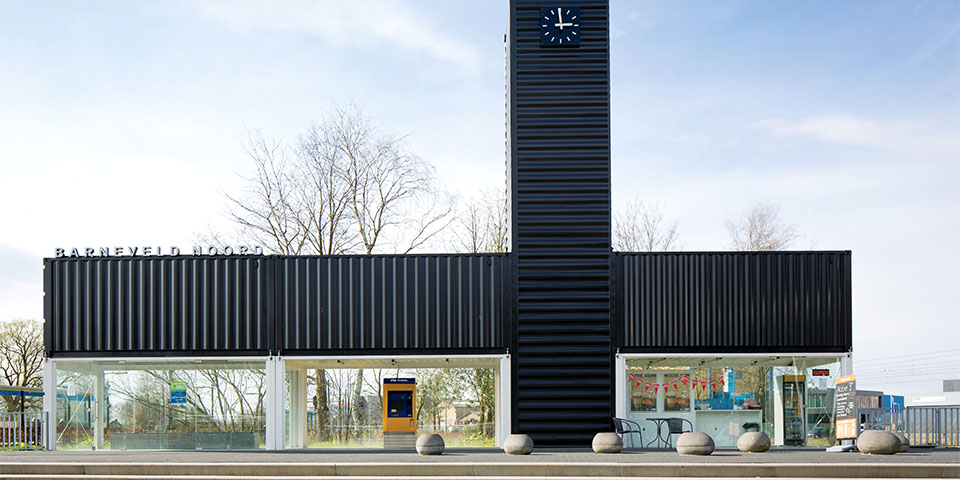
Barneveld North Station, constructed from shipping containers. How circular do you want it to be?
And you know what the great thing is? That's actually never changed. "We work together to make the station the calling card of the railroad and its surroundings," says Astrid Bunt, Director of Stations at ProRail. What has certainly changed is the approach to designing, building and managing stations. Sustainability and circularity are the new benchmarks. In all phases of the station's life, maximum efforts are being made on these themes. When designing stations, we have developed guidelines on sustainability and at every existing station we apply the so-called station sustainability scan. We have made this part of the application of the sustainable GWW approach. In this way, we are constantly looking for opportunities to make stations more sustainable."
"Today's station is a multimodal hub, especially compared to the past," Astrid explains. "Surely the basic function of a station used to be mainly to get on and off the train. In those days, stations were usually decentralized, on the outskirts of a city or village. Today, stations are bustling centers of connection. They are more central, partly because the city or village has grown closer to the station, and provide connections within the broader public transport spectrum. Train, bus, streetcar, metro, cab and share bikes are offered to the traveler to facilitate the smoothest travel possible."
With the addition of hospitality, workplaces, meeting places and even residential facilities, the station plays a central role in people's lives today. "The trend today is that a station represents development that is not limited to the cadastral boundaries of the station itself," Astrid continues. "The surrounding area develops along with the station, especially at the major junctions. A radiating development that slowly blurs the boundary between station area and surrounding area. It's a nice, soft integration and that's why the station really is a calling card for its surroundings and the railroad."
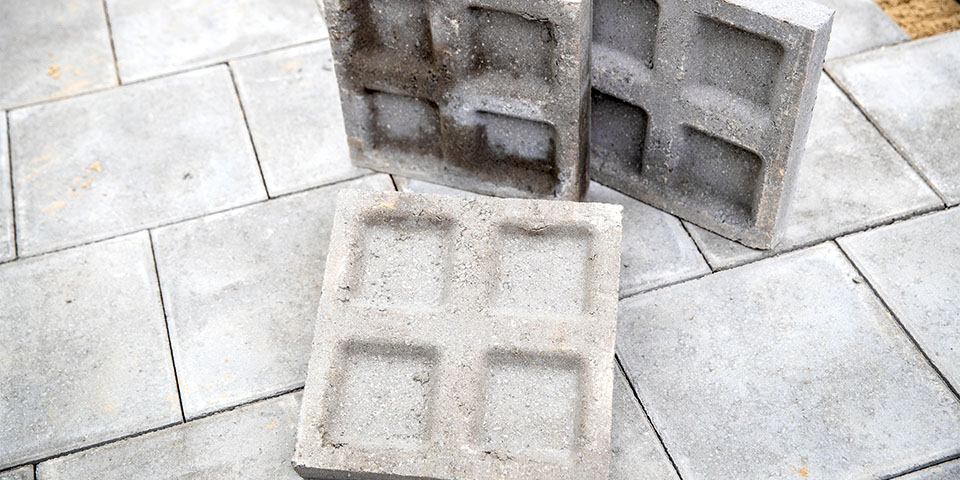
New durable, lighter platform tile on test platform Railcenter, Amersfoort.
According to Astrid, the Netherlands has about 401 stations. Not an exact number? "No, because there are also temporary stations at events and new stops are being added. In essence, a station is still a place to get in and out, whether it's a large central station, or that "little plank in the meadow. We have about 50 large and medium-sized stations in the Netherlands, the rest fall within the 'small' category. It is our responsibility, together with NS Stations, to make and keep the stations comfortable, accessible and safe. We can do this by renovation, by adaptation or by enlargement. The latter can be a desire of a municipality, for example, when they want to add a forecourt or bicycle parking."
'Connects, Improves and Preserves' is the motto for everything ProRail does. "When we look at sustainability within ProRail, we see that factor rests on four pillars. The first pillar is energy. We then talk about saving as well as generating. Savings are achieved, for example, by switching to LED lighting, with a dynamic dimming function. No one at the station? Then turn on as few lights as possible. This not only saves on energy consumption, it also benefits flora and fauna by keeping it dark at night. Last year, for example, we gave Mantgum, a beautiful village in Friesland, its stars back by applying dynamically dimmable lighting to the platforms located in the middle of a meadow."
Energy is generated on its own by applying solar panels on platform roofs. A number of stations have already been tackled in this way. "We are now working towards a second group of stations. We are doing that for all ProRail assets," Astrid explains. "At the same time, we are also working on gas-free stations. The second pillar is the application of sustainable materials. We are committed to using circular, preferably recycled materials wherever we can. For example, we recently reused the platform tiles from Maarn station at the Hof van Cartesius in Utrecht, a city park under development, and we had the depreciated platform tiles from Anna Paulowna station processed into new platform tiles for Bunde Station. Finally, in 2018 we worked with the market to develop innovative platform tiles with significantly less concrete use by using a waffle profile on the underside. So we try to do as much as possible with as little material as possible."
The third pillar is nature. "With this, we take greening, biodiversity and climate-adaptive building into account in the design of station developments. We see great examples in recently completed projects such as the so-called landscape station Driebergen-Zeist. The fourth pillar is increasing mobility through public transportation. The biggest contribution we can make to this planet is by getting as many travelers as possible out of cars and onto trains. So actually this fourth pillar has the biggest impact. We want to make sure that hubs are comfortable now and at the same time ready for the future. Together with NS Stations we steer towards this; the passenger experience must average a 7 if the traveler is to experience a station as comfortable. With sufficient capacity on the tracks and in the stations. And that requires a long-term vision that you embrace together with all stakeholders. Currently, under the direction of the Ministry of Infrastructure and Water Management, we are working with municipalities, provinces, NS Stations, transport operators and passenger organizations on the Toekomstbeeld OV 2040. In it we look ahead and determine which junctions we want to tackle in the future. Above all, we need to be smart and innovative.
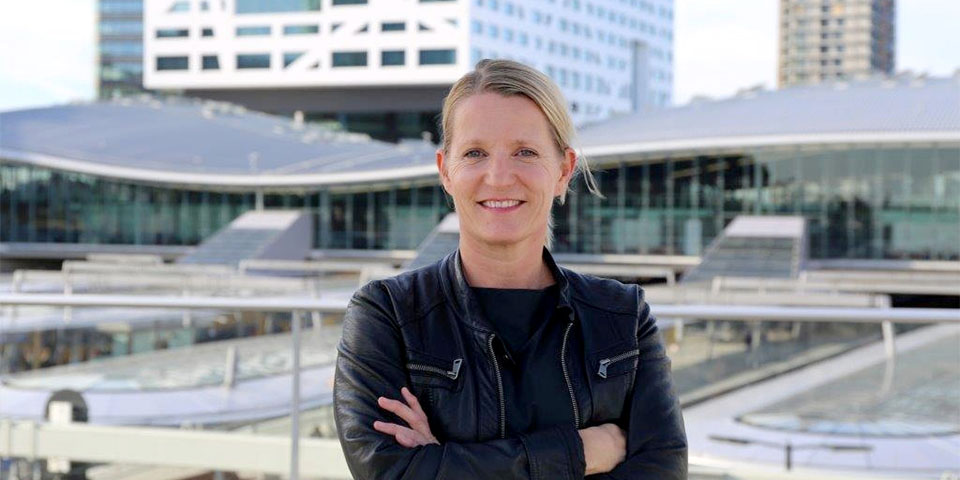
Astrid Bunt, Director of Stations at ProRail.
To be ready for the future, Astrid says cross-sector knowledge sharing is needed. "To be circular and innovative you need to work together with open minds, removing old boundaries. A great example is the 'What if we design a circular railway station' challenge we are holding together with NS Stations and Spoorbouwmeester. The What if Lab Circular Stations concerns innovation of a small station designed based on circular principles. What does this mean for the design? What innovations are possible? Think for example of circular platform tiles, a canopy with biobased materials or perhaps a leased station, which can be put in a different place after its use. The question got us over 40 entries. We received different people and parties than usual. They inspired not only our people but also each other! In the end, 10 ideas were selected for further elaboration. Of these 10, 3 entries were eventually allowed to present themselves at Dutch Design Week. "
Astrid gives the people on her team space to work independently and with their own responsibility. "For innovation, it is necessary to leave space and highlight initiatives that have energy. But I do stay in constant conversation with people, to encourage a focus on sustainability and new forms of cooperation. And of course things sometimes fail, but not trying means stagnation and therefore regression." In conclusion, she says, "Stations belong to all of us and together we can make a substantial contribution in the area of sustainability. Not only in the station itself but also in its surroundings."