Platform on civil engineering, underground infrastructure, energy, construction equipment & construction machinery

If you compare it to not building at all, putting up houses, offices, flats, factories and other structures is always bad for the environment. Regardless of whether you use concrete, stone or wood.
Building with concrete is more environmentally friendly than you might think. In the Netherlands, concrete contributes only 1.6 percent of CO2-emissions, and that already includes the production of cement and reinforcing steel abroad. When making concrete, cement is the material that causes the most CO2-emissions. In fact, cement accounts for about 80 percent of total carbon dioxide emissions. The rest of the CO2-emissions is energy for transportation and production.
The 1.6 percent share is low, especially considering that three-quarters of the mass of building materials in residential and commercial construction in our country is concrete. The contribution to carbon dioxide emissions in our country is comparatively not high, but it must go back to zero. The European cement industry has agreed to be emission-free by 2050.
Globally, concrete contributes seven percent of total CO2-emissions. That's because of the huge demand. And there's a good reason for that: concrete is strong, safe, lasts a very long time and you can make just about anything with it. Towering skyscrapers, homes, sewers, bridges, industrial floors, you name it.
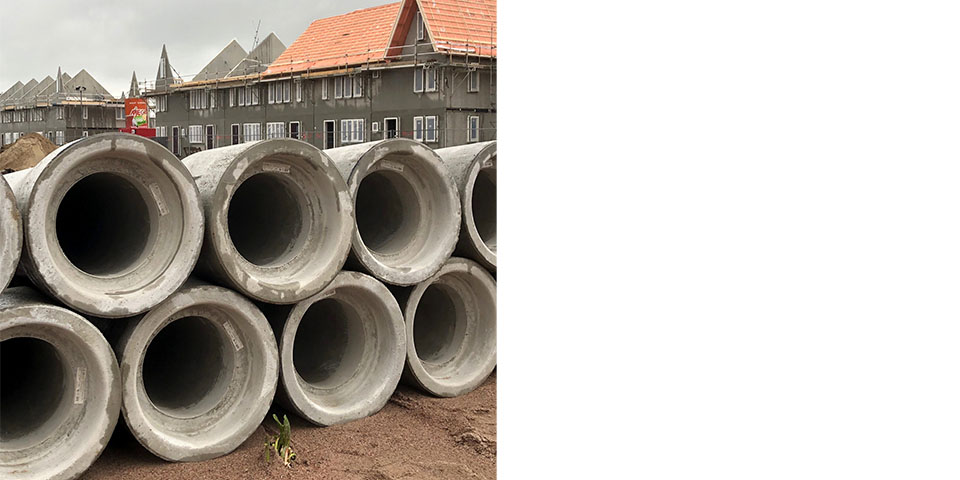
With concrete we build the future: it is strong, safe and it lasts a long time. You can make just about anything with it. Towering skyscrapers, prefab homes, sewers, bridges, traffic circles, you name it. Scan the QR code to view this animation on Youtube.
At first glance, building with wood may seem less CO2-emissions, but upon closer examination this turns out not to be the case. By the way, wood in construction often involves CLT, or cross-laminated timber.
That is glued laminated wood, sourced from production forests. Making it requires adhesives and resins, with substances such as polyurethane and melamine-formaldehyde. Protective coatings are also used in the application. To make it more fire-resistant, cladding is needed or thicker wood is used. So CLT is something other than a freshly sawn, fragrant beam right out of the woods.
To make a fair comparison, it is best to look at building level. The values per kilogram or ton are less interesting. They are difficult to compare in practice because for a building you need a larger volume of CLT than of concrete. On the other hand, a cubic meter of concrete is much heavier than glued wood.
Studies show that concrete at the building level in terms of CO2-load scores better or comparable to CLT. But that doesn't get you there. In fact, heating and cooling a wooden building requires more energy than the concrete version. In the case of a house made of wood, the additional heating and cooling alone generate as much CO2-emissions as the production of the concrete for a comparable home.
These are independent studies done in Belgium, Sweden and Norway. The study in our southern neighbors shows that there is no environmental difference between a house made of concrete and one made of regular structural timber. For an eight-story apartment, the difference in favor of concrete is ten percent.
The Norwegian study shows that in terms of CO2emission at a 16-story apartment building scores better than CLT, at eight stories it is about the same and at four stories CLT comes out slightly more favorable. Small note: The Norwegians assumed a clinker content of 70 percent for the concrete, which is more unfavorable than the Dutch situation. Here the clinker content is 50 percent.
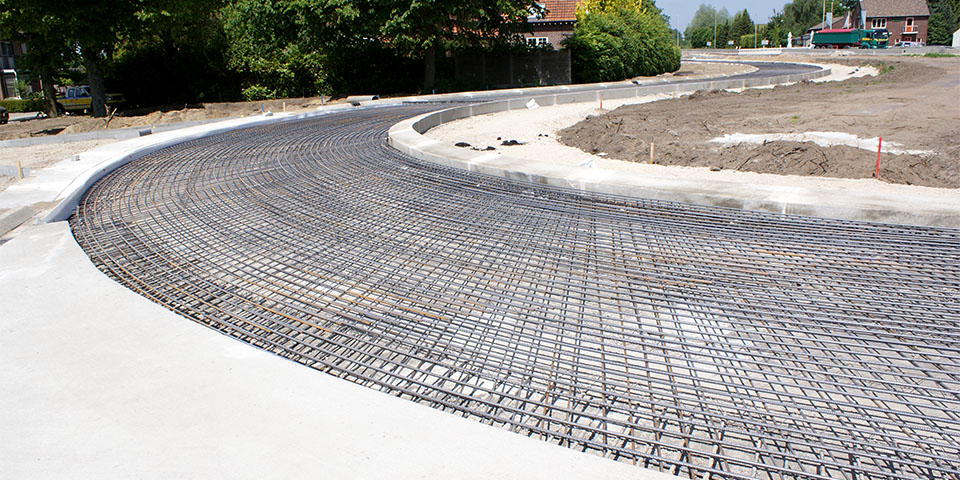
This roundabout is located in the middle of Bergen, at the intersection of the Rijksweg and the Siebengewaldseweg, and is made entirely of concrete. The province of Limburg chose concrete because this material can withstand the high wringing force of freight traffic and does not show any rutting. Concrete was chosen for the separate bicycle paths because of the absence of root pressure. The province assumes a life span of forty years without much maintenance.
The LCA or life cycle analysis provides great insight into the environmental impact and associated CO2-emissions, but there are caveats. The LCA considers 11 key aspects to arrive at a single number: the environmental cost indicator (EQI). This expresses in Euros what it costs to offset adverse environmental impacts. In the Netherlands, all MKIs of materials used in a building are collected to arrive at a so-called MPG. That stands for Environmental Performance of Buildings.
Life cycle analysis does not measure everything. For example, no attention is paid to the organic matter left behind, for example, in tree felling. Furthermore, uptake and release of CO2 Although rightly offset against each other, if the tree had not been cut down, it would have produced much more CO2 have included.
The increase in biodiversity in river areas as a result of sand and gravel extraction plays no role in the LCA. Moreover, the useful life for concrete is estimated very conservatively for the analysis: for offices 50 years and for homes 75, while they can easily last more than a century.