Platform on civil engineering, underground infrastructure, energy, construction equipment & construction machinery
A natural duality
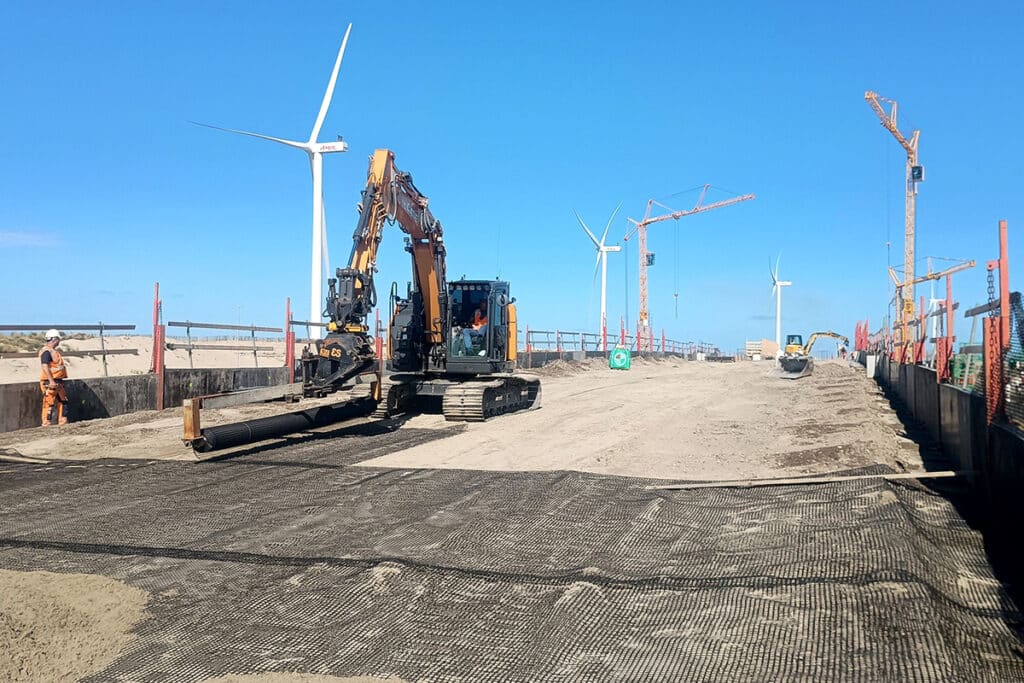
In the construction of the new Princess Alexia Viaduct, reinforced soil construction has an important role to play. In the approaches, it offers not only functional but also constructive opportunities: by applying reinforced soil, the design can be leaner, more sustainable and more efficient. The project is thus a textbook example of how early collaboration in a design & construct environment leads to smart solutions in which civil design and reinforced soil interlock naturally.
Design & construct projects are no longer about building prescribed products, but about providing solutions that truly meet the client's needs, begins Gino Jongmans, business manager at Voets Reinforced Earthworks. “That is exactly where we distinguish ourselves. By thinking along with the main contractor and client at a very early stage, room is created to optimize projects integrally with reinforced soil. Such structures require a design philosophy in which civil design and soil construction are inextricably linked. Also in this project, the Port of Rotterdam Authority offers sufficient space to design in reinforced soil. This is in line with their decades of experience with this construction type in previous projects. This open attitude gave us the opportunity to bring in innovative and sustainable optimizations together with BAM Infra Nederland.”
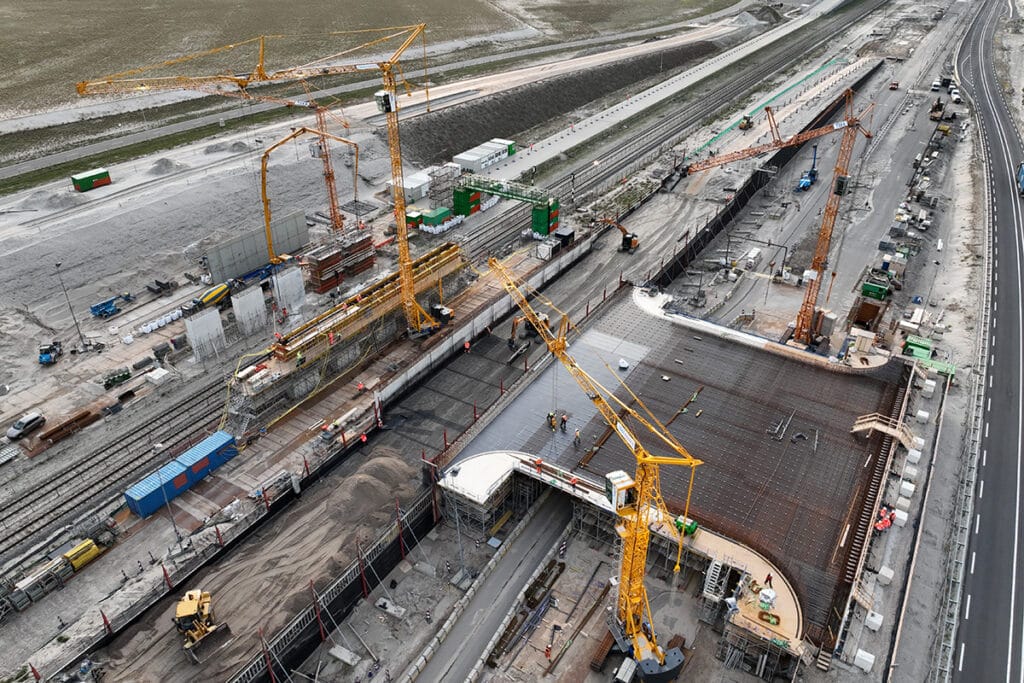
One of the main optimizations achieved is the application of reinforced soil directly adjacent to the walls of the structures. “This significantly reduces loads and makes the civil design leaner, more efficient and sustainable,” according to Jongmans. “Less concrete and steel means not only lower costs, but also a much smaller carbon footprint. In that sense, reinforced soil and sustainable construction form a natural duality.”
Port of Rotterdam has additional requirements in their HBR standard, where, for example, the heads of reinforced soil must be realized with hydraulically bound mixed granules. “Because of the alkaline environment, not all geosynthetics are suitable,” Jongmans knows. Huesker, supplier of geosynthetics and partner of Voets, therefore recommended the durable and resistant Fortrac MDT geogrid based on polyvinyl alcohol. “Not all fibers are resistant to an alkaline environment,” says Sander Suk, geotech engineer at Huesker. “Fortrac MDT geogrid yarns are permanently durable under those aggressive conditions.”
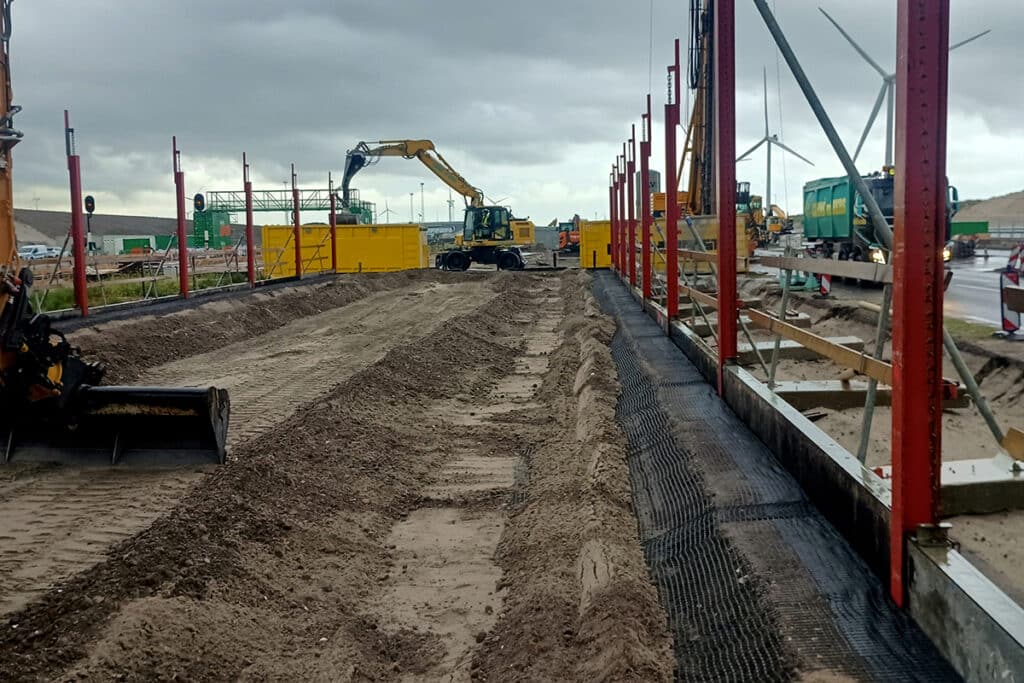
An extraordinary choice by the Port of Rotterdam Authority was the provision of no less than 150,000 m3 of sand, fitting within their own soil balance and master plan. “Whereas normally the contractor makes demands on the replenishment material, here it was reversed,” Jongmans says. “The quality of the sand was fixed, and so were the design guidelines. That made the project unique, but also challenging. With the right attention, the sand turned out to have excellent applicability.”
According to Jongmans, what sets Voets Armed Ground Structures apart is its ability to connect early, co-design integrally and then build form-fitting. “Controlling dimensions is crucial: reinforced earth structures grow up meter by meter, and every tolerance affects the final profile of the ramp. That requires craftsmanship, accuracy and consistency. In addition, safety was central from the first tender day. Working at height, near heavy equipment and in coastal areas with extra wind loads requires extra attention and sharp agreements. That shared focus on safe working forms a common thread in the cooperation between all parties.”
Neem dan rechtstreeks contact op met Voets Gewapende Grondconstructies B.V..
 Contact opnemen

Solutions for infrastructural issues Voets Gewapende Grondconstructies is a company that focuses on consultancy, design, delivery and realization of various system solutions in the field of reinforced soil structures. Over the years, the necessary experience has been gained in the entire process from detailed design to realization of reinforced soil structures. With that, the primary function of [...]
Bekijk Bedrijfsprofiel