Platform on civil engineering, underground infrastructure, energy, construction equipment & construction machinery

In order to prevent flooding and damp basements in the old buildings during extreme rainstorms, they wanted to be able to store and drain rainwater. In addition, they wanted to prevent heat stress. However, there was no possibility for an infiltration facility in the narrow street. Moreover, the ground layers could not be disturbed because of the possible archaeological value. Wondering how this was solved? ACO is happy to explain.
After a tender process, the Municipality of Elburg and Aannemingsmaatschappij Van Gelder worked together in a construction team. "Our assignment consisted of repaving and installing a rainwater sewer to disconnect homes," says Erwin van Boven, design manager at Aannemingsmaatschappij Van Gelder. "All the rainwater had to be discharged into the creek that runs right through town. Given the appearance of the historic town, a line channel was preferred."
The task seemed simple, but it was not. Time was the biggest enemy. Implementation of the project began in January 2021. Because traditionally the tourist season starts at Easter, the goal was to have the terraces and the fortified town accessible again by then. "In order to meet the completion date, we actually did not want to dig too deep in this old fortified town, because there was a chance that we would encounter archaeological finds. Therefore, we started looking for a storm sewer with less coverage," Erwin says.
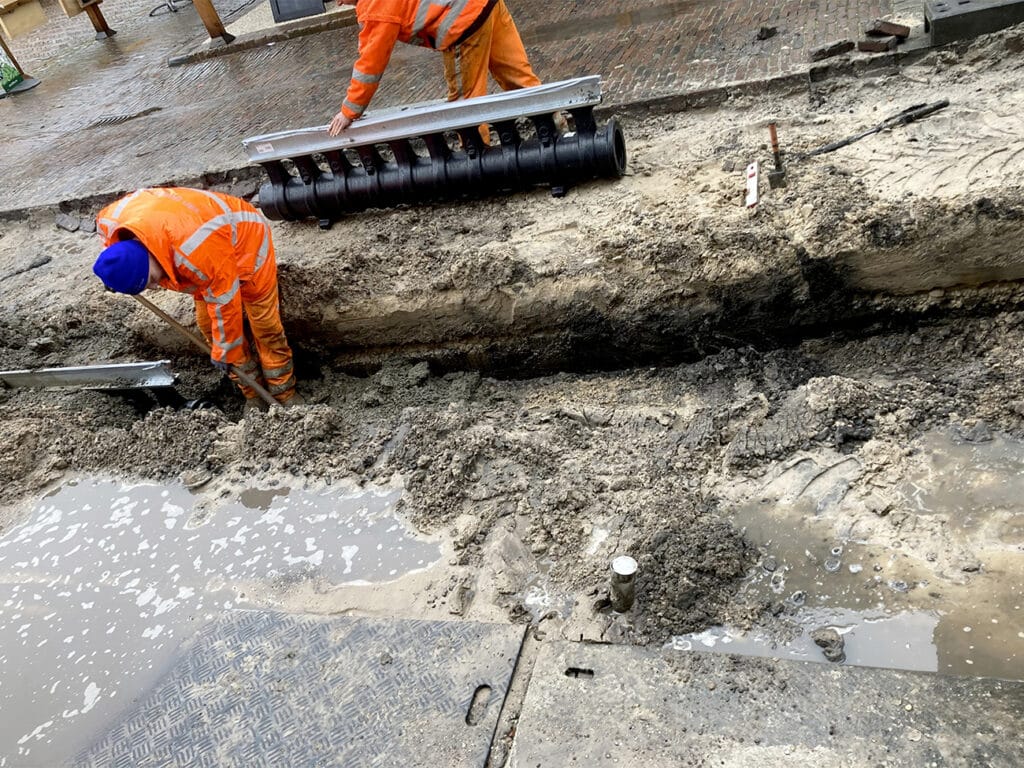
In Elburg, they also felt it was important that during extreme rainstorms, the water would be stored and drained, preventing flooding but also damp cellars in the old buildings. In addition, they were eager to prevent heat stress on hot days. Time constraints, the prevention of archaeological finds and the desire for a sustainable climate-proof city were important factors in the search for the right solution. The solution to this challenge was found at ACO with the Q-max, a trench gutter that no longer requires piping and can be placed high below ground level. Unlike systems with separate collectors, this trench gutter could be connected to the city canal.
Whereas until recently the relatively clean rainwater always ended up in the sewage system, nowadays rainwater is increasingly collected. Simply because it can be put to good use. For example, you can use it sustainably to water trees and plants and reduce heat stress on hot days, while at the same time relieving the burden on the sewer system during extreme rainfall. In Elburg they chose to disconnect the rainwater that falls on the roofs of houses from the sewerage system and transport it via the Q-max to De Beek, which flows into the Vestinggracht. Gerard is happy with the choice of the Q-max, "It's been a while since Rieks Hulst, sales engineer at ACO, told me about the Q-max during one of his interesting coffee conversations. This conversation has stayed with me, because this product is a super combination of a line gutter that collects and collects rainwater and then drains it climate-adaptively. ACO's products may be slightly higher in price, but we get quality in return on all fronts. In my opinion, the ACO brand brings the best products available on the market."
Because we were also curious about the processing of the Q-max, we talked to Henri Struik, contractor at van Gelder. "The disconnection of rainwater was very easy with the Q-max because we were able to make the side connections ourselves. I would like to use the Q-max more often in inner-city areas. It is a light product and therefore very easy to set and quick to install. It requires much less earth moving and we didn't have to make any cutting holes as with gullies. I received good support from ACO, because they were always there for me in word and deed. It was a special project for me because it was in a beautiful old town with Van Gelder's headquarters around the corner. It is one of the most beautiful works I have made."
"This line gutter is slightly more expensive than gullies and installing a separate storm drain," Erwin says. "But on the installation we gained so much extra that it was very interesting. We could fortunately use this product over the Vitens water line, so we didn't have to dig as deep. This also meant we had no risk of archaeological finds and kept a grip on the schedule so we could meet the desired completion date."
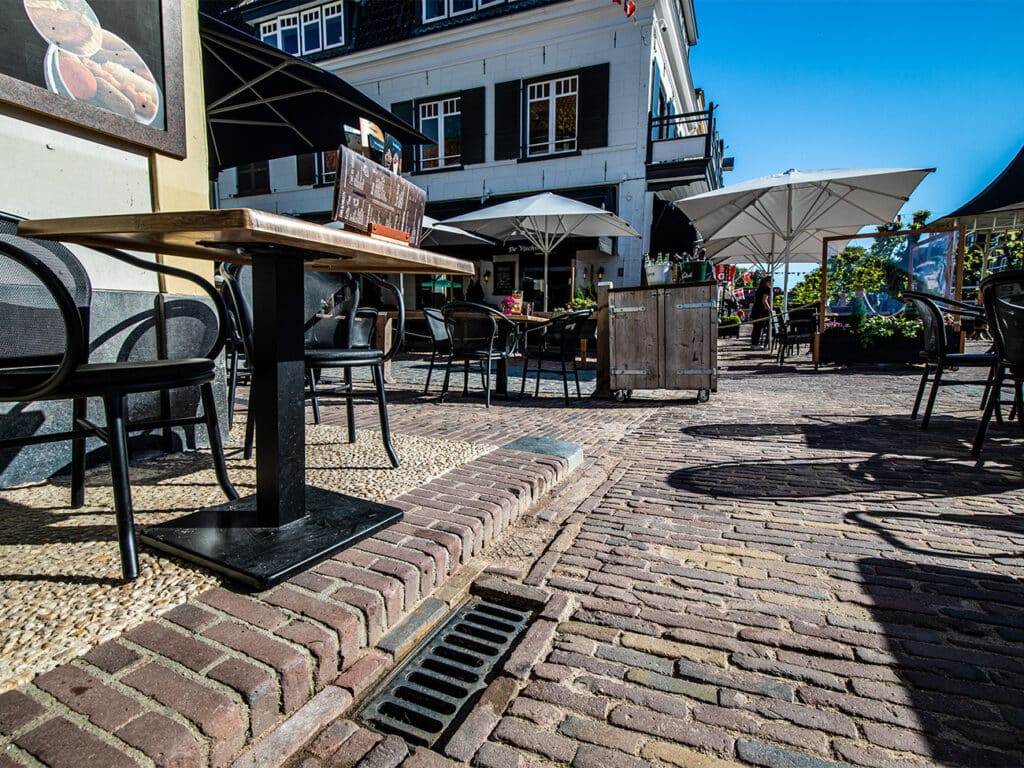
Because the old street profile was perceived as uncomfortable, the paving also had to be addressed. In repaving Vischpoortstraat and Jufferenstraat, Van Gelder ensured that the rainwater drains to the sides so that it ends up in the Q-max trench. The relatively clean rainwater then enters the fortified moat so that it can contribute to the cooling of the fortified town. Thanks to the Q-max's narrow trench, this linear gutter hardly stands out in the streetscape.
Erwin proudly looks back on the project and the collaboration; "We had quite a few challenges in the project about the technical interpretation. For example, we had to deal with an old city and height differences. Johannes Doornbosch, ACO's account manager, was very helpful in everything. I only knew ACO from the line gutters, but now I know that they have many more solutions. At ACO everything is negotiable and solvable so we should definitely work together more often." Gerard is also satisfied with the results. "We completed the downtown redevelopment on time so that the terraces could open on time. By disconnecting the houses and transporting the rainwater to De Beek, the rainwater stays where it falls and is not discharged to the treatment plant. The ACO system can drain a shower factor of 10, making the fortress well prepared for the future. By installing a cooling island, we prevent heat stress. It will be good for tourists in the summer on the cooling islands in the city with water taps, benches and trees."
The sustainable use of rainwater is important to relieve the burden on the sewer system. Unlike in Elburg, there are also conceivable situations where the runoff water must be cleaner. For example, if rainwater must be connected to a wadi, or if it must be stored for later use in watering plantings. In these situations, an additional facility is often needed to remove the pollution from the stormwater runoff. Because runoff rainwater from roofs and traffic surfaces is often contaminated by zinc from roofs, worn particles from car tires, brake dust, soot particles, sludge or oil. At ACO they are happy to tell you about the best available technology or they develop an interesting solution so that the water is sufficiently clean for further application. Invite them - as Gerard did - for an interesting coffee talk, challenge them and develop together. They like that and who knows, maybe your project or municipality will be in the news with the most innovative climate solution!