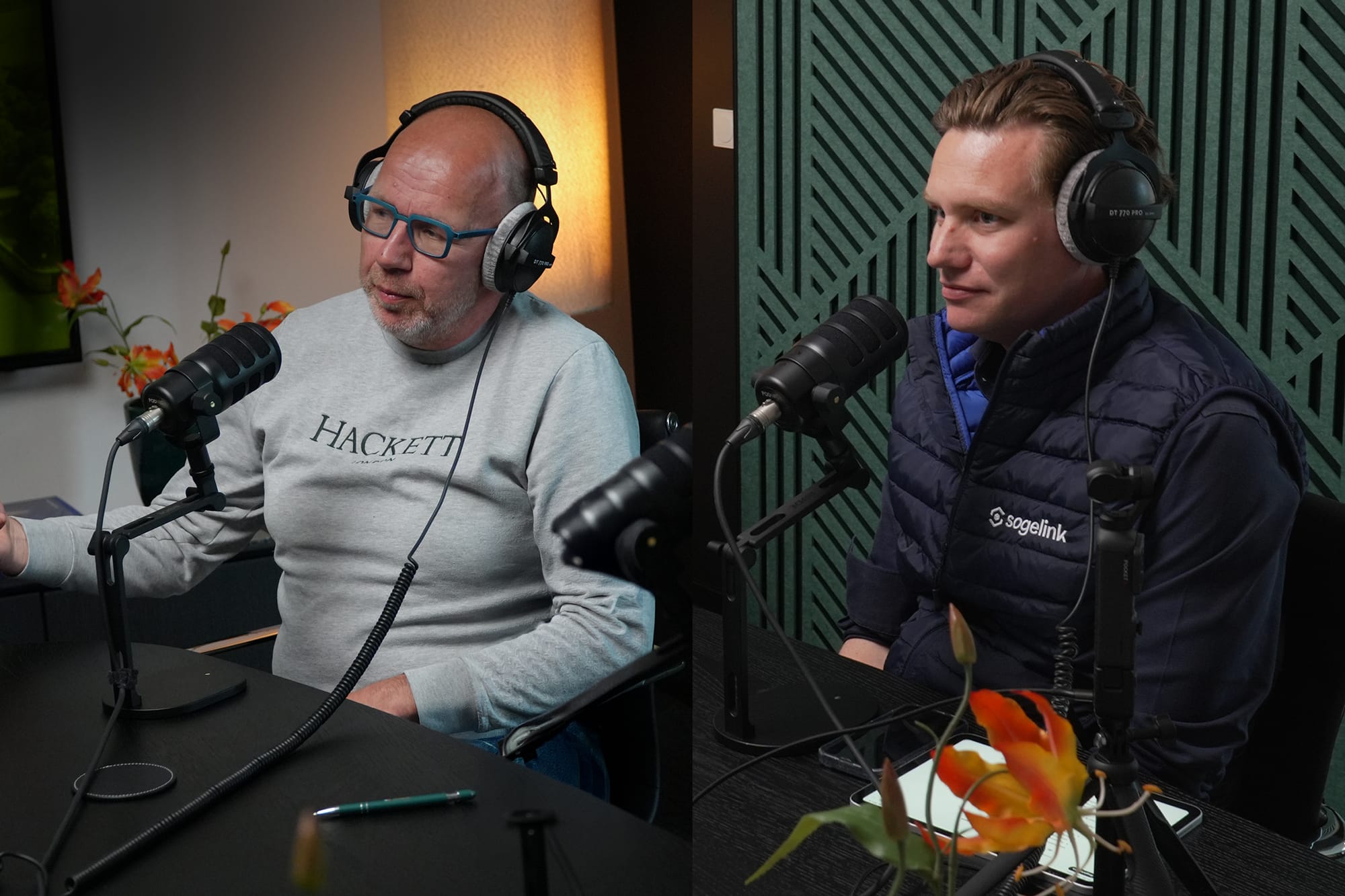
[00:18] Welcome to this episode of GWW-Bouwmat, the podcast. Today we highlight a topic crucial to the future of the Netherlands. Digitalization of underground infrastructure. Joining me at the table are two gentlemen from Sogelink.
[00:31] You know about the Klic App, among other things, a new solution. More on that later, of course. Peter and Victor, gentlemen, please introduce yourselves.
[00:41] Yes, thank you very much. Victor van Baal, Managing Director of Sogelink Netherlands. Since January of this year.
[00:50] Thank you.
[00:51] Peter van Dijk, Head of Product Netherlands. Worked in this field for almost 15 years.
[00:58] Look at this. Let's start at the macro level. First, why do we need to pay attention now to the Klic app, to your new solution? Why is that so important?
[01:09] Yes, it won't surprise you that we have to talk about the energy transition and all the challenges that that brings in the Netherlands. We are talking about a whole physical task, the aggravation of infrastructure.
[01:24] And there, of course, come all kinds of challenges that we often hear about in the news, along with everything that's going against in the country. People not being able to get connected, businesses not being able to expand themselves.
[01:39] And when you look at that interpretation, very often you look at the number of people we don't have to do the work. The number of transformer houses that need to be placed, which is way too slow.
[01:53] The permit application which is all slow. That's all true, just the digitization is often an under-reported issue.
[02:09] And also something I think we can be very proud of. Before this role, I worked in France and in the Netherlands on the same subject. If you see how it's done in other countries, we just have something that is very, very nice. Which is very, very well put together.
[02:22] So in the Netherlands things are actually going a little bit better than if you look in the surrounding countries.
[02:26] Definitely. We should be really proud of that. We have a lot of examples in our company, in my work, last two years, where I can present Holland as the click system that was built,
[02:41] so the whole database, that's progressive. And that's seen by the whole world as progressive. But then now with the energy transition, we have to take the next step in that. And that doesn't happen very often the
[02:57] footlights. We like to come and do that here. Okay, but the common thread is actually it has to be faster.
[03:02] It definitely needs to be faster yes. And Victor mentioned it, for example, I went to America last year on behalf of Socialink and to present what we are doing in Europe in this area, digitization and standardization of underground infrastructure.
[03:16] And then I explained both the French and the Dutch situation. And then when you talk about the Dutch, we are so far ahead. Only with the challenges we have, we have to go even faster. And that's not only with the capacity of our infrastructure, especially electricity,
[03:32] but also the water, because that's still something that's underexposed, but that's also undoubtedly going to play a much bigger role, is that the infrastructure needs to be expanded. And also renewed, because there are things lying around that are too old.
[03:47] And so then you have to standardize more. And what it's also about is that first time right. And that's where I think, as our company, we also have a proven track record over the last 15 to 20 years. We focus very much on that standardization, but also on that first time right. And you guys are familiar with the Klic app.
[04:06] You're also the Klic expert, I've just been told.
[04:10] Yeah, that's kind of how I'm classified, yeah. And yes, if you look at, you have two parts actually of the CLIC. You have the landowner side and the grid operator side. Because what it's about is that the grid operators are obviously the owners of the underground infrastructure. And the ground stirrer side, those are the ones who work on it. That can sometimes be the grid operators as well. And the Klic App is actually meant to provide that underground data that you get.
[04:38] To be consulted in a unified and easy way. And also on feedback where necessary. So that you can actually prevent excavation damage. And what we're going to expand on that of course.
[04:51] What we have actually been doing for years also for the home connections. Is that you have what you actually build. so in your new house connection, that you have it within 24 hours, as realized with all the data, also measured in, back to the grid operator.
[05:06] And then you get what is very important, what we call then a closed loop approach. So that flows back through the grid operator back to the land registry. And at the time you would actually reapply for the Klic an x-day, x-days later,
[05:20] then it's already in there. And that's going to be a reality soon for the new infrastructure, for the main grid.
[05:27] We'll get to that later, I think.
[05:28] We'll get to that later.
[05:30] Why is the subject now playing Victor?
[05:34] We always just call it the invisible delay. I was talking about the main points that are often in the news, but the data and the processes in this whole story, a piece of that peter told us that those also produce a lot of delay
[05:52] so without the good software and the good data flow you can't you can't scale up and so you can't accelerate you're going to make mistakes that that have to be fixed later what the net
[06:05] about about first time first time right you're talking about manual transfers between between between between between departments. So without that standardization it's not going to happen.
[06:15] And of course you also have the scale of energy transition of course. It's a lot,
[06:19] it comes together a lot. You're talking about a very large scale, an awful lot has to happen. And you have that standardization for that.
[06:30] What's very important there, too, is that it keeps the simplicity. Because there's a pressure on building that infrastructure and where you saw there was that in the past, and then it also has a piece of scalability to do, is that there was early to
[06:46] present actually the surveyors need to come in. Now the idea is actually, this is already kind of anticipating what we want to talk about more extensively later, but that those who build the infrastructure also directly measure and feed back and that there is also direct validation
[06:59] takes place in the field. Yes, and then you mean the NLCS++ as well? Yes, that is the NLCS++ standard in combination with what we then called the NLCS++ is the interchange standard and there is also a digital collaboration platform, the DSP, which from me is a connection and which has existed for years for the
[07:19] house connections is now also in production for in use for the main grid but there is no NLCS++ exchange yet but we are getting closer to that. And then it's very quickly what it what you actually built.
[07:34] That you can quickly deliver that back to the grid operator. The grid operator processes it. And it actually flows back into the Klic again. And with that you also have the closed looper there.
[07:43] Because that NLC++ is now in version 12 I believe?
[07:46] Yes, but make no mistake about it. It's not quite in production yet. Because you see some grid operators, three big grid operators for electricity and gas, that would be Stedin, Alliander and Annexes, they are the drivers in that.
[08:01] And that was in at the time actually with the home connections process. That that fast, that see the need that it has to go fast. Just what there is, is that you have to get a whole chain going.
[08:15] And that's quite a challenge internally for those parties. But that also means a big change for the ground operators, the contractors, as well. That's where we're going to help
[08:26] expediting that. Then we come to an interesting point. What is the role of the public parties,
[08:30] like the Land Registry for example? Yes, of course a very important one. I think mainly where we need as a market party is direction. That can be different parties, but certainly
[08:45] the Land Registry plays a very important role in that. The Netherlands is strong precisely because you have such good direction actually, at least you told. Yes. The Land Registry's Klic Database, for example, internationally it's well positioned, but...
[09:04] Well, what we do see is experiments from lots of parties and lots of different directions, also towards commercialization of public data there we wouldn't necessarily not
[09:19] necessarily be in favor not so much from their own interest but especially from that acceleration toward the market what we what we need is it your choice for everyone to make sure that you
[09:31] can choose between which solutions used yes and I think if you but that's also more from the role as as a taxpayer that you should each take your own role is make good stick to your last exactly and that we as as as a commercial party
[09:48] and in addition there are a lot more are positioned to be on top of what is being built and what is being made by public parties can make software that the that the
[10:01] market further helps what you see with that is it's about governance of course in fact and that with standardization and certainly if you want to roll that out broadly it's important that it's managed by an independent party. And in this case that is there is such a party in the domain and that is
[10:18] the DSP-MA, my connections and it's also moving in that direction that they have the full governance
[10:26] about it. And then if we zoom in to the market, what specifically is going on in the market? An awful lot of demand for work. All of our customers say we have an order book for the next few years, but not the people.
[10:43] The concrete question is always how can I do more work with the same or fewer people. How can I work smarter?
[10:55] There's also a huge demand for simplicity, that it's easier, I think of. Or what you say, working smarter.
[11:00] Yes, so our customers who work in the field, they didn't necessarily go into that work because they love working with software.
[11:09] No, I understand.
[11:10] Or keeping track of forms. Or making sure that layouts are measured properly. They want to get concrete. So where our role is, is to make sure that we make software
[11:24] that helps them do that work. I mentioned that earlier, the simplicity as well.
[11:31] There are often, I get that comment internally too, it looks so simple, why did it take so much time? I say yes, because in the end it's something to make something very simple, sometimes it takes a lot of time. And there we have also over the years, because we have been in this domain for a long time and serve a lot of ground routes with this,
[11:52] there really I think also a very good solution to that. And we're building on that. And there you can still see that that's a challenge for some parties. Because just not only the parties possibly competitors, but also just for the contractors to make the right choices in that.
[12:12] And we are actually always the parties there that of course follow them as well,
[12:17] but who also advises them. But then let's make it concrete for a moment. When will Sojalink
[12:25] The Netherlands in the picture? We are already very much in the picture. It's not a question of are we coming into the picture or are we going to get started. When we talk specifically about this solution, which we are launching in the next
[12:38] month. You're talking now about registration to the slot. Registration at the slot. Yes, and maybe you could also introduce Socialink Netherlands. Because it may not be a familiar name to everybody yet.
[12:47] Yes, in the meantime I think we have. So we've done a lot of it, of course. But Socialink consists of two established names in the Dutch market. GoConnected and Geodan.
[13:00] And we brought those together in the group. And we help construction and infra contractors with exactly that. Working smarter with good software.
[13:12] And people obviously know you from the Klic App.
[13:16] Yes, and we also have a big business that does permit management. So that's where the municipalities are our customer.
[13:23] So you guys are also much more broadly active still.
[13:25] Sure.
[13:27] And then your new solution does indeed come into view. Registration at the slot.
[13:33] Yes, that's really just a logical extension of what we already do. We provide in the field, or yes not only in the field, but also office in work preparation, a piece for the applicant of the Klic report. Well, you have to have that data with you on the
[13:48] underground information because that is required by law. What we have been adding to that for years is the process for the home connections which is digitized which has also been working successfully for ten years and
[14:03] now it's actually going to do the same thing we're going to do it in a big way again but for it for the main grid yes and and and so there's what I said earlier that standardization of the and if you stuffst the exchange model and that's integrated into our Klic App and and also our us
[14:19] office part so in our case it doesn't mean separate tooling or whatever. It's really nothing but adding some extra functionality and therefore value for our customers in an already existing app that's already rolled out
[14:34] is. Okay, so for the customers little changes in that sense. A lot of course, a lot more efficient.
[14:41] But we offer more than there was before. Actually with the basis remains the same. And also based on the same, yes, one can expect that to be in accordance with the quality that we have been providing for years.
[14:55] And in that, too, we proved ourselves.
[14:57] And contractors can then digitally register the main grid during implementation?
[15:03] Yes, but what is still an important aspect there is that the main grid is neatly designed. So the things that are already designed, those also go with it to the field.n what you then get your own in the field is that you take that is a final design that you end up taking those to the field and that you
[15:26] which can adjust and nagang how that really that councils yes the overhaul the s-image yes and also can be easily delivered back and what is also important main grid you don't build in a day that are
[15:39] long-term projects so what you can then also do a do is, that's what the process is also in, that you can deliver in partial reviews. So that you can also do your settlement on partial revisions.
[15:52] And so that the contractor also gets paid earlier. And what makes this solution unique? I think it is,
[15:57] yes, what makes it unique, what I said before, that it's an addition to an existing app, which has already been rolled out more broadly, with an existing office part, which the customers are also familiar with. I think that brings the uniqueness and also it's not an aggregation of, say
[16:15] external GIS tooling. You see that with other solutions. We have complete control over this piece from start to finish. What also makes it attractive to contractors is that it actually builds on also
[16:31] integrations that they already know with our existing external integrations through our API. We also try to minimize the impact on our contractors, customers.
[16:43] And is that solution already working at scale?
[16:46] We are going to run the first pilots in June. And then there will undoubtedly be improvements to be made in them. But what we also see is that this whole piece is not yet in production.
[17:04] Because the grid operators are preparing to be ready. They have their own roadmaps for that. And it will have to take off, but I expect that once it's up and running, it will be very fast.
[17:17] But those pilots that are coming, then?
[17:19] Those pilots are coming, yes. That's where we're in discussions with contractors, already existing customers, to start rigging those pilots. And then also in collaboration with the grid operator to start running this.
[17:31] And here again the role of standardization. So it has to stop changing at some point, that standard. Only then can you really get on to scale. So the moment that stands, then you will start to see that acceleration. And if you can then
[17:48] To summarize, why does this solution make a difference? Specifically, it delivers,
[17:55] faster turnaround times, faster felling costs. What I think actually always is that the person who builds the infrastructure so, yes that they are also directly actually doing the work of the surveyor who came in the past.
[18:09] And so you see that even with the house connection already. That's where a surveyor used to come and the person who does it is not a surveyor later on, but has a surveyor, uses surveyor, surveying to record it. And that's kind of the challenge again to make that as simple as possible
[18:27] because it is someone who builds infrastructure and not a surveyor. I understand that you
[18:33] registration to the trench already going to present the solution as such at InfraNext? True yes, I gave
[18:39] the surprise already gone for a while, but that's right. We have been very excited about InfraNext from the beginning, expect a lot from it, so this is a great moment. And what can visitors there expect a lot from it. So this is a great moment.
[18:51] And what can visitors expect there then?
[18:53] We are there, we are there, we are showing what we have made. And we actually expect a lot of our customers to be there. And that we can go and show this.
[19:08] And then if we look a little further toward the future. What is the roadmap? Where are you guys going?
[19:14] Where is the solution evolving? We focus on making all the processes within construction and infrastructure simpler. The whole, as you call it in software terms, value chain of that construction process, we want to be able to serve that.
[19:33] Now we have a piece of that with our solutions. And we look in both directions, both maintenance and management and making, designing.
[19:45] What else can we offer in that?
[19:49] And then when you talk about innovation, is that you also talk about the Klic App, for example, which is viewing underground information. Well, you'll soon be able to do the recording of new construction infrastructure in that as well. One of the extensions we're also doing is that soon you'll be able to view the Klic in augmented reality.
[20:06] We already have a version of that available in itself, but that so you can see in the camera view of your mobile device where the cables and pipes are. The next step is, in that registration to the trench, we still choose the traditional approach with high-accuracy GPS surveying for now.
[20:23] Over time, that's what we're going to invest in as well, is that so you can actually do point cloud scanning with LiDAR, what your phone has, and so you can actually do the object recognition and in measurement based on your point cloud. We are not there today, we are not there tomorrow, but we will be there in x period of time.
[20:40] And then you can also at the time you've done that point cloud scanning, you can in combination with that augmented reality, if you then actually visualize that image and you get to a place where you've done point cloud scanning at some point in the past, you can actually look directly into the subsurface.
[20:55] Because then you get that information back.
[20:57] So will I soon see someone in a slot wearing smart glasses?
[20:59] That could also be eventually, but the moment it's a trench, then you can actually see there already. It should actually be at the moment that you're actually walking down the road, that you're so and just based on the Qlik data it's visualized, but at the moment that actually everything in the
[21:13] past in point cloud is established, that you can really actually look into the subsurface.
[21:19] Yes and one more addition to that very concretely, expecting in the in the Klic have more data layers more map layers is something we are working hard on and also in the netherlands anticipating is around previous
[21:34] week on the lekdijk on a project together with an american that I could tell them very clearly of your here has happened a lot in history and we have all that archaeological data that goes
[21:45] get into the Klic App to make sure that so you know where explosives might be. That you know where archaeological remains are. That's where we're really ahead. That probably surprises. Absolutely.
[21:58] And there as an extension by on, the registration at the trench is of course mainly about at the trench. But what you see with the laws and regulations, that it's becoming more and more important, that you also, that's actually already now, that you do soil testing the is the soil possibly contaminated well then we also offer
[22:16] opportunities to request that kind of information directly in our portal but also about soon we are going to add information about tree roots tree roots are a threat to cables
[22:28] and pipelines where trees we also need also forwege the energy transition you can also turn it the other way is that you actually where are you going to plant trees later and that you're not going to threaten cables and pipelines. So things like that
[22:39] we're going to add more and more. So it's getting more and more complete? More and more complete and it's almost a one-stop shop where everything is integrated. So that you have different data sources in an intelligent way
[22:52] used, so you can do a good risk analysis and inventory. Which is also becoming more and more important. And as a user
[23:00] you don't have to be a computer scholar, I suppose, because all ... No, because that's
[23:04] is what you see on a regular basis anyway. There's a lot of what you then call GIS, geographic information systems, technology behind it. You use those, but you don't have to be, to operate all this, you don't have to be GIS experts. That's not going to work.
[23:20] It remains intuitive, user-friendly. Yes. And if it summarizes, where but as a sector,
[23:28] what should we focus on next? Well, I think there are a lot of things have already come up in this story make sure that we tackle that big societal approach together that both public and private parties pull together by
[23:45] investing in innovation make sure that we don't let ourselves be fooled by everything the marketing stories around egg tell us and so make sure that also stay realistic about how software is built.
[24:01] How stable software is built. I think that's a very important one and also a role that maybe I can play a role in myself. And making sure that people stay realistic about that in the marketplace. While I do see how that can also make it faster.
[24:15] But it also has to be stable faster. So those are just some of the points that we have to deal with in the coming time.
[24:24] And accelerating standardization, too, of course.
[24:26] Which has been mentioned.
[24:27] That one was mentioned, yes. Finally, your message?
[24:33] Well, I'm not much for shopping honestly. Advice? Yeah, no. Look, we have a very clear plan. We know what we want, we know who we are and
[24:46] work with a lot of energy every day with a great group of people. I think the main message for this listener, for this audience, is, hey, there's already a lot going well in the Netherlands. And we know and we see and we know from the past
[25:03] where things could be even better. But above all, let's also keep that pride in how well things are going, how well the whole system is put together. Yes, well, and complementary to that, and that's
[25:16] well maybe a bit of a message, is I think we are not proud enough of what we have already achieved in the Netherlands with that. I notice that myself. Does so myself.
[25:25] There is a lot of complaining.
[25:26] There's a lot of complaining, but that's kind of part of it. And we should be a little more proud of how it's all arranged in this little country. With so many people and so much underground infrastructure.
[25:39] Look at that, super. Well, thank you guys for this insight. Your coming to the studio here. Thanks for listening to this podcast from GWW Bouwmat. Live from the studio, Louwers Mediagroep in Weert.