Platform on civil engineering, underground infrastructure, energy, construction equipment & construction machinery

Hydraulic engineering has played a major role in shaping the Netherlands as we know it today—and will continue to do so tomorrow. After all, our country was formed by water, but it must also be constantly protected from it. Dry feet have never been a given here, which makes the sector indispensable for the future. Dick van Aalsburg experiences this in practice every day. Together with his five brothers, he runs the family business that once started as a traditional osier trade but has now become a modern hydraulic engineering company with a natural mission.
“Hydraulic engineering is undergoing rapid change,” says Van Aalsburg. “With the increasing focus on climate adaptation and ecological restoration, there is also a growing need for natural materials and smart implementation methods. Clients are increasingly open to natural and circular solutions. Ten years ago, people were surprised when we proposed willow wood constructions; now, just like 100 years ago, it is much more widely embraced and used.”
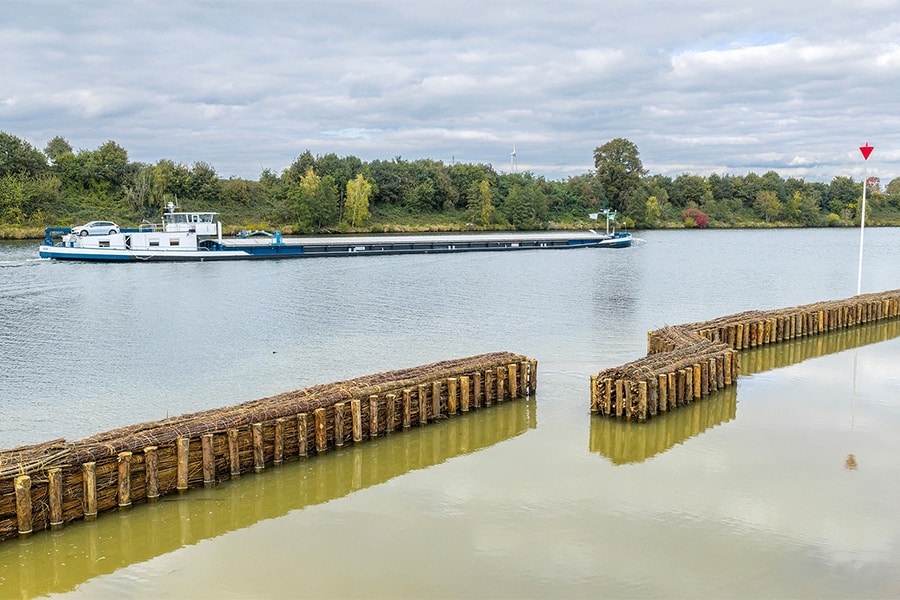
Van Aalsburg works—also internationally—on soil and bank protection for rivers, lakes, and coastlines. According to him, there is an increasing demand for an integrated approach to biodiversity and water quality. “Natural products and traditional Dutch constructions are once again being seen as serious solutions to these kinds of issues: we are rediscovering what has always worked well.”
Nevertheless, Van Aalsburg also sees challenges. According to him, the implementation of the many WFD measures requires realism and speed. “These are major tasks that are now entering the market. The trick is to realize them within the frameworks and timelines, without getting bogged down in procedures, permit processes, or lengthy investigations. A pragmatic approach and good coordination with the right parties are crucial. If we work more alongside each other instead of after each other, we will gain valuable time.”
At Van Aalsburg, innovation is not only found in materials, but also in working methods. Electrification and robotization make the craft lighter and safer. “We combine traditional knotting with modern techniques such as automated whipping and mowing machines and smart winches, which allow us to preserve the craft while bringing it into the modern age.” Experiments are also being conducted at the material level. Jute and wool are natural alternatives to geotextiles; already successful underwater, but still under development above water.
As a member of the Dutch Association of Hydraulic Engineers, Van Aalsburg contributes to knowledge sharing within the sector. “We demonstrate that natural materials can be fully-fledged solutions and benefit from the knowledge of others, for example in terms of regulations or new techniques.”
According to him, the biggest challenge for the coming years lies in the recognition of willow within technical standards. “There are clear calculation models for steel and concrete, but not yet for willow. That is why we are collecting data together with knowledge partners to demonstrate the performance of our structures. In doing so, we are not only helping ourselves, but the entire hydraulic engineering sector.”
Neem dan rechtstreeks contact op met Van Aalsburg BV.
 Contact opnemen
Van Aalsburg BV is the brushwood trade, in which the craft of the brushworker has been passed on from father to son(s). By now it has grown into a family business with 6 brothers. Renowned in the Netherlands, but also abroad for its knowledge and experience in the field of zinc pieces, corbels and wattles in particular.In addition, Van Aalsburg BV provides braided willow [...]
Bekijk Bedrijfsprofiel