Platform on civil engineering, underground infrastructure, energy, construction equipment & construction machinery
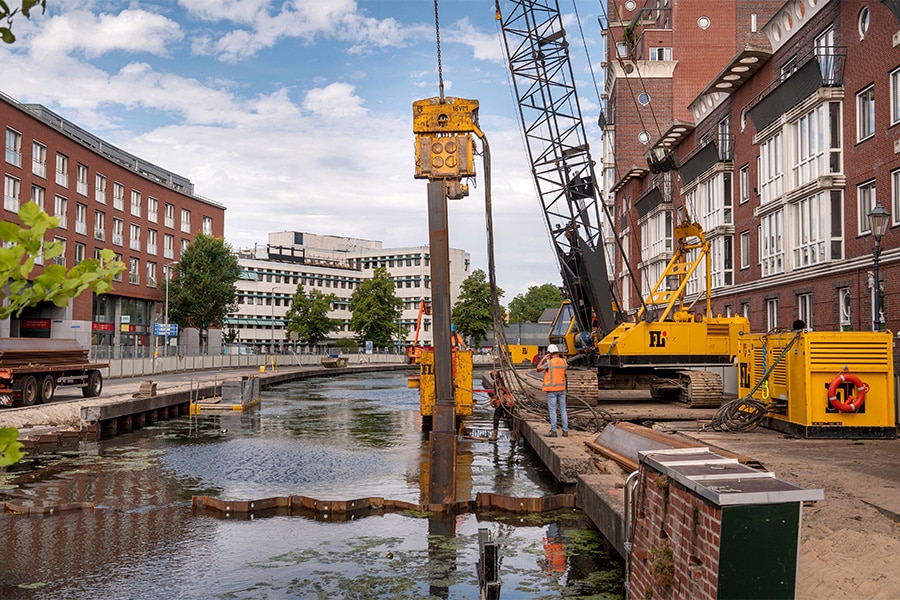
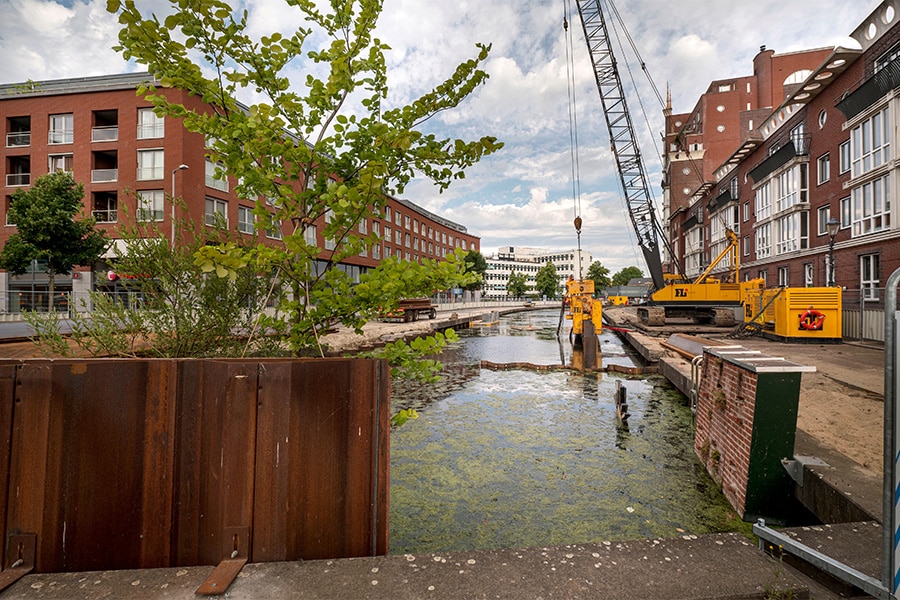
The Nieuwe Mark flows through Breda's inner city again. The banks of the city river consist of nature-friendly quays and there is a new Toll Bridge leading pedestrians and cyclists across the water. Main contractor FL BV (part of the Reyrink Group) delivered the work in June 2025, after implementation in three phases since 2022. The project combined Champions League-level civil engineering with urban logistics, nature-inclusive construction and a constantly changing scope. A story about how FL BV brought back a city river in the heart of Breda - with green quays, a new Toll Bridge and a construction team that made a difference under high pressure.
"We were just getting started and then prices shot up because of the war in Ukraine. That immediately required mature consultation with the client," Gert van Dieren, director of projects at FL BV kicks off the conversation. "On top of that, many technical details changed during construction. It demanded maximum flexibility from everyone in the construction team."
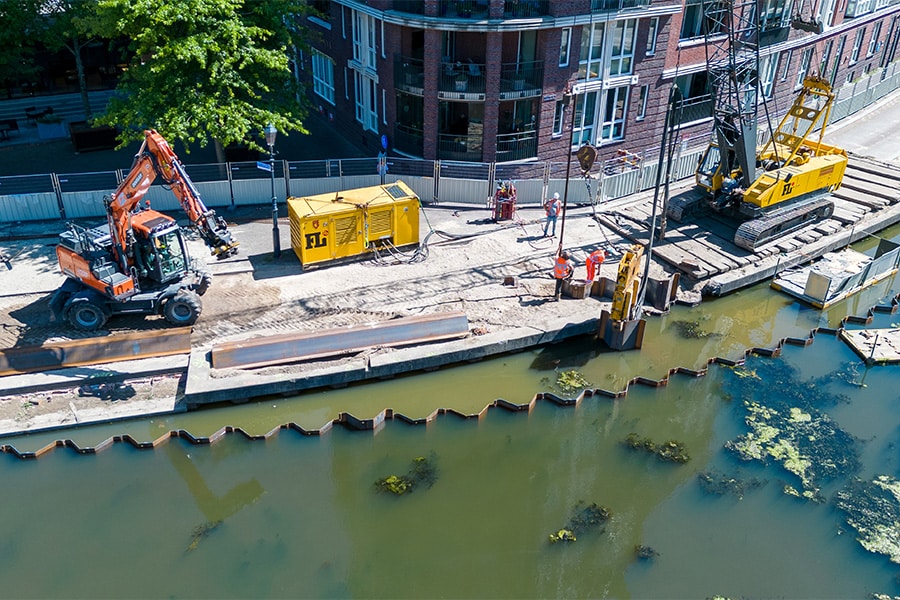
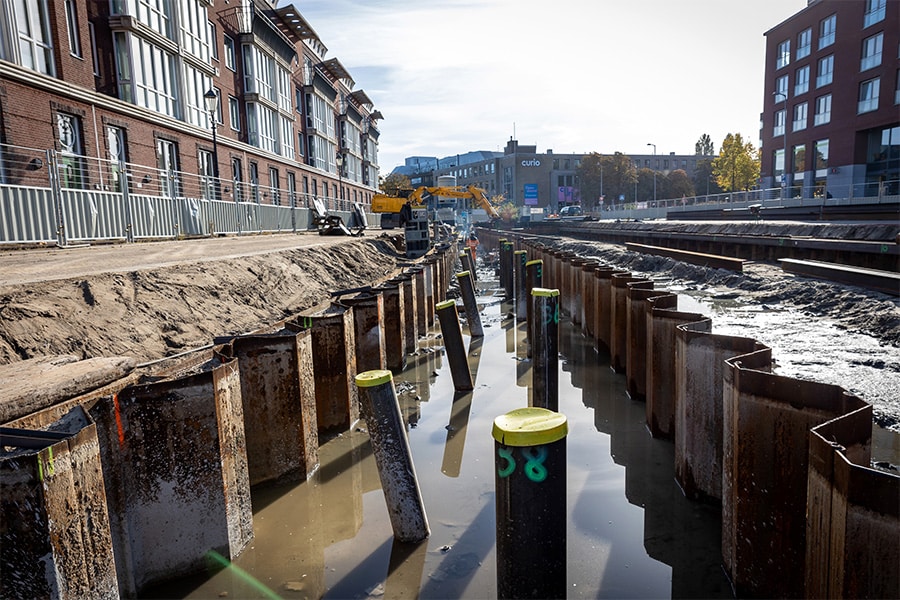
The new waterway is therefore much more than a cosmetic intervention, but a complicated civil work that was constructed in phases in a construction pit of about 2,800 m², including underwater concrete floor 60 centimeters thick. 2,125 m³ of concrete mortar and 2,170 tons of gravel went in, with 1,500 m³ of dry earthmoving and 11,500 m³ of wet dredging. Methods used for the tub included 120 meters of sheet piling, an outrigger frame up to 18 meters in length and 85 screw injection piles. During the work, FL also constructed a 15-meter temporary pedestrian bridge to keep the downtown accessible. "Working half a meter from monumental buildings, with shoppers around you and a tight window for nuisance: that really is millimeter work," Van Dieren said.
A striking feature is the nature-inclusive quay (GreenQuays): quay walls that provide space for trees, wall plants and mosses. Together with knowledge partners, the municipality mapped the preconditions; FL translated them into feasible details, sequences and tools. For example, the contractor developed its own piece of equipment to apply the substrate between the concrete and masonry in a controlled manner; crucial for the root volume and moisture balance behind the sight wall.
Tijn Boons, work planner at FL BV: "On paper such a quay looks logical, but you only really learn when you have to get the cavity, substrate and water management right on site. We iteratively detailed, tested and adjusted; always with safety and the monumental character of the inner city in mind."
The quay construction included 455 meters of in-situ poured walls up to 3 meters high, a 400 m² concrete deck on piles, and a substantial masonry task: 1,550 m² of vertical masonry (approximately 233,000 bricks) plus 710 m² of horizontal masonry (approximately 58,000 bricks).
The paving consisted of 1,700 m² of asphalt, 2,800 m² of paving brick and 1,700 m² of natural stone.
The new Toll Bridge was technically and organizationally the most difficult part. The design and execution were worked out in a construction team with the municipality of Breda and Ingenieursbureau Rotterdam, because the work had to take place literally half a meter from a monument, in soil full of foundation remains of old bridges (masonry, natural stone). Low-vibration demolition and foundations were preconditions.
Van Dieren: "Building so close to monuments and hoisting a bridge in the meantime: you want to understand every detail in advance and still remain alert during the work. The construction team gave us room to choose smart, low-vibration methods."
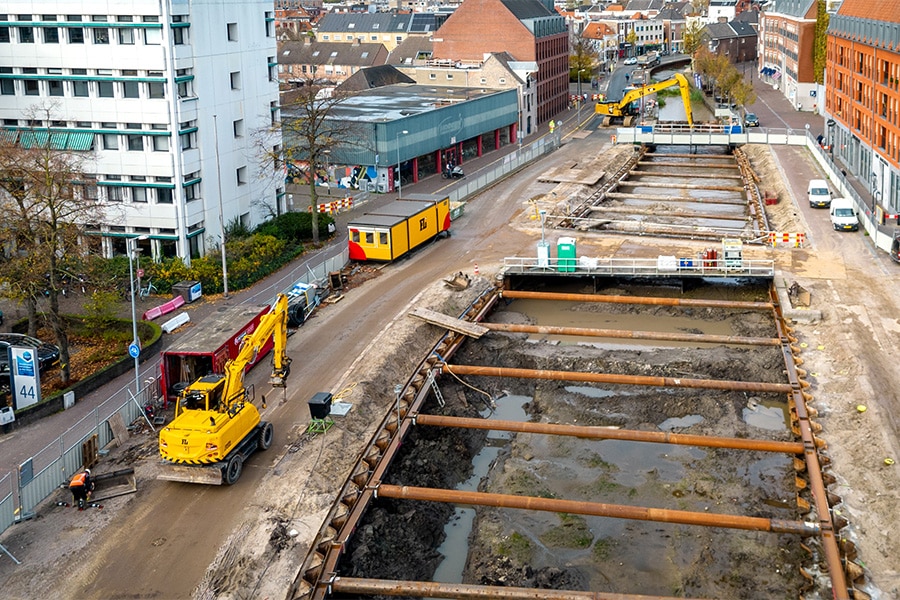
For Boons, The New Mark was his baptism of fire. "I just came from college and immediately got a job like this. That sounds intense, but the confidence worked motivating. You grow hard when you have to interact from day one with designers, local residents, suppliers and the execution crew." He credits the combination of urban environmental safety, logistics (tight windows, detour), changing details and securing quality in new solutions as his most important learning experience.
"You learn that good work preparation is not a one-time document, but an ongoing process," says Boons. "Especially with nature-inclusive quays: detail, sequence, materials, monitoring; it all intertwines."
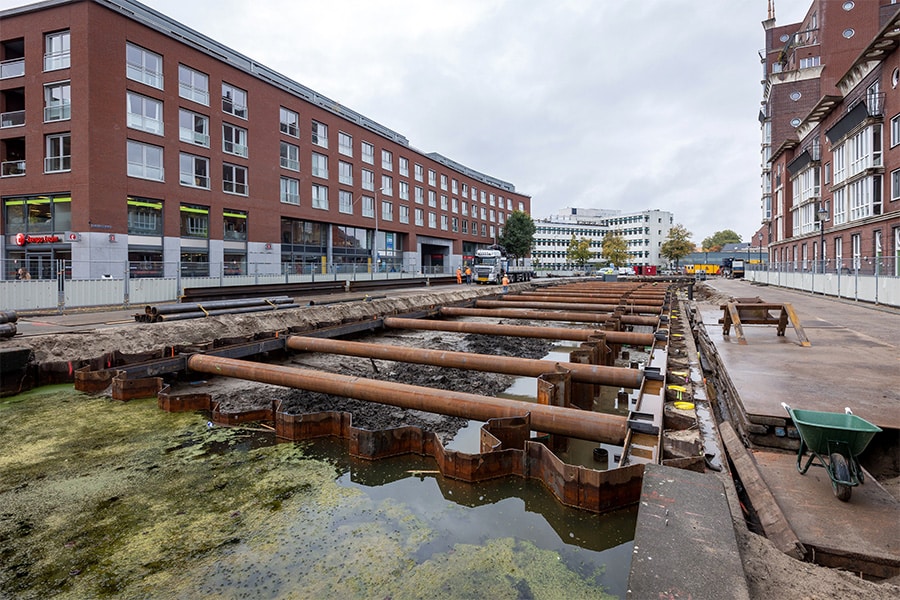
Implementation proceeded in three distinct phases with each phase having its own environmental measures and detour. Van Dieren: "The key was trust. Instead of legally cramping when something changed, we sat down with the municipality and looked for a makeable variant that met the ambitions."
The project ties into the municipality's GreenQuays program, in which research from government, water board, universities and nature organizations has been translated into feasible quay concepts. FL contributed with detailed design, work sequencing and practical tooling (the substrate device) to put the research findings into practice.
Engineering in key facts:
- Low-vibration demolition of the existing bridge deck: 50-centimeter-thick concrete floor with 15 pieces of steel HEB500 girders.
- New abutments: 2 bored pile walls with a total of 32 Ø800 mm piles (lengths alternating between 6 and 14 meters), supplemented by 4 pieces of HEM360 and 11 pieces of HEB400 as reinforcement and 6 SI anchors per abutment.
- Abutments were given a 1.0 × 1.5 meter concrete slab and walls 4.5 meters high; built in phases.
- Bridge deck: prefabricated steel, approximately 14 tons.
- Circular detail: application of masonry bricks that reused 24,190 kg of material.
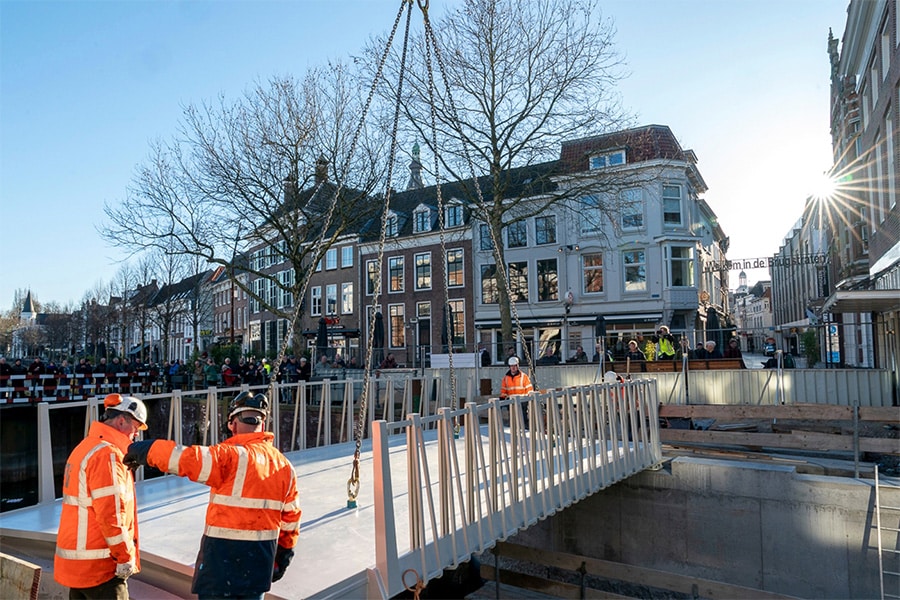
"We ended up having to put money on it," Van Dieren says soberly. "But when you walk along the wharf today, you see why we're in this business. The river is back, the city has added quality, and together we have built something everyone can be proud of."
That pride is not just emotional. The New Mark provided concrete lessons: early involvement in construction teams, iterative detailing for innovative elements (such as the green quay), realistic city logistics, and clear decision routes when the scope changes. Van Dieren: "If there is a follow-up phase, we are happy to tender; with an even sharper plan on vibration control, monitoring and prefab where possible."
"The New Mark shows that innovative and engineerable is not a contradiction," Van Dieren concludes. "If you know each other's interests and keep the conversation open, you can bring back a river even in the most sensitive inner city situation."