Platform on civil engineering, underground infrastructure, energy, construction equipment & construction machinery
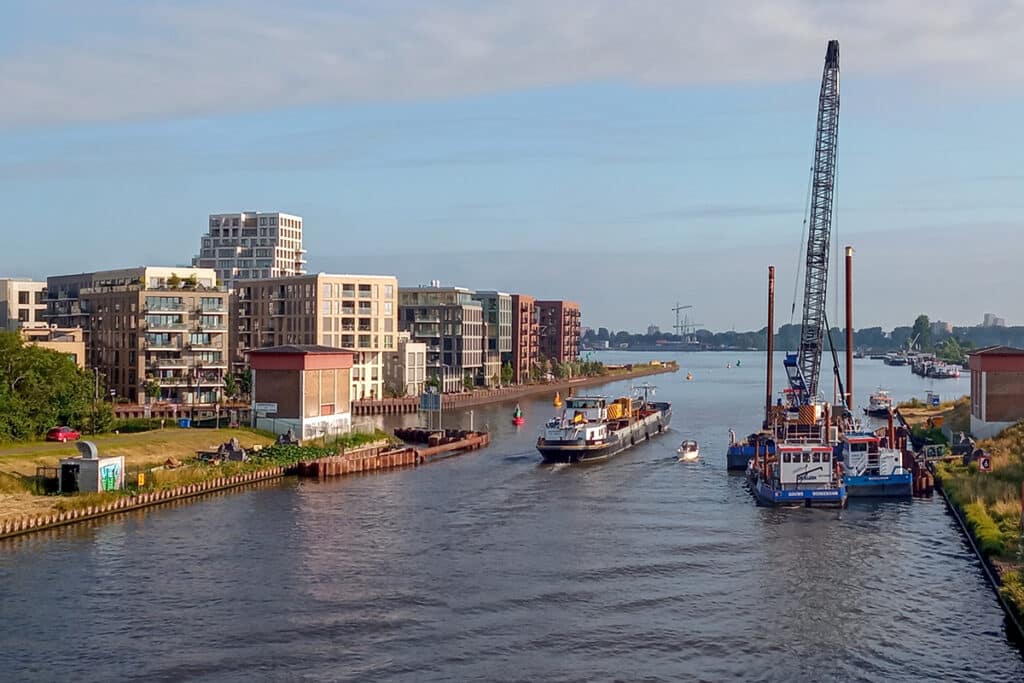
New collision protection for Zeeburg siphons
Under the Amsterdam-Rhine Canal are the siphons of Pumping Station Zeeburg, which play a crucial role in the water management of Amsterdam's inner city. These siphons are relatively shallow and even rise above the canal bottom at the edge of the canal. Therefore, collision protection is essential here to ensure Amsterdam's water safety. BT Engineering was engaged to provide sustainable and future-proof protection for the siphons.
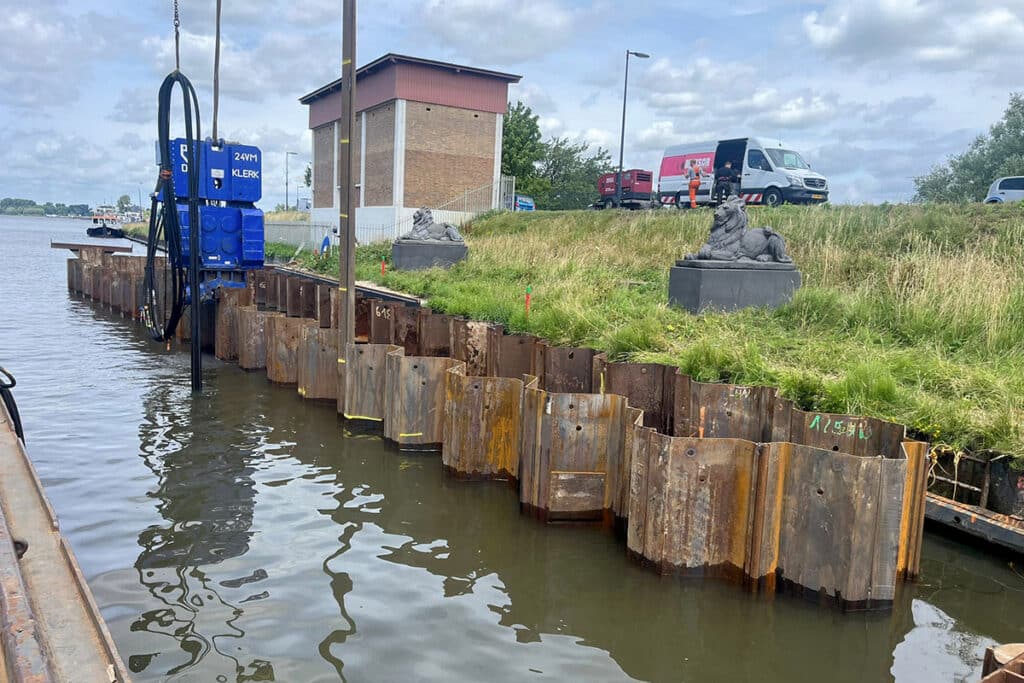
Waterschap Amstel, Gooi en Vecht, the manager of the siphons, wanted a robust solution to protect them from collisions. In the old situation, the siphons were protected only by a number of signaling posts, some of which were already no longer present. “With the growth of shipping and larger vessel sizes, the question arose as to whether the existing situation was still safe,” says Sytse Alkema of BT Engineering. “A collision could have drastic consequences for the water level in the city. At the request of the water board, we initially conducted several conditioning studies and a variants study into the most promising solution to protect the siphons.”
In that first phase, the situation, risks and needs were extensively surveyed. “Three variants were investigated: a classic retaining structure with steel tubes, covering the area with bulk rock, and making cofferdams filled with soil,” Alkema explains. “In doing so, we looked not only at technical performance, but also at feasibility, sustainability and future developments such as a possible widening of the Amsterdam-Rhine Canal, where the new approach protection can be dismantled and reused.”
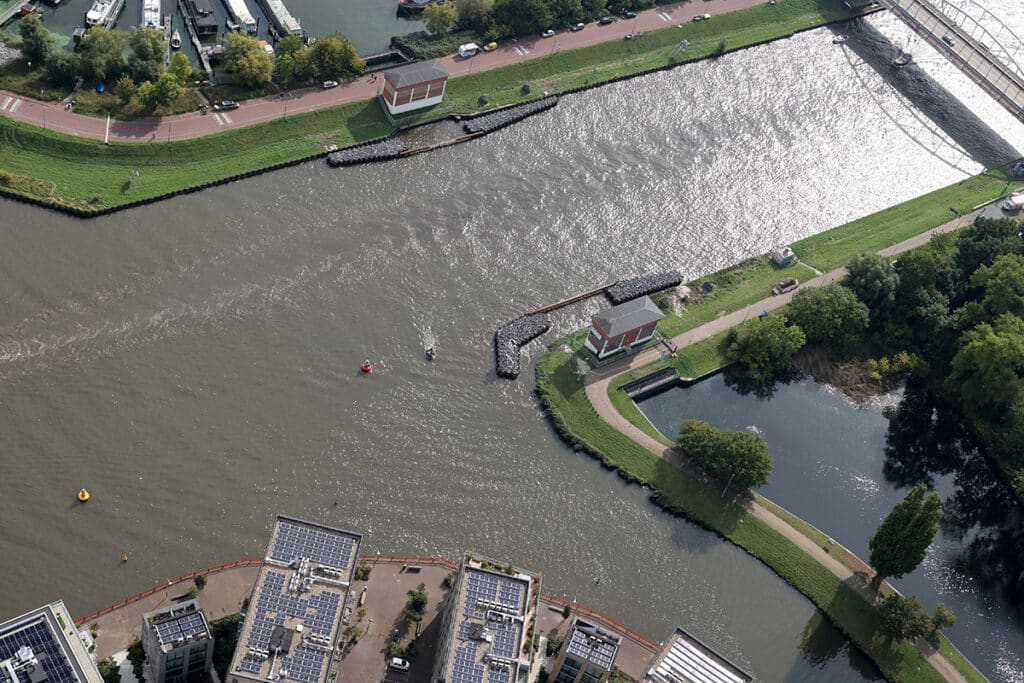
The choice eventually fell on a system of four steel cofferdams, says Bart van Langevelde of BT Engineering. “This construction offers an optimal balance: sufficiently robust to absorb collision energy, but not so rigid that ships suffer too severe damage in the event of a collision. Moreover, the components of the structure can be reused in the future, should the canal be widened in the future.” Circular construction thus played a major role: about 95% of the steel can be reclaimed later.
According to Alkema, there was quite a bit of innovation in terms of calculation methodology. 3D calculation models, deformation analysis and energy calculations made it possible to optimize the design without overdimensioning. “For example, we used Plaxis 3D to estimate the deformation of the structure at a certain impact. This was used to calculate the energy absorption and to calculate what the cofferdam structures could withstand. These consist of a steel sheet pile wall with a purlin and anchors behind it and are filled with sand and poured stone on top. Where the siphons themselves are, you cannot install sheet piling. The cofferdams are connected with a steel pipe that also functions as guide work.”
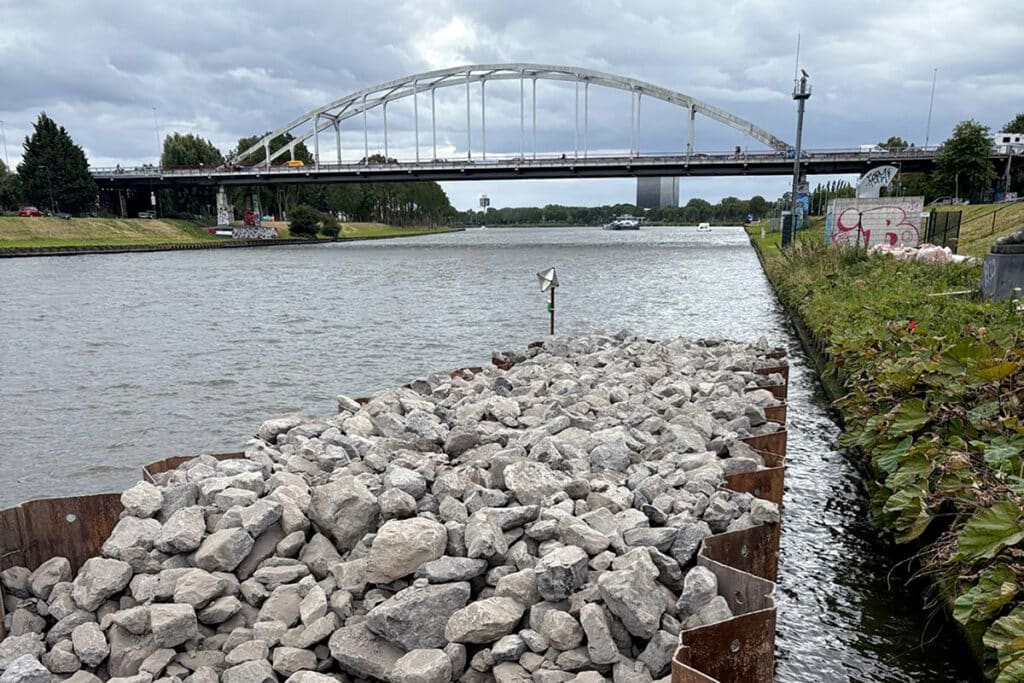
BT Engineering considered the manufacturability of the design at an early stage, according to Van Langevelde. “As soon as the contractor was connected, we discussed and coordinated that down to the detail level.” Alkema adds: “That's where we make a difference. Including the feasibility of the design throughout the process. Especially with these kinds of tasks that become quite quickly technical in design, that is very important.” During preparation, an old pile foundation hidden in the ground was unexpectedly discovered. “Even then we are able to move quickly. In a construction team with Waterschap Amstel, Gooi and Vecht and performing contractor De Klerk Werkendam, solutions were quickly and efficiently coordinated.”
According to Van Langevelde, the project reflects the development of BT Engineering, which recently adopted this new name. “We are originally geotechnically oriented, but in recent years have opted for a wider range of expertise: structural engineers, modelers, pipeline engineers and hydrologists. By broadening our areas of expertise, we are now able to take on this type of project from A to Z in an integrated way. From variant study to execution and delivery, we are involved in all phases.”
Neem dan rechtstreeks contact op met BT Engineering.
 Contact opnemen
BT Engineering combines engineering, sustainability and customer focus to create reliable solutions for today's and tomorrow's challenges. At BT Engineering we believe that technical innovation, sustainable solutions and customer-oriented cooperation go hand in hand. We combine our deep knowledge of the civil engineering onshore and offshore world with a future-oriented approach, always tailored to the needs [...]
Bekijk Bedrijfsprofiel