Platform on civil engineering, underground infrastructure, energy, construction equipment & construction machinery

In April last year, one of the six mega-pumps (with a capacity of 50 cubic meters per second) at IJmuiden pumping station gave up the ghost, and the condition of a second pump turned out to be not too good either. Overhauling both pumps would take at least a year. To deal with the loss of capacity, an emergency installation was installed with a whole battery of pumps fed by diesel generators. Thanks to a temporary high voltage installation by Bredenoord, the generator sets could be placed remotely, so that the adjacent residential area was not bothered by noise and exhaust fumes.
Pumping Station IJmuiden is the largest pumping station in Europe and capable of discharging as much as 260,000 liters of water per second from the North Sea Canal into the sea. “In the storm season, during high tide and inland winds, the locks close and the pumping station pumps the water over the locks, keeping the Westland dry feet,” says Gert-Jan Elfrink of Bredenoord. “To take over the function of the two faulty pumps, Van der Kamp has built an emergency installation at two locations, both with a pumping capacity of 36,000 liters of water per second.”
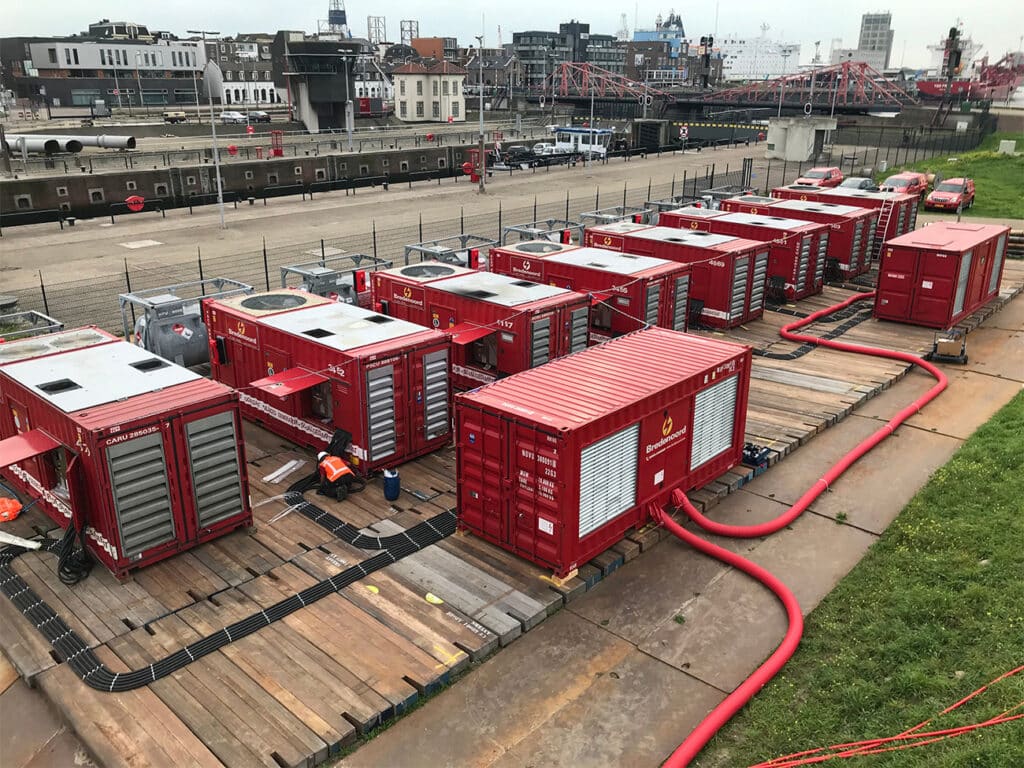
The pumps in the emergency installation are driven by electric motors. Elfrink: “Initially, the idea was to place diesel-driven generators right next to these pump sets. Given the required power of 8 MW, that would cause a lot of nuisance to the adjacent residential area in the form of noise and exhaust fumes. The only solution was to move the siding of the generator sets. This did imply that the 8 MW capacity would have to cover a greater distance of some 400 meters. The package of copper required for that, quite apart from whether it would be desirable, would then be prohibitively expensive. To avoid that, the solution was found in high voltage. For, the higher the voltage, the lower the current. Via transformers the voltage is raised from 400 V to 22,000 volts and then 400 meters away at the pumps the voltage is brought back to 400 volts via transformers.” The high-voltage cable was moved through the air via a scaffolding structure at a height of 5 meters. “We also looked at handling it in the ground, but it was already too ‘busy’ there. Through the air turned out to be the safest solution.”
The emergency facility operated for over six months, from October 2020 to June 2021 to be exact. During that time, both pumps from the pumping station in England were overhauled and reinstalled in the IJmuiden pumping station.
Bredenoord is a well-known player in emergency power and has become big in well drilling. “We rent out generators from small to large in all possible variations on diesel, hydrogen, gas or electro. Thanks to a specific exhaust gas cleaning system in combination with a battery supply, we are even able to generate power in Natura 2000 areas under strict environmental requirements,” Elfrink concludes.