Platform on civil engineering, underground infrastructure, energy, construction equipment & construction machinery

In the parking lot of one passenger car, treat the wastewater of 16 people? It seems like science fiction, but recently just became reality. The Phytoparking is an innovation from Rietland, with support from Argex. The expanded clay pellets manufacturer ran a pilot project last year. Because of the promising results, this new approach suddenly opens a lot of perspectives for both companies. Argex is mainly known from earthworks, civil engineering and road construction. With the development of Phytoparking, the company is proving to be innovative and not standing still.
Rietland has long specialized in the construction of (aerated) reed beds. In the brain of Dion van Oirschot, the idea of a new sustainable application matured in recent years. "The results of a recent German study set me thinking. After all, their research showed that an aerated system without reeds performed at least as well as an aerated reed field. When I later looked up more information on grass dales, I thought it would be valuable to investigate to what extent the combination of grass vegetation with an aerated system would offer new possibilities."
Pilot project
Van Oirschot, Jean-Paul Dues and Pieter D'hont (the latter two working as sales managers at Argex) put their heads together. For years, Argex has supplied the well-known expanded granules that form part of the substrate for aerated reed beds. The company was interested in the idea and decided to participate in a pilot project.
"In May 2017, we started work where we installed a water treatment system under two parking lots," hooks Pieter D'hont. "The parking lots will have natural vegetation with grass. Underneath are the pipes and the actual purification system. The biggest challenge was properly balancing the pressure distribution layer to stabilize the lower layers."
Dry period
During the testing phase, one of the important things was to be able to test the load-bearing capacity of the system so that passenger cars could be parked on it without problems. Soon the partners arrived at the right composition. "During the construction of the parking lots it was a dry period, so we immediately had to anticipate another pain point," continues Dion van Oirschot. "Especially during such a period, it is important to water the grass so that it can take root. If you don't do that, the grass withers. It was useful to be able to respond to that problem right away."
The treatment method of the Phytoparking is largely similar to that of an aerated reed field. Above all, the designers had to find a solution for the accessibility of the pipes. "With a reed field this is not a problem, but with the Phytoparking you can hardly reach them because of the grass dales above. That's why we opted to install the pipes in drainage ditches. It suffices to loosen the gutters to easily reach the pipes."
Once those challenges were addressed, the system proved to work well. More than that, one parking bay proved capable of treating the wastewater of sixteen people (IE). In this way, the two bays at Argex even manage to treat all the wastewater from the entire office. "That water more than meets Vlarem II standards (BE) and is therefore very pure. So at the moment we are actually discharging clean water into the sewer, when we could just as easily drain it into the nearby flowing Scheldt River," says Dion van Oirschot.
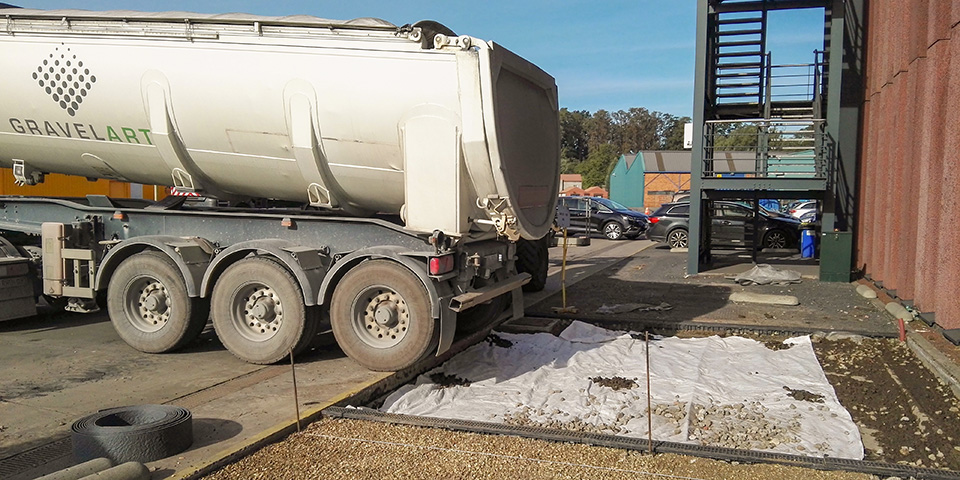
Because of their light weight, transportation is much more economical than if you were to use gravel, for example.
Space-saving
This recently figured out system immediately opens up interesting perspectives, especially for industry. "With companies considering investing in a reed bed, you sometimes see some doubt because a reed bed does take up quite a bit of space. Not every company has the necessary space. But: every company normally has its own parking lot. If you can build the water treatment plant under that parking lot, you kill two birds with one stone. It can even be three, because some companies have a solar parking lot and can therefore generate renewable energy on the same space."
Tests of the project at Argex showed that the Phytoparking results were equivalent to those of an aerated reed field. Still, according to Dion van Oirschot, this need not mean the end of (aerated) reed beds. "Certainly not, both systems can perfectly coexist. Because of the extra cover required and the grass dales, Phytoparking is slightly more expensive as an investment than an aerated reed field. So for farms that have enough space, a reed bed will definitely remain an option. The Phytoparking can be integrated basically everywhere: in street-side parking lots in residential areas, in the healthcare sector, industry, offices, et cetera. Actually, we can work out a solution for any application, even truck parking lots. Then we just have to find another dimensioning for the pressure distribution layer."
Commercialization through licenses
Rietland has already applied for a Belgian patent for the Phytoparking and will also apply for an international patent this year. It is the company's intention to roll out the innovation worldwide through a licensing system. "We want to market the system ourselves in the Benelux countries, Germany and France. In addition, we are already seeing a lot of interest in the United States, Canada, Spain, Portugal and China. Especially in China, the potential is huge. There, the system would function as an after-treatment system for a sewage treatment plant in certain cities, with a capacity of as much as 30,000 m³ per day. The added value of our system is that its relatively long residence time, combined with the use of Argex granules, ensures that the system is able to is to remove drug residues and micro-pollutants from the water, something the ordinary WWTP fails to do," said Dion van Oirschot.
Indeed, the Argex grains play a crucial role in the system. "They form the substrate on which a film of bacteria forms, which take care of the purifying work," said Pieter D'hont. "Thanks to the porous nature of the clay granules, the bacteria get all the space they need to grow. The grains also contain iron, which has phosphate-containing properties, which is an additional advantage."
Grains also have important advantages in the construction of (aerated) reed beds. "Because of their light weight, transport is much more economical than if you were to use gravel, for example. Moreover, we also save a lot of time and effort during the distribution of the granules, because we can distribute them evenly over the reed field (or the Phytoparking) via a blowing system. For us, the Phytoparking is already a promising new market segment," explains Pieter D'hont.