Platform on civil engineering, underground infrastructure, energy, construction equipment & construction machinery

With this headline at the top of the message, we received an invitation from Soltegro of Capelle aan den IJssel to an event they organized on November 15 this year. Curious, we spoke with Hans de Man, general manager of Soltegro, prior to the event.
"We all know that in order for the energy transition to succeed, we have to change things drastically. Businesses are developing all kinds of initiatives, on their own. Often sector related, sometimes alone, mostly in groups. That in itself deserves kudos, but the major concern we should all have is the lack of central direction. The lack of overarching agreements. The failure to share knowledge and hook up with each other. The will to do good is there, but who points the way?" explains De Man.
The social, economic and technical aspects of energy transition
"We believe we are doing the right thing with this event to bring various parties together to network, learn from each other and provide integral information. We will do this with a resounding group of speakers. We've been shouting it as Soltegro for some time, now we're actually going to do it," Hans continued. "The three dimensions we have named are the social, economic and technical aspects within the energy transition. A trinity that cannot be separated. Everything affects each other."
The setting for the event is the Floating Pavilion in Rotterdam. While enjoying a snack and a drink, the group of people attending is growing. The gathering comes from all ranks of the infra and energy sector as well as a diversity of other industries. De Man opened the meeting with a speech, stating, "With what is currently being done by the government to meet the requirements for 2030, which are in the Paris Energy Agreement, we are concerned about feasibility. There is no direction, no master plan. At most, there is shouting and everyone gets to figure it out for themselves." Soltegro itself has achieved level 5 on the CO2 performance ladder and considers the lowest possible energy consumption in all its designs.
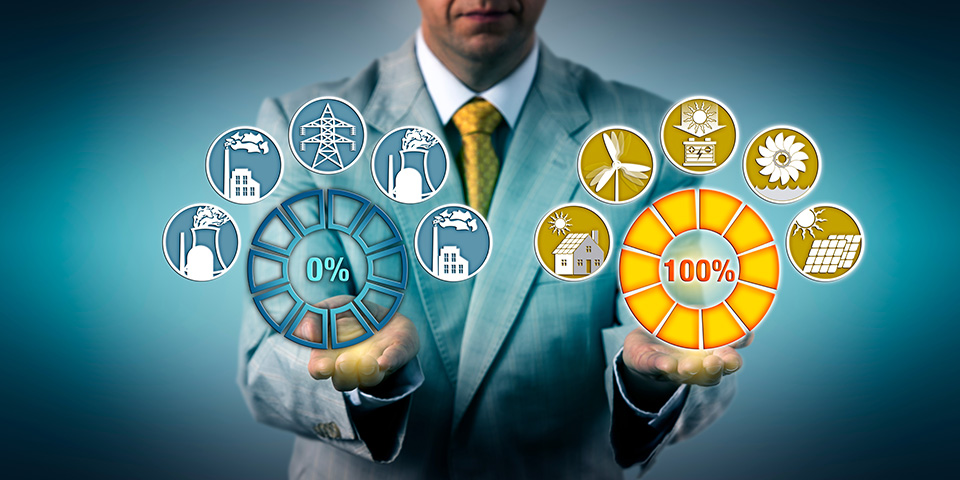
We all know that in order for the energy transition to succeed, we need to change things drastically.
Energy Transition in the Delta
The next speaker is Jo-Annes de Bat, deputy of the province of Zeeland. His presentation will take attendees to his province, where the energy transition in the Delta is in full swing. "The nuclear power plant in Borssele suffers a loss of 100 million euros per year. Zeeland is a shareholder with an additional problem: waste. In 2033 the plant will close, if the plans go ahead. So where do you start with the energy transition? With 35 million euros to make changes, Zeeland has started. The Tidal Technology Center is being built in Lake Grevelingen, we are bringing wind turbines to the sea. Zeeland has developed a program to train students as wind turbine mechanics for maintenance. Initiatives within the business community also make sense. For example, the heat generated by a French fry factory goes directly to a company where onions are dried. The question now is how to include households. At least by building circularly. Storing materials from demolition, rethinking and reusing them. We are going to use the agricultural sector for CO2 storage. Harvesting beets for a bio-based economy. Zeeland is ready and constantly innovating," said Jo-Annes De Bat.
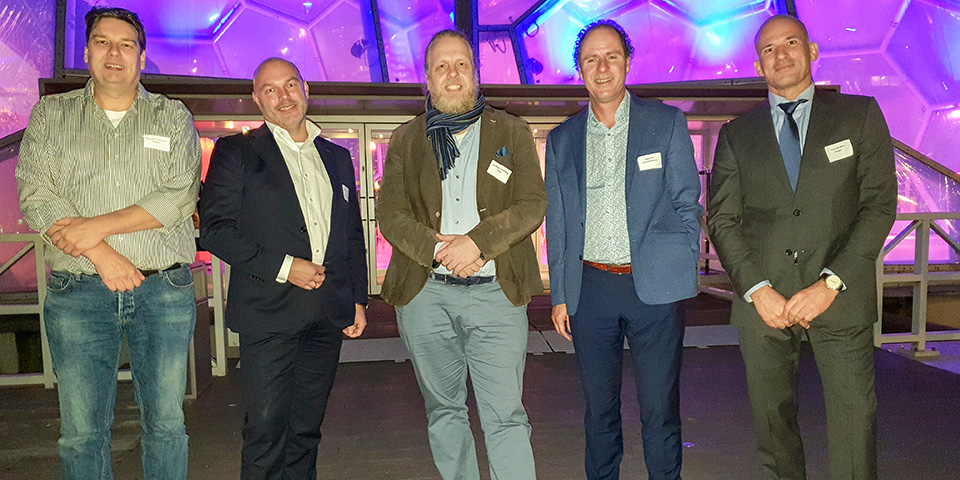
The speakers, from left to right: Bas van Duijnhoven, senior consultant reliable systems at Soltegro, Arend-Jan van der Vlugt to, alderman for Innovation and Sustainability at the municipality of Goeree Overflakkee, Jan Peter Doomernik, business developer at Enexis, Hans Pos, senior project manager engineering at Croonwolter&Dros and Hans de Man, managing director of Soltegro.
The energy transition in our properties
Bas van Duijnhoven, senior consultant reliable systems at Soltegro, is speaking: "Paris wants to limit global warming to 1.5˚ to 2˚ Celsius. In the Netherlands, however, we have other problems to deal with, such as rising sea levels, subsidence, not just in Groningen. We need to become less dependent on energy from abroad. The return on dearly purchased energy is 50%. This is not due to industry, but mainly to households. A waste of expensive energy. The reduction of CO2-emissions are not going fast enough here. Renewable Energy now scores 7%, but needs to get to 14%. If it continues like this we are not going to meet the 2020 target." Van Duijnhoven talks about what might work: layered energy systems, far-reaching electrification (letting the electric car, for example, send energy back into the grid), replacing energy from coal-fired power plants with solar and wind energy, and rethinking alternative energy systems. "Homes should have their own battery, of 10 to 15 kW per hour, to buffer. This will limit the number of kW we take from the grid and give back per household to plus and minus 1 kW."
The best solutions have no competition
"Can we come up with a solution so cheap that companies can't compete with it?", Jan Peter Doomernik asks the audience. He is Business Developer at Enexis and deals with disruption within the energy market. "Imagine that with the right technology cars are self-thinking, part of a 'swarm' and as a system make their own purchases, without human intervention. Cars that give energy to each other, give energy to society and just make money. Money they don't need, money that can be invested in peripheral services for humans. Is that unimaginable? No. The system would be similar to nature. Animals know no ownership, no identity and no money. Not even scarcity, our great artificial problem created by commerce." Doomernik explains that we should use the fair rules of a natural ecosystem as an example. "Work together, share energy, work 'anti-fragile.' Build an 'energy commons' (sharing without an owner - ed.). Go for 'abundancy' (create abundance - ed.) and let's work on an 'Internet of Energy'." Doomernik points the audience to the existence of the 'Nature 2.0' group, within which such solutions are sought on a voluntary basis.
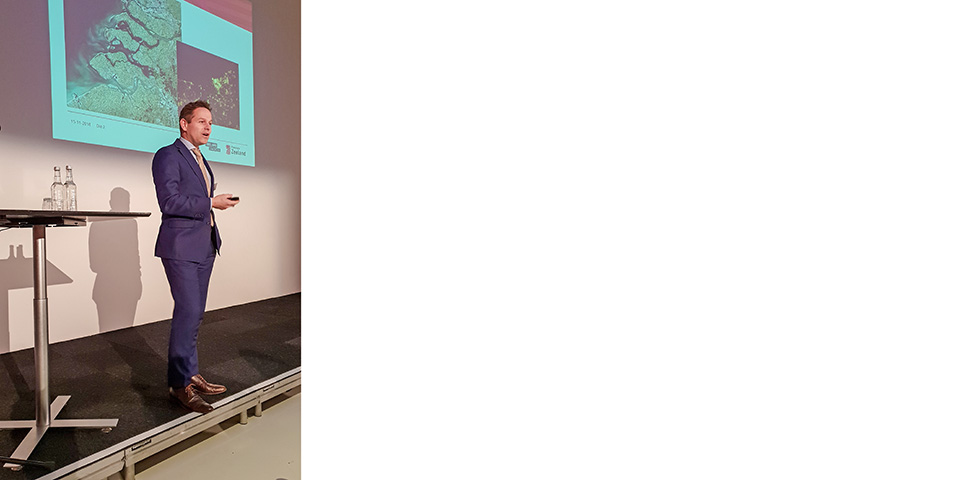
Jo-Annes de Bat, delegate
of the province of Zeeland.
Energy-neutral tunnel as a good example of innovation
From Croonwolter&Dros, Hans Pos, senior project manager of engineering, enters the stage. "Tunnels are big energy consumers. We are currently building an energy-neutral tunnel, saving and generating energy. To arrive at solutions that make this possible, we continuously ask ourselves the "why?" question. Why do we do what we do and what would be a good solution," Pos says. "The opportunities we have defined are energy reduction, material use, well-being, spatial quality and accessibility. How could infra do a better job in this? We need to get rid of existing methods that are wasteful. Most installations in a tunnel operate on direct current. Then it makes sense for everything around the tunnel to operate on direct current. That saves energy and is more reliable. With LED lighting and good reflective surfaces, we reduce energy consumption. With transporting daylight via fiber optics, we can bring sunlight into the tunnel. A DC grid around the tunnel operates redundantly, powered by 20,000 m2 solar panels. Generated energy will have to be buffered, for the day and night rhythm." To achieve all this, Croonwolter&dros is using 'proven technology'. Pos: "Regulation will have to change if we want to continue to innovate. Rijkswaterstaat must be able to be an energy supplier, for example. We are already building the tunnel of the future."
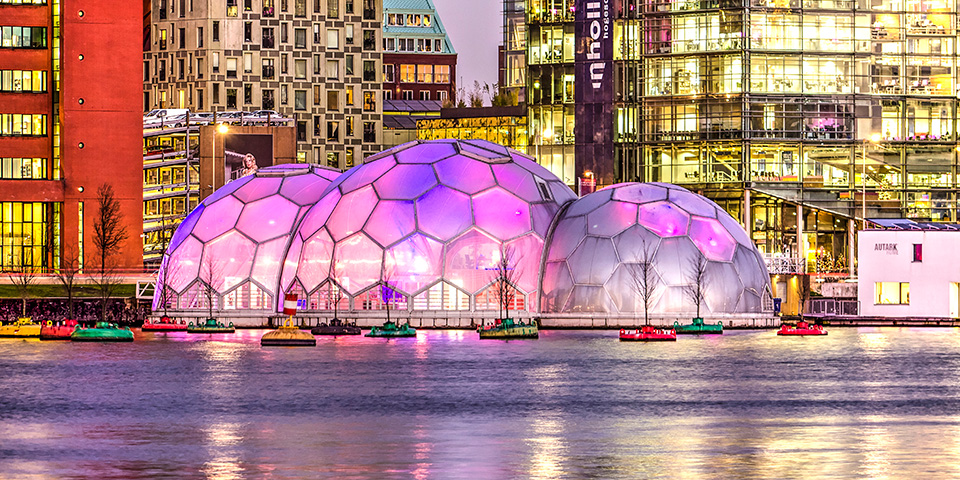
The Floating Pavilion in Rotterdam provided a stunning backdrop for the event.
Hooray for Goeree!
The final speaker will be Arend-Jan van der Vlugt, Alderman for Innovation and Sustainability at the Municipality of Goeree Overflakkee. Energy Island," is the nickname for Goeree Overflakkee these days. Not unfairly, we learn. "The state warned Goeree Overflakkee that things were not going well. An aging population, disappearing jobs and youth moving away posed a great risk. The municipality and the entrepreneurs joined forces to tackle this problem."
A number of spearheads that are being addressed: Islandness, preserving the island character, Social balance, between tourism and living and Quality, the tourist or new resident must experience more quality on Goeree Overflakkee than where he comes from. "Meanwhile, Goeree Overflakkee has won the Quality Coast Award for all the changes. Think of the good connections, the water bus, the access roads. We have a strong fiber optic network and entrepreneurs, municipalities and government work well together. For example, we are betting on electric sharing cars in residential areas. We are investing in charging stations. The gas station of the future is in Oude Tonge, eloquently named GreenPoint. "Creating awareness is the key word," said Van der Vlugt. "That goes so far that residents are proud of the results achieved and are happy to contribute. Goeree Overflakkee has signed the Hydrogen Covenant, supported by the entrepreneurs. The municipality is investing in solar panels. By 2020, Goeree Overflakkee must be an energy-producing island."
The meeting ended with a networking reception where the speakers' presentations were still hotly debated. One thing is clear: Where there is a will, there is a way to sustainability.