Platform on civil engineering, underground infrastructure, energy, construction equipment & construction machinery
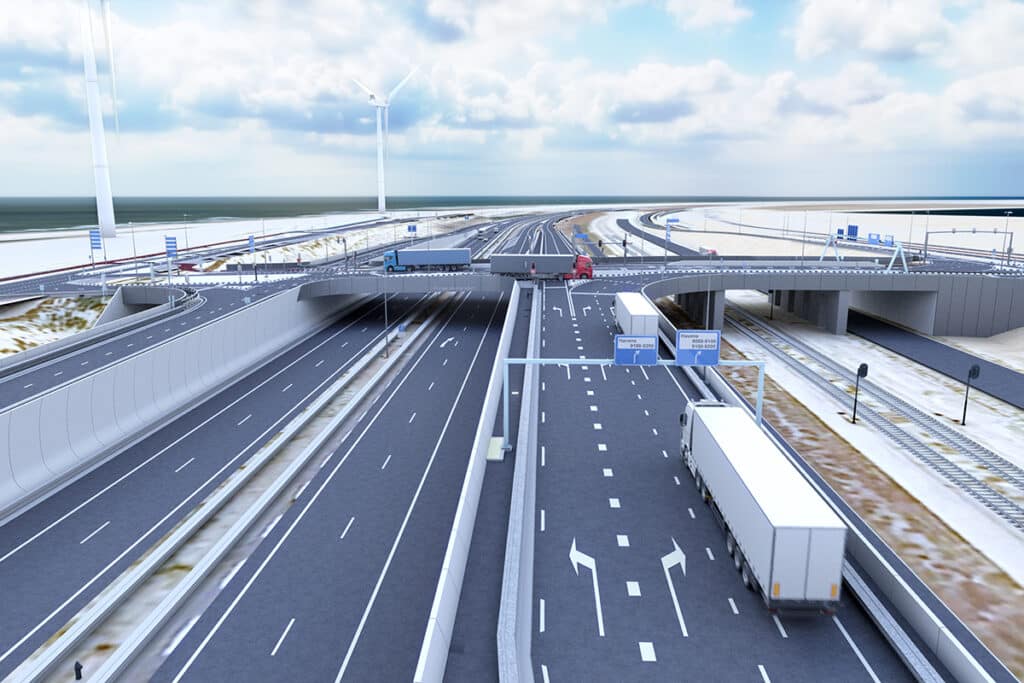
The Maasvlakte continues to develop at a rapid pace. After the phased realization of the Princess Amaliahaven, among other things, it is now the turn of the Princess Alexiahaven: an area of approximately 300 hectares where various sustainable companies will settle in the coming years, focused on bio-based and circular activities. In order to properly open up this new activity, the infrastructure is already being prepared, with the construction of the Princess Alexia Viaduct as the most eye-catching part.
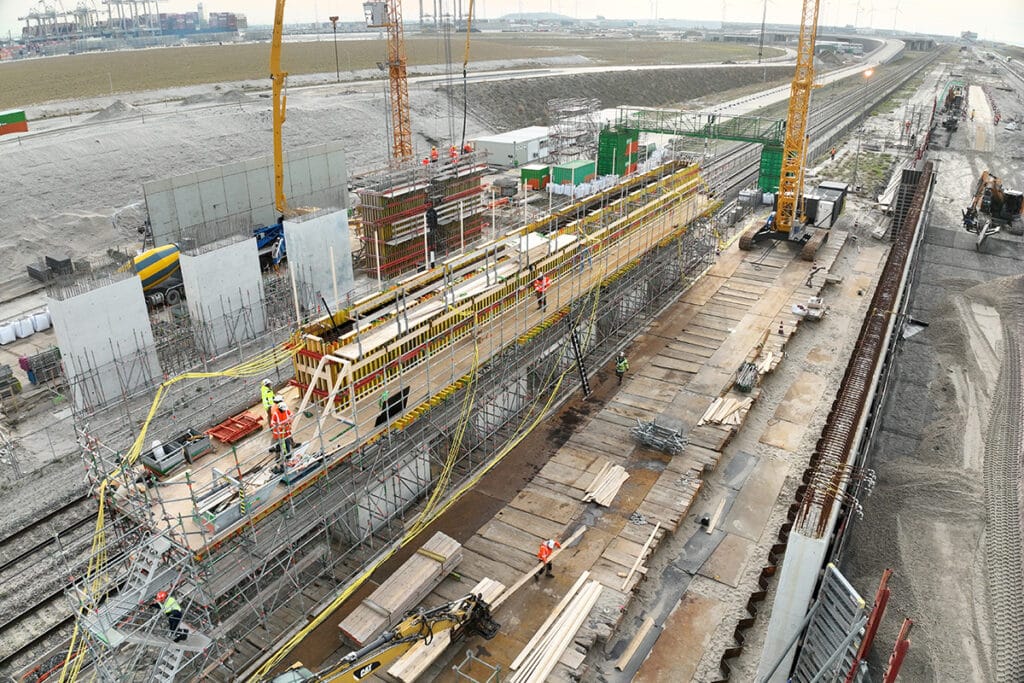
Currently, the Alexiahaven is still accessed via a level crossing. “For the time being, this poses few problems,” says Peter Keesmaat, project manager at Port of Rotterdam. “However, simulations show that during the construction and operation phases this would lead to considerable traffic congestion, especially on Maasvlakteweg - the main artery of the area. At the same time, the number of companies wishing to locate in the port is growing, and with it the amount of construction, freight and industrial traffic.” Therefore, future traffic is already being anticipated: a flyover crossing that bridges rail, the Container Exchange Route (CER) and several pipeline lanes in one go. “The goal is to provide robust and future-proof access so that the area does not become gridlocked during development.”
The Princess Alexia Viaduct consists of three adjacent viaducts with a total length of approximately 130 meters, from the Princess Máximaweg to the Mekongweg. “The clearance height is 5 meters, and above the track even 6.5 meters, to allow for future overhead line expansion,” says Pim Vermerris, contract manager at Port of Rotterdam. “At the same time, the Maasvlakteweg will be widened from 2×1 to 2×2 lanes over a length of 3 kilometers.” The design of the new viaduct follows the Port Authority's visual quality vision: all the viaducts on the Maasvlakte form one architectural family, the so-called dune viaducts. The contractor was given constructive freedom, but the appearance and clearance profiles were fixed, as were the lighting and road design.
The Port Authority has high sustainability ambitions, and they are also reflected on this project. “We asked for as many sustainability aspects as possible in the tender,” says Vermerris. “The sand (150,000 m³) we need for the ramps and exits became available during the dredging of new quay walls in the adjacent Amaliahaven. This largely avoids transport by axle. In addition, in the tender we expressly asked for ideas for low-emission construction and sustainable concrete.” Keesmaat: “We are in the fortunate circumstance that the environmental permit for nature conservation activity (formerly the nature permit) has been issued for the entire Second Maasvlakte. Nitrogen issues are not an issue here for the infrastructure construction phase for that reason. Nevertheless, as the Port Authority, we want to go the extra mile and inspire and stimulate the market by asking for low-emission projects.”
BAM offered an almost entirely electric construction site: electric trucks, tower cranes, asphalt equipment and its own charging station. “The result is an expected CO2 savings of about 854 tons,” says Vermerris. “Well in advance, we requested a medium-voltage connection from Stedin so that the construction site could run electric right away. Running all other construction equipment on HVO will save another 2,200 tons of CO2 emissions. Steps were also taken at the material level, including the use of innovative GREENR Concrete with less cement and a low MKI score for asphalt.” According to the gentlemen, BAM's plan also scored high with regard to safety and accessibility. Few road closures and detours are required to complete the project. In addition, foundation methods are vibration-free to prevent damage to crucial utility lines, and safety is anchored via additional requirements, such as a permanent segregated bypass for traffic around the construction site, a pedestrian bridge over the railroad and the complete shielding of railroad zones. Keesmaat: “The latter was taken out of the competition to ensure that it was included directly in the tender.”
Since the award in July 2024 and the construction start in April 2025, the project has been on track for completion in November 2026. Cooperation between contractor and client is intensive and focused on a ‘warm’ process: lots of face-to-face consultations, emphasis on joint problem solving and continuous attention to safety through frequent safety walks. “We really do it together.”