Platform on civil engineering, underground infrastructure, energy, construction equipment & construction machinery
Ingenious system extracts peak heat from concrete
Hoteco has been in the concrete cooling business for 25 years, a specialty in which the company is completely unique. “While many companies depend on standard solutions, we developed our own cooling machines back in our early years,” says Leo Suiker, owner of Hoteco. “And those machines are still at the heart of our services.”
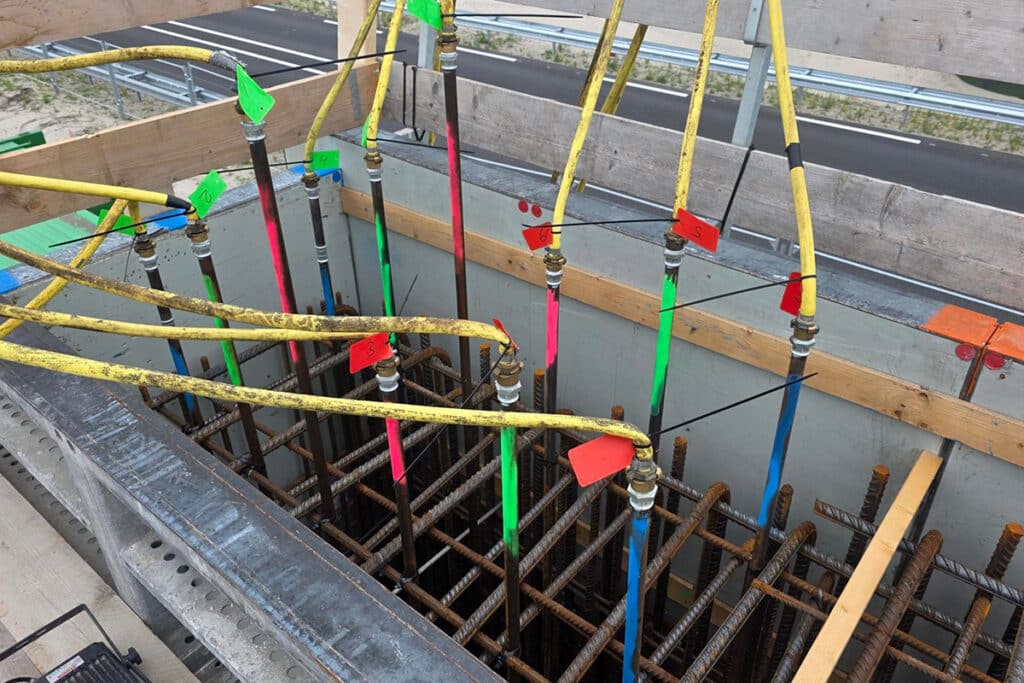
Concrete consists of a mixture of sand, gravel, cement and water. “Once the binder cement reacts, heat is released. That heat must be dissipated. If it is not, the concrete can shrink too quickly when cooling and cracks develop. Especially with large structures, this poses a real risk,” Suiker explains. “That's why we extract the peak heat from the concrete through an ingenious system similar to underfloor heating, but in reverse: through tubes in the reinforcement, we let cooled water flow that extracts heat from the concrete.”
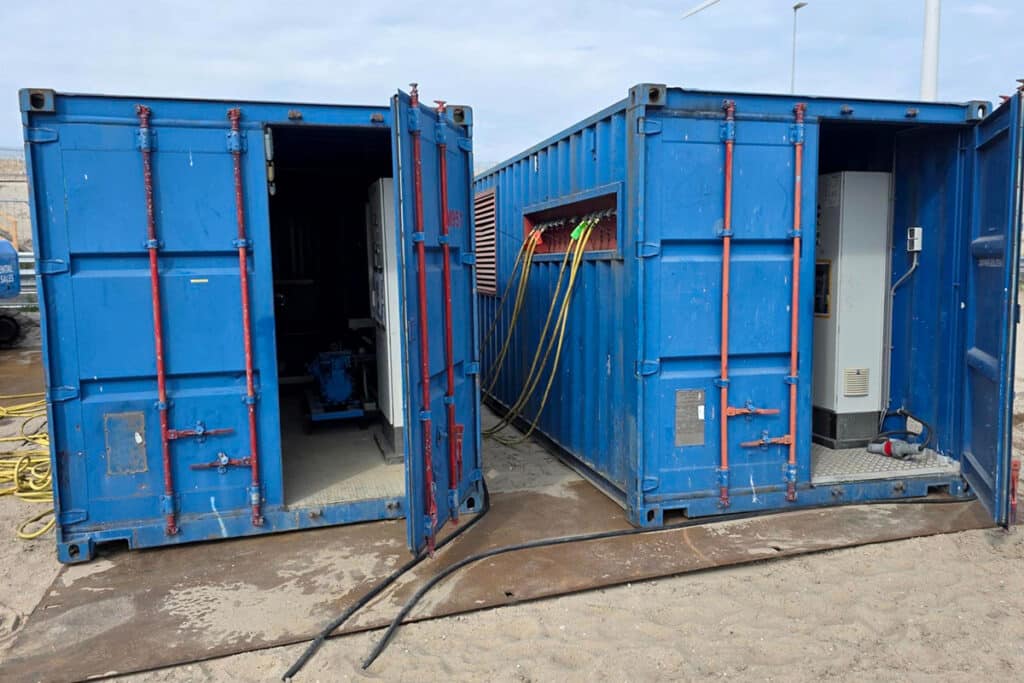
Those tubes are placed by iron braiders about 40 to 50 centimeters apart and divided into groups, with a maximum length of 150 meters. “If the groups are too long, the cooling process is not efficient,” Suiker says. “Per group, we send about one cubic meter of water into the system. The water returns hot to the buffer tank, where it is cooled back to about 10 degrees Celsius. Our chillers, housed in compact 20-foot containers, can drive six groups simultaneously and are easy to move. Special connection hoses allow us to quickly connect and disconnect between pours, while the pipes remain permanently in the concrete.”
The cooling process usually takes up to three days. “Especially the day after pouring is crucial: that's when the most heat is released,” Suiker knows. “Here on the Princess Alexia Viaduct, BAM's concrete technologist calculated in advance the heat development of the sustainable GroenR concrete used. Based on that, we supply the required cooling power. In this case, as much as 200 kW is released from the concrete. Our machines dissipate that heat in a controlled manner, combining several units.”
Hoteco's expertise is used on major infrastructure works. “We were involved in the HSL, the Betuweroute, numerous tunnels and viaducts, and we are currently in Belgium on the Oosterweel link. Our machines have also proven their services in the construction of the nuclear reactor in Petten, and we will soon be going back for the next phase.” Increasingly, Hoteco is being asked for complex projects. “In Denmark, we are now supplying our systems for the largest immersed tunnel in the world, between Denmark and Germany.”
With twenty chillers in its current fleet, Hoteco is on the eve of even more and larger projects, Suiker notes of the requests. “To cope with that future, we are currently building a new generation of chillers that can be read and controlled remotely. Because after 25 years, clients are really convinced that concrete cooling is a profession. And we are proud to have elevated that craft to an art.”