Platform on civil engineering, underground infrastructure, energy, construction equipment & construction machinery

The new 380 kV high-voltage substation in Tilburg could be realized using an integral approach in which advice, design and supervision came together. Commissioned by TenneT, Antea Group fulfilled a connecting role between client, contractors and environment. Soil, ecological and archaeological studies and the design for the water storage facility to be relocated were followed by environmental management and implementation supervision. Project manager Martijn Elings and project leader & senior consultant Arjan van Beek explain how pragmatic integrality contributed to the success of this project.
“Normally we only take care of the conditioning studies and are not involved in the design and construction phases,” says Elings. “But TenneT asked us to do more.” Since 2019, Antea Group has been involved. From surveys and advice to design, planning, permit processes and implementation supervision. Van Beek: “What was unique was that we directly translated our findings into an integral design for the new water storage and structures such as culverts and dams. We were there from the beginning and were therefore able to actively advise and guide during the implementation phase as well.”
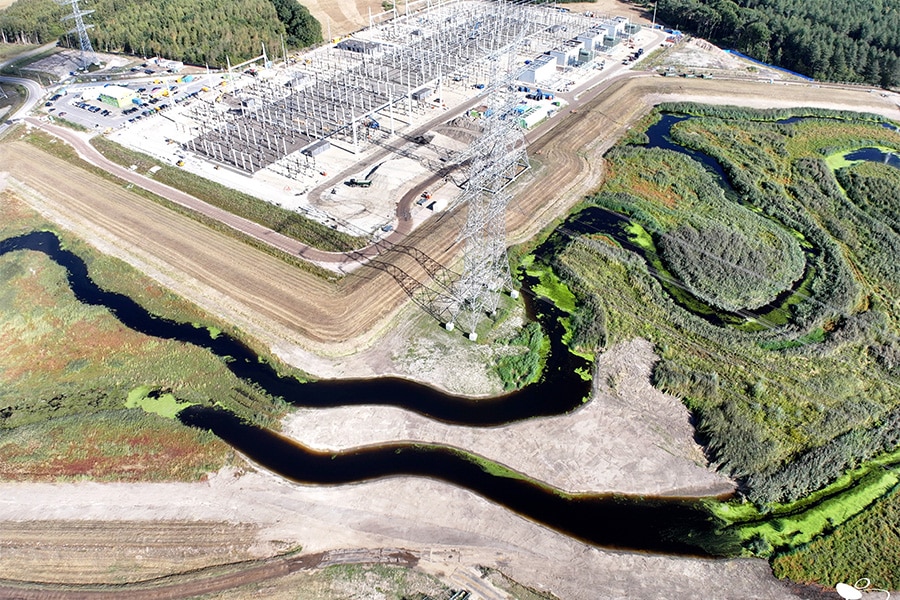
The location made the project complex: partly in an existing water storage facility near the existing sewage treatment plant, which had to remain operational. In addition, the soil was partly polluted and the surroundings ecologically valuable. Nature also required care. Badger setts, bat routes and valuable trees had to be preserved or compensated for. “Our biggest role was in the redesign of the water storage, the landscaping and the design of artworks. We created gradients in the new water storage: zones that are sometimes flooded and higher areas where animals can take shelter. In this way the area remains and becomes usable for water management and ecology,” says Van Beek. Antea Group's research and planning brought water, technology, ecology and environment into balance.
According to Antea Group, the strength was mainly in the collaboration. “We worked for TenneT, but also with contractors, water board, municipality, province, construction partners and nature organizations. It was constantly balancing between technical feasibility, regulations and the interests of the environment,” says Van Beek. The integral role also meant intensive coordination during implementation. Antea Group - as an extension of TenneT - supervised soil flows, ecology, safety and concrete construction, and maintained contact with partners and stakeholders. “This enabled us to ensure that the agreements in the permits were also observed in practice,” says Elings.
After six years of intensive involvement, Elings and Van Beek look back with pride. “This project proves that integrality is not just about technology, but about connection,” says Van Beek. “We speak the language of the various parties - from ecologist to contractor - and can therefore bridge the gap between the various disciplines.” Elings concludes, “By connecting interests and keeping an eye on the environment, we have made this complex project a success together with TenneT and all partners.”