Platform on civil engineering, underground infrastructure, energy, construction equipment & construction machinery
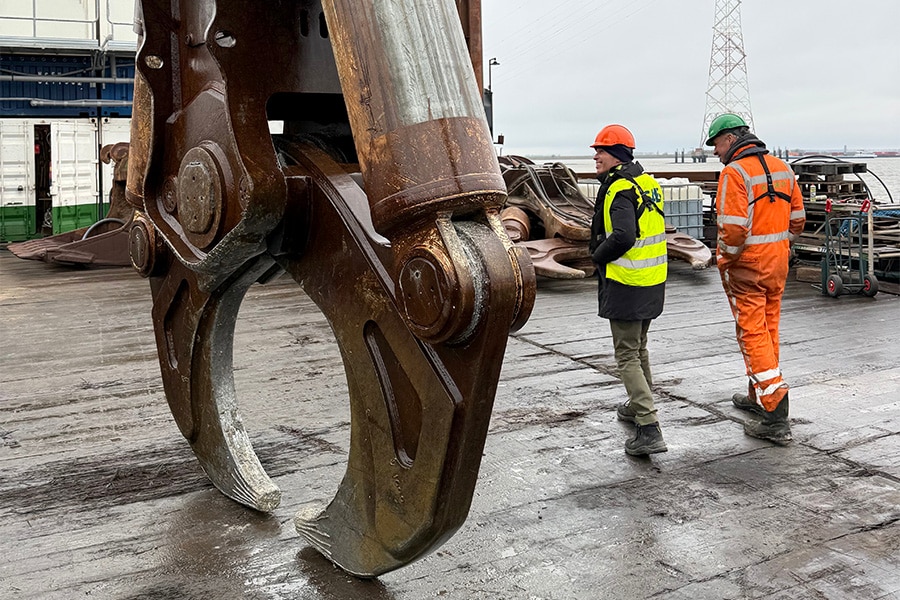
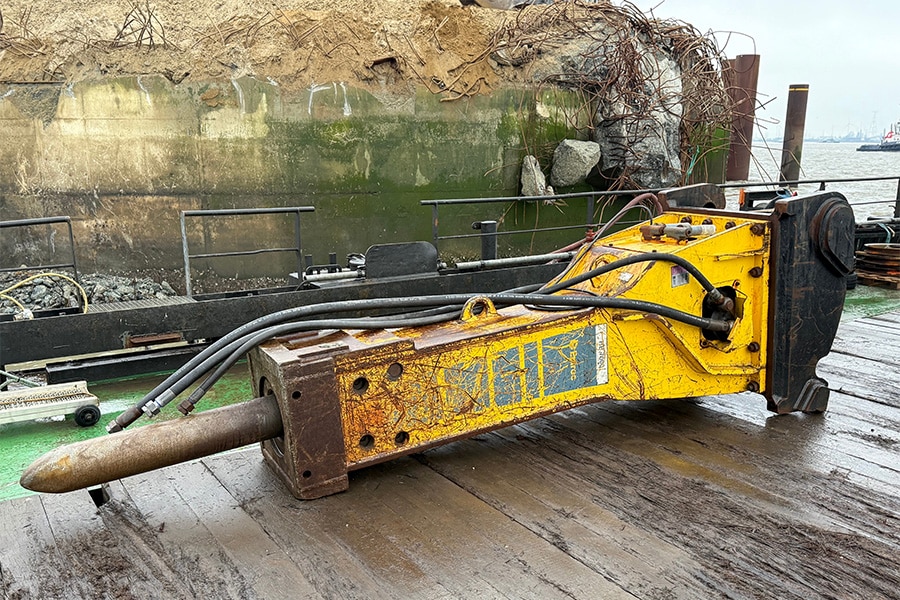
Work is underway at the Europa Terminal in Antwerp on one of the most impressive hydraulic engineering projects of the moment: the construction of a new quay wall. Equally impressive is the demolition of the old quay wall by Adex Groep. The leading demolition company developed a suitable configuration for this: a self-leveling pontoon with a mega demolition crane on top. The 320-ton ‘Genius’ with concrete shears easily ‘bites’ chunks of concrete up to 1 m3 from the old wall. The 7-ton Epiroc demolition hammer from SAES proves its added value here, even at depths of up to 24 meters underwater!
A completely new quay structure is being built over a length of 1,200 meters. To this end, the old quay is being removed in phases. “The old quay is founded on 49 gigantic concrete caissons with a diameter of 30 meters and a height of 30 meters, 24 meters of which are underwater,” explains Davy Kies, head of technical services at Adex Group. “The caissons, made of heavily reinforced concrete, are filled with sand and compacted with grout, and all have to be removed. This is because they are located in front of the new quay wall.” Adex Groep was called in because of its extensive expertise in specialist demolition work.
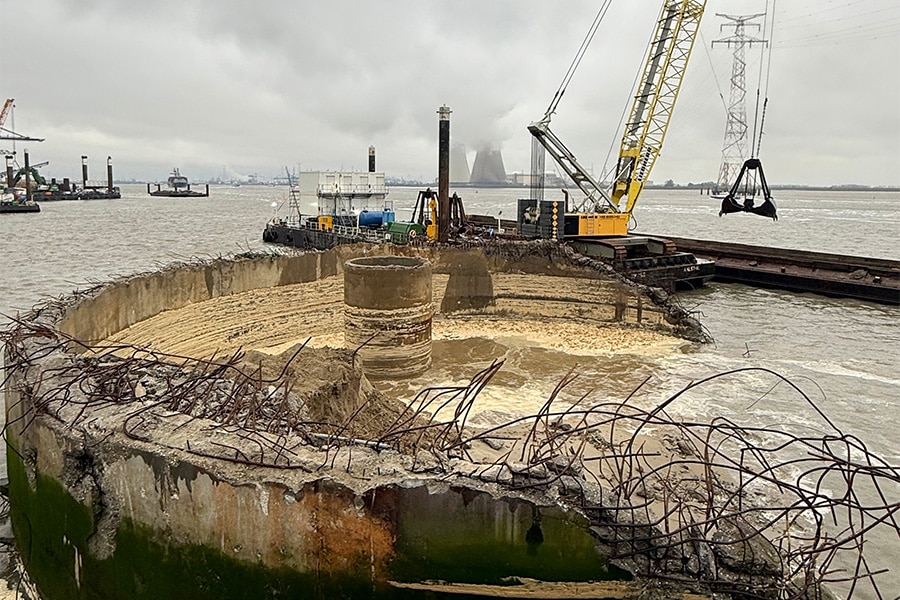
The working conditions are extremely challenging. “Here on the Westerschelde, the tidal range is no less than 6 meters, which makes the project even more complex. That is why we have specially adapted almost all of the equipment: extended booms, extended spud poles, and a completely modernized pontoon, equipped with an automatic leveling system that continuously measures and corrects the load via pressure sensors,” says Kies. The pontoon has an impressive history: built in America, deployed in Japan, laid up for ten years and finally completely overhauled by Damen and prepared for this operation.
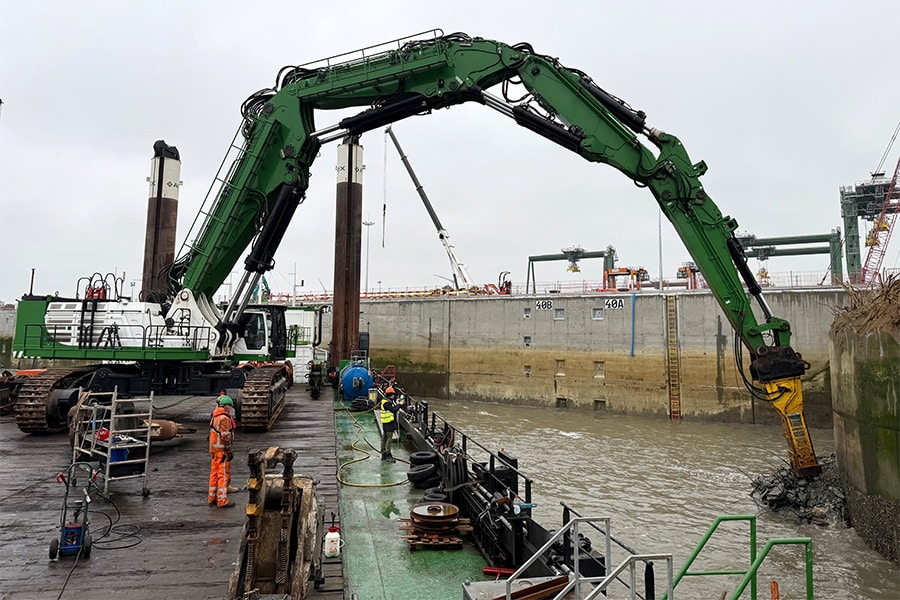
The Genius is also an absolute eye-catcher. “The 320-ton crane has a circular design and is largely constructed from used materials,” explains operator Willem van de Nagel, who helped develop the mega demolition crane. With a joystick in each hand, he or one of his colleagues calmly cuts or vibrates up to 1,000 tons of concrete away from the old quay wall here on the Westerschelde every day. “We cut away about six meters in height from each caisson and then sail on to the next one, so that a wire crane on another pontoon can scoop away the concrete. When we demolish for about three hours, they have a full day's work clearing up.”
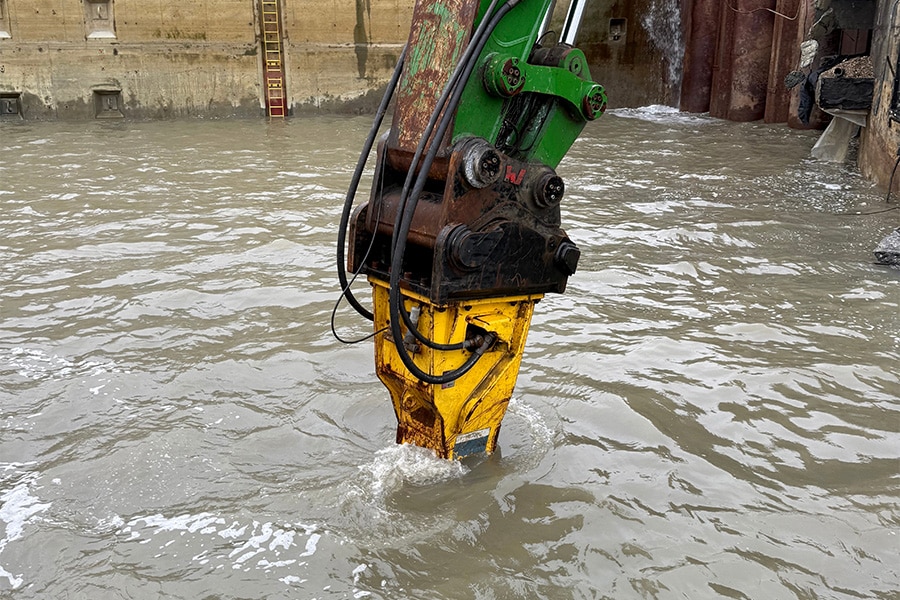
The caissons are being demolished to a depth of 30 meters below TAW level (Second General Levelling, the Belgian reference point for height measurements, ed.). “This means that we are working up to 24 meters underwater with our demolition crane and therefore also with the shears and demolition hammer,” says Van de Nagel. “Working at that depth is only possible thanks to CT Systems” sophisticated GPS and laser system, which provides live data to other machines and the correct parameters on the attachments."
Speaking of attachments, what stands out in this project is SAES's role as a permanent partner for hammers, parts, and technical support. “Demolition hammers are powerful, but sensitive,” says Kies. “SAES understands the complexity of our projects and knows that a potential malfunction can be extremely costly. They not only supply parts, but also technical personnel who can take immediate action. And if a hammer really does cause problems, they always have a replacement hammer available.” Van de Nagel adds: “The latter is particularly important to us, because that certainty means that operations can always continue.”
Since its launch in August 2023, Adex Group has made enormous progress in the Port of Antwerp, despite a difficult start-up phase and the challenge of getting so much specialized equipment up and running in such a short time. The result: an operation that ranks among the very best in hydraulic engineering in terms of technology, logistics, and organization.
Neem dan rechtstreeks contact op met Saes International BV.
 Contact opnemen
SAES International was founded more than 35 years ago by current general manager Henk Saes. Since then, SAES International has been the manufacturer and supplier of equipment for recycling, demolition and earth moving. Our history in a nutshell... In 1982, Henk Saes began producing steel structures, mainly excavator buckets, loading buckets, fork boards and extension poles. Characteristic were the in-house, forward-looking [...]
Bekijk Bedrijfsprofiel