Platform on civil engineering, underground infrastructure, energy, construction equipment & construction machinery
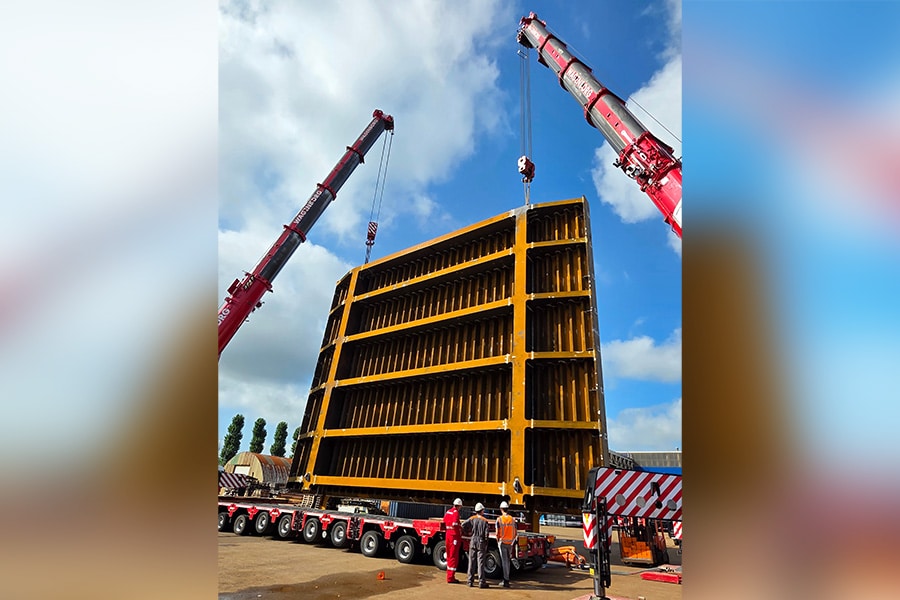
The run-up began for Solidd Steel Structures many years ago, when the steel constructor was involved in the plans for Zuidasdok. Even at that early stage, the company made an impression, which led to the TriAX construction consortium asking them to participate again when the tender for the De Nieuwe Meer junction came onto the market.
Within this extensive project, Solidd Steel Structures is focusing on a clearly defined part: the steel construction and mechanical engineering components of the Schinkel Bridge. “Of the ten bridges in the planning area, we are responsible for the construction of four new bascule bridges and the renovation of one existing bridge,” says Wouter Wassink, project manager at Solidd Steel Structures.
A major challenge lies in the design. ‘This project is the first in the Netherlands to be carried out in accordance with the new ROK 2.0 guideline from Rijkswaterstaat (the Dutch Ministry of Infrastructure and Water Management) in terms of important details,“ says Jan Willem Stob, managing director of Solidd Steel Structures. ”The new guideline places extra emphasis on fatigue resistance, because many existing bridges in our country do not reach their service life due to higher traffic intensity.“ For Solidd, this meant that the deck plates had to be thicker, the troughs had to run continuously through the cross beams, and all critical details had to be fully welded. According to Wassink, this results in a more complex production process, including test pieces and close coordination with Zuidasdok.
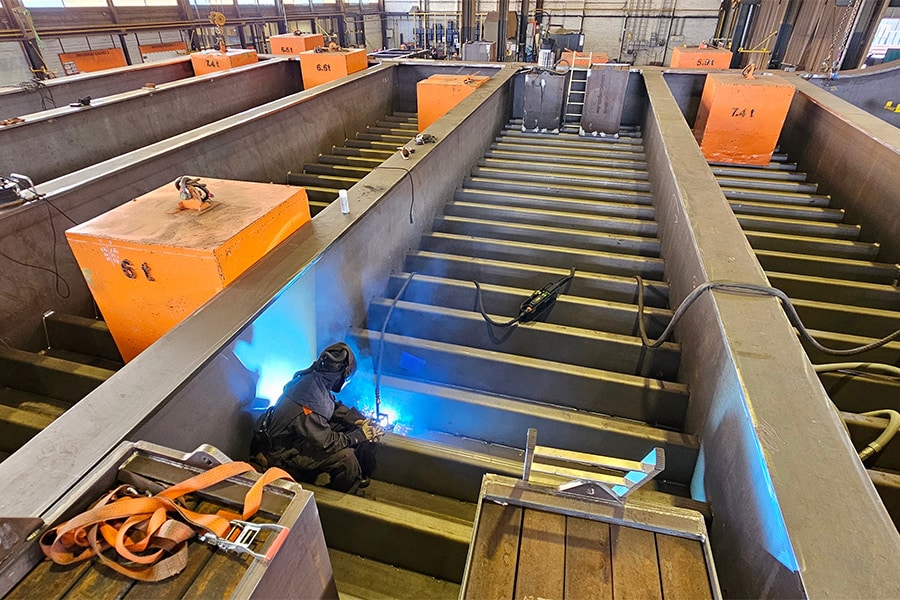
Although all bridges over the Schinkel River use more or less the same drive principle, they differ in shape, dimensions, and weight. “The bridges span approximately 16 meters, with a passage width of 12 meters,” explains Wassink. “However, the largest bridge is an exception: 27 meters long including the ballast box, 21 meters wide and weighing 300 tons, excluding the 250 tons of ballast that we add on site. It is precisely this size that makes transport and installation a complex logistical challenge, requiring us to include strength calculations and lifting points in the design at an early stage.” Each bridge is powered by an electromechanical system. “An electric motor with gearboxes drives transmission shafts that open and close the bridge via Panama wheels. The motors and gearboxes are supplied by SEW, while the Panama wheels come from CMD in France. At Solidd, we take care of the assembly, integration, and installation.”
The first new southern bridge will be installed by Solidd Steel Structures in May 2026. “We will start installing the moving parts in the basement of the bridge in March 2026,” says Wassink. “In the fall of 2026, we will install the first section of the northern bridge and start building two sections of the southern bridge in our workshop, which will be installed in 2028/2029.” The Schinkel Bridge will be completed in 2031. With this project, Solidd Steel Structures once again demonstrates its expertise as a steel and mechanical engineering specialist.