Platform on civil engineering, underground infrastructure, energy, construction equipment & construction machinery

Due to the ever-changing climate, our country is increasingly experiencing massive downpours, causing flooding. Fortunately, our country is not easily fooled in the battle against water. This is how the Vissers Ploegmakers B.V., F.P.H. Ploegmakers B.V. and Van de Wetering Cultuurtechniek B.V. contracting consortium, together with the Rijnland Water Board, realized the Nieuwe Driemanspolder, with a peak storage facility for excess water.
Jan Meerkerk, project manager at the contractor combination, explains: "The Nieuwe Driemanspolder is an area between Zoetermeer, The Hague Leidschenveen and Leidschendam-Voorburg. From the completion of the project, people can walk, cycle, ride horses or sail here in a varied landscape of water and greenery. During extreme rainfall, the area will be used as peak storage, greatly reducing the risk of flooding from the regional water system."

At the time of this writing, the Nieuwe Driemanspolder is ready. "The peak storage area is capable of buffering two billion gallons of water, water that can no longer be drained any other way," Meerkerk continued. "If the area is not used as peak storage, it has a recreational and a nature function. The Nieuwe Driemanspolder can count itself among the lowest-lying polders in the Netherlands. The polder is at about 4 to 5 meters below NAP and the situation is really Dutch, if we look at how the water has to be drained."
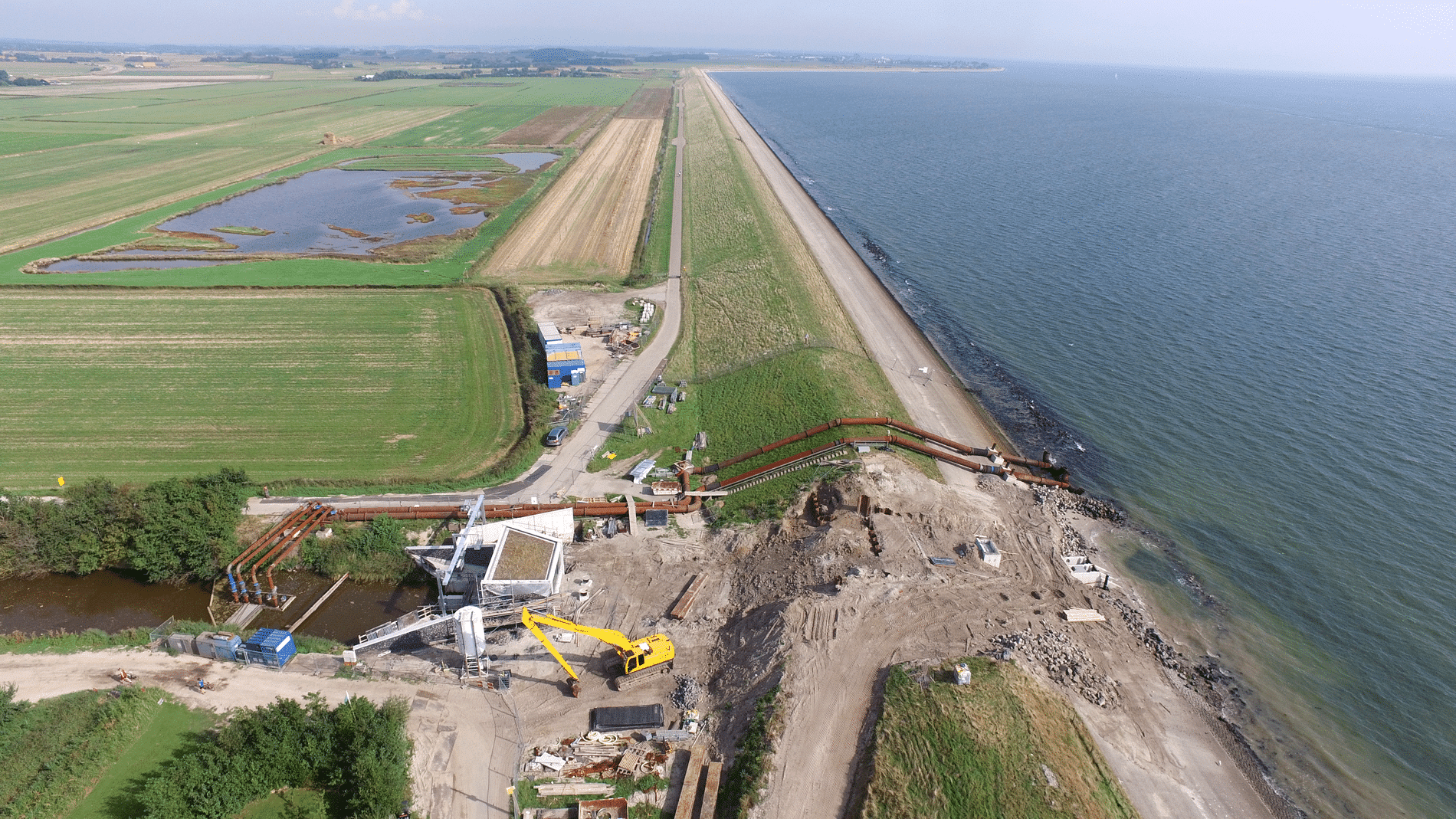
Paul Hollander, project manager at the Rhineland Water Board, adds, "The polders are equipped with pumping stations. Some 350 pumps within our management area process the water to the main water system. The four polder pumping stations then provide discharge to the rivers, the North Sea Canal or directly to the sea. During heavy precipitation, the main water system can become overloaded. You are then forced to turn off polder pumping stations to prevent dikes from overflowing or even collapsing. That results in damage, with a rapidly running damage counter. The challenge was to make the main water system, the storage basin, more robust. The solution was to enlarge the storage basin pumping stations so that we could discharge more water, which now has a total capacity of 200 cubic meters per second. But at a certain point you reach the limits of what the storage basin can handle in terms of water discharge to the pumping stations. The next step is the construction of peak storage facilities so that we can park water during wet periods. This water is then later discharged through the same system.

Hollander outlines the run-up to implementation, "The first plans date from the end of the last century. In 2013 the final plan was finally developed, in the following years the plan was worked out in more detail together with local residents and other stakeholders
and then tendered for execution, in 2015. That's when contractor combination Vissers Ploegmakers / F.P.H. Ploegmakers / Van de Wetering Cultuurtechniek came into the picture, they won this tender based on their value for money in which quality had an important share. Immediately after signing the contract, they started work. Test sections were made at various locations. There they tested how the soil and groundwater reacted to work. Very important for carrying out the work safely and achieving stable quays. The focus with the contractor combination from the beginning was on the greatest risks."

On July 1, 2020, most of the area was opened to the public and on October 30, 2020, the New Three Man Polder was completed, though finishing work is currently underway. Since the area has been open, people have always been there. Meerkerk and Hollander note that there are many riding stables in the area and a lot of horseback riding takes place in the area. There is active canoeing, biking and hiking. In conclusion, Hollander says, "Originally we expected to need peak storage only once every 25 years. However, with the current climate development we are adjusting that expectation, we now expect to need to use it once every 10 years and in the future once every 5 years. We as a water board are already seeing the effects of climate change, which is why it is good to act now!" About the cooperation between the contractor combination and the Rhineland Water Board, both gentlemen unanimously agree: after a turbulent run-up, a special collaboration has emerged. "Reality automatically forces you into the best cooperation," Hollander said.