Platform on civil engineering, underground infrastructure, energy, construction equipment & construction machinery

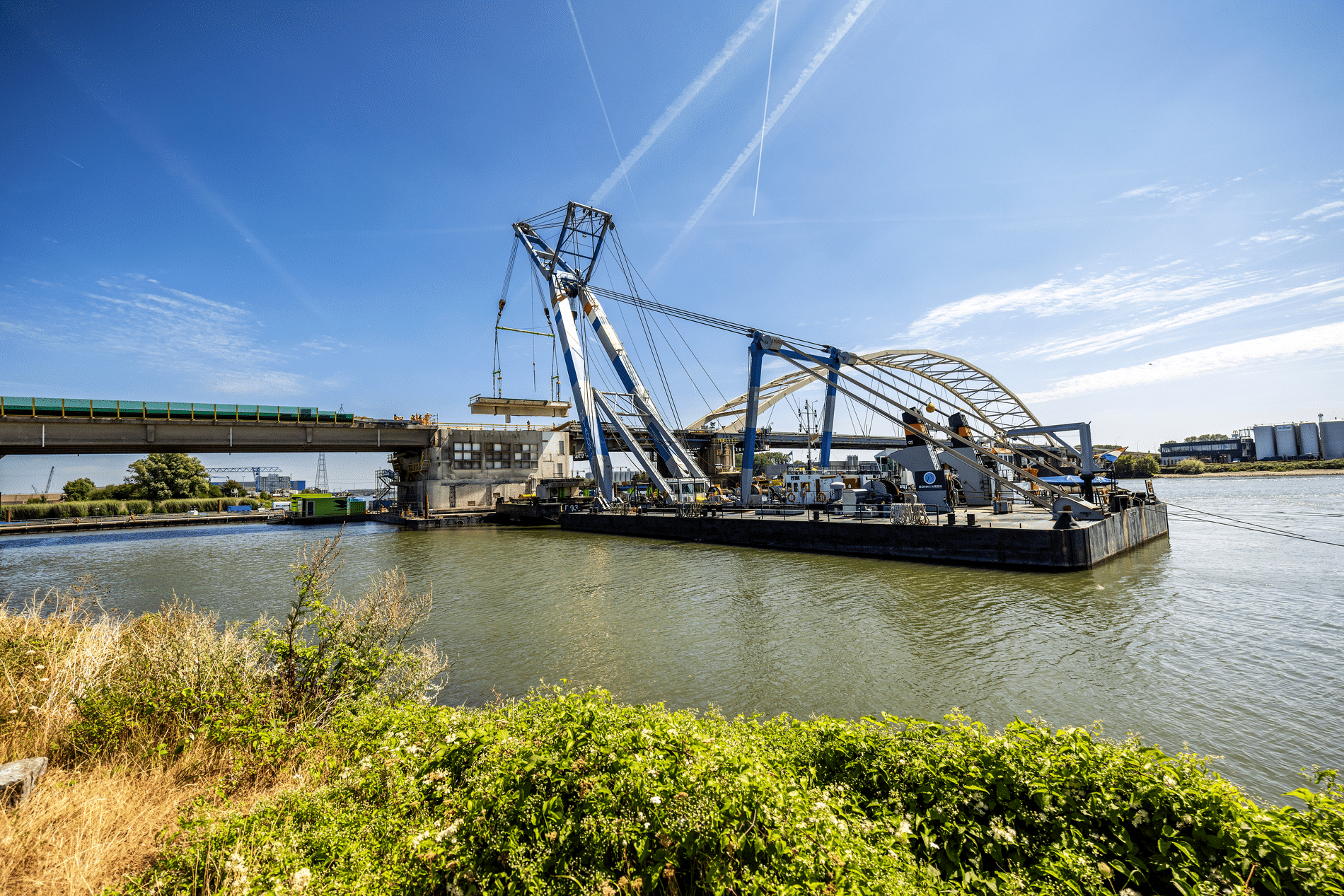
Part of the Blankenburg connection will soon be below ground level and will be built largely underwater. As a specialist in civil underwater constructions, DISA International is making a major contribution to various subprojects, many of which are located at great depths below water level, such as the Holland Tunnel and the Maas Delta Tunnel ramps. According to John Penson, Operational Manager at DISA International, there is a lot of pressure under water at some locations.
As early as the tender phase, BAAK held regular consultations with DISA International in order to deal with certain matters concerning the underwater structures as efficiently as possible. "The pouring of the underwater concrete is actually the final piece for us. It is important that all processes for this are well managed and well coordinated. That also means that we regularly carry out inspections in the various construction pits during the project. For the Blankenburg connection we are active in no fewer than twenty excavation pits of varying sizes. Incidentally, we have started realizing approach protection in the Scheur by installing outrigger frames."

The building pits of the Holland Tunnel are on average 150 meters long and 35 meters wide, those of the Maas Delta Tunnel 100 meters long and 25 meters wide. Penson: "The Maas Delta Tunnel involves cofferdams in which the approaches to the immersion tunnel will be built. They lie under a slope of 4% and descend to a depth of no less than 28 meters, the location where the ramps merge into the immersion tunnel. The sheet pile walls, anchor piles and GEWI anchors were installed from ground level, after which the building pits were excavated in the wet. Our job is to use diving teams to clean the sheet pile walls, where the underwater concrete will eventually be poured. We are also responsible for any lengthening of the anchors and the installation of the dishes on the anchor piles and GEWI anchors."
A gravel layer is then placed in the construction pits on which DISA International places concrete spacers. "The concrete beams are very meticulously positioned to the nearest centimeter and leveled with depth sensors," Penson explains. "On top of these beams of 20 by 20 centimeters in diameter, the reinforcement baskets are placed after which the underwater concrete can be poured, the final piece of our operation in the construction pits. A total of twenty cofferdams will be constructed in this way. At the approaches to and from the Maas Delta Tunnel, we are working in three cofferdams simultaneously with a total of three teams per cofferdam. Each team has its own diving container with tools. There really is top pressure under water. At the Holland Tunnel, we are working simultaneously in two excavation pits. In the twenty cofferdams in which we have been active, 80,000 m3 underwater concrete poured."

DISA International is active with thirty diving containers and over a hundred divers on the various projects in the Netherlands alone. "It seems like in the Netherlands all tunnel projects are being realized at the same time," Penson notes. "It is precisely in those large projects that we can assert our added value. This means that in addition to the Blankenburg connection, we are also involved in other projects at the same time. In short, we will be busy for the next few years."