Platform on civil engineering, underground infrastructure, energy, construction equipment & construction machinery
The dike along the Hollandsche IJssel protects Krimpenerwaard from flooding.
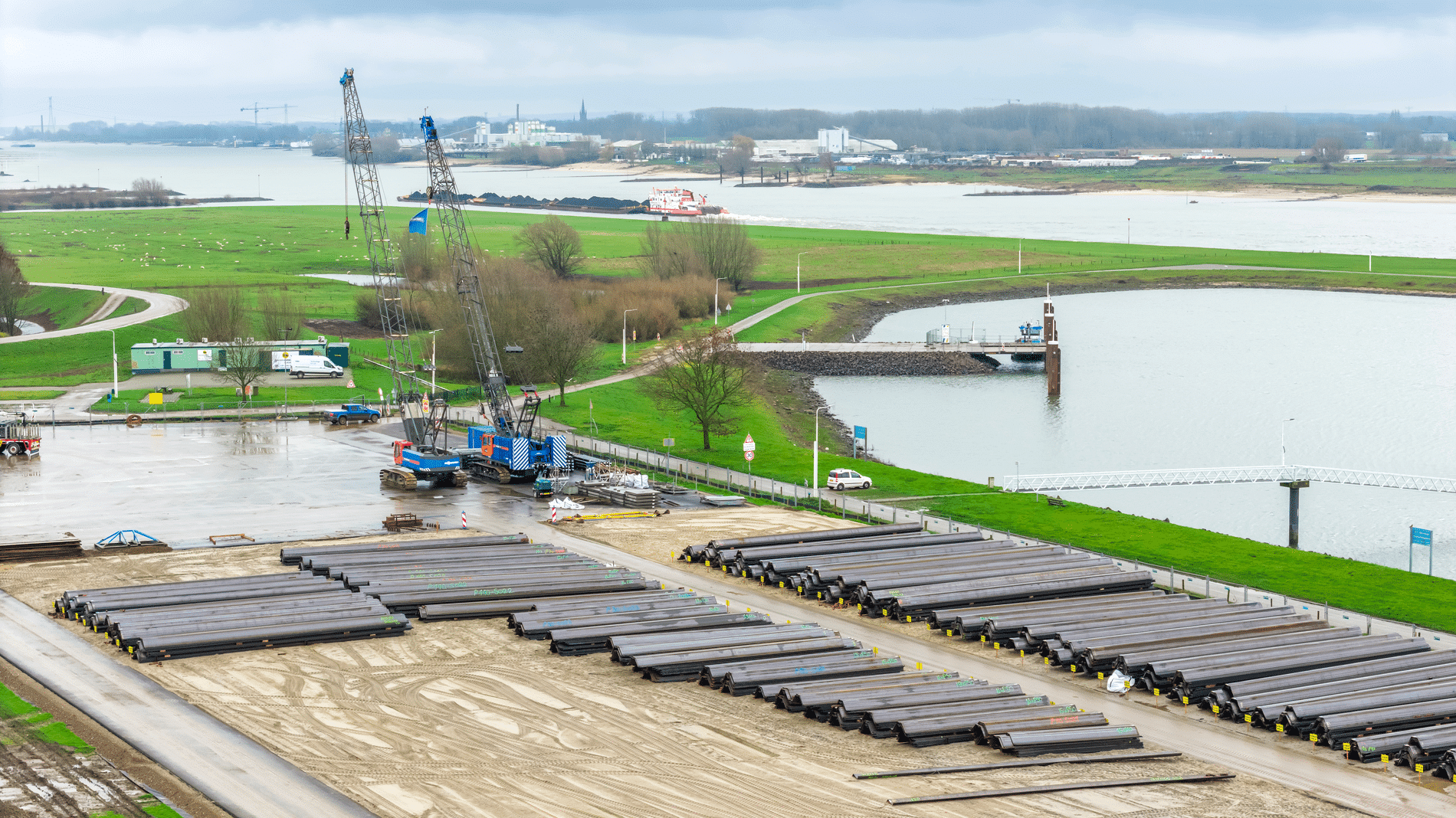
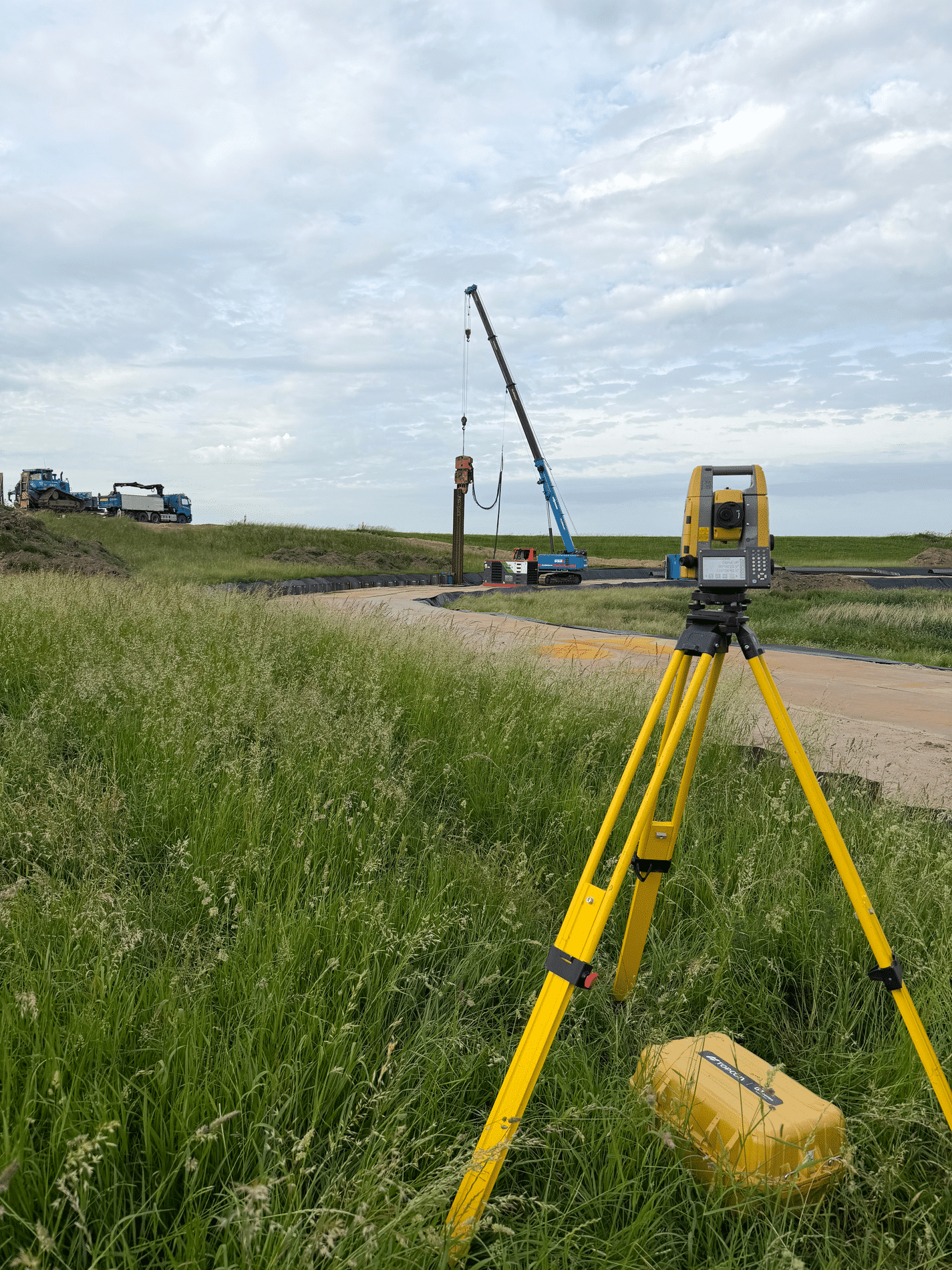
To guarantee this in the future, the dike will be reinforced and raised within the Krachtige IJsseldijken Krimpenerwaard (KIJK) project. This involves the use of a special foundation technique for the first time in the Netherlands: a continuous sheet pile wall combined with stabilizing tubes that are both installed with little vibration. The sheet piles will be statically pressed into the ground using a Silent Piler. Using the Gyro Piler, the steel tube piles are screwed into the ground. Between 2025 and 2029, ArcelorMittal Projects will supply over19,000 tons of tubular piles and 9,000 tons of sheet piling for a route totaling 10.5 kilometers of dike.
In many other dike reinforcement projects, often only sheet pile walls are used, but in KIJK, a conscious decision was made to use a combination of sheet piling and tubular piles that increases the macro stability of the dike and prevents the dike body from sliding during high water, explains Patrick Mulders of ArcelorMittal Projects. “The technique is still new in the Netherlands, but it has been used successfully in Japan for decades. The Gyro Piler was developed by the Japanese company Giken. The machine does not drive the tube piles into the ground piling or vibrating, but screws them into the ground. Thereby, the already installed pipes are used for the reaction force to install the next pipe. Thus, there is hardly any vibration or noise pollution. In addition, only a limited working space is required because the installation moves over its own work. That is precisely what makes this technique very suitable for application along dikes, where space is very limited and the environment sensitive to vibrations.”
In the Netherlands, the Gyro Piler has previously been used in Amsterdam and The Hague when renewing inner-city quay walls. “Gebroeders De Koning has a lot of experience with this, including in Amsterdam at the Singel,” Mulders knows from experience. “What is special about dike reinforcement project KIJK, however, is the scale of the work and the diameter of the pipes: where previously pipes of around 500 mm were used, here pipes with a diameter of 1,016 mm are being used. This size of tubes has not previously been installed with a Gyro Piler in the Netherlands.” ArcelorMittal Projects supplies the tubular piles and sheet piles directly to the main contractor KIGO, a combination of Boskalis and Van Hattum and Blankevoort. A subsidiary of Van Hattum and Blankevoort, VSF, pressurizes the sheet piles with its own Silent Piler. Gebroeders De Koning, in turn, provides the installation of the tubular piles with the Gyro Piler. “Over a contract period of five years, from 2025 to 2029, we will produce and deliver approximately 2,500 pieces of tubular piles and 4,500 pieces of sheet piles for the route.”
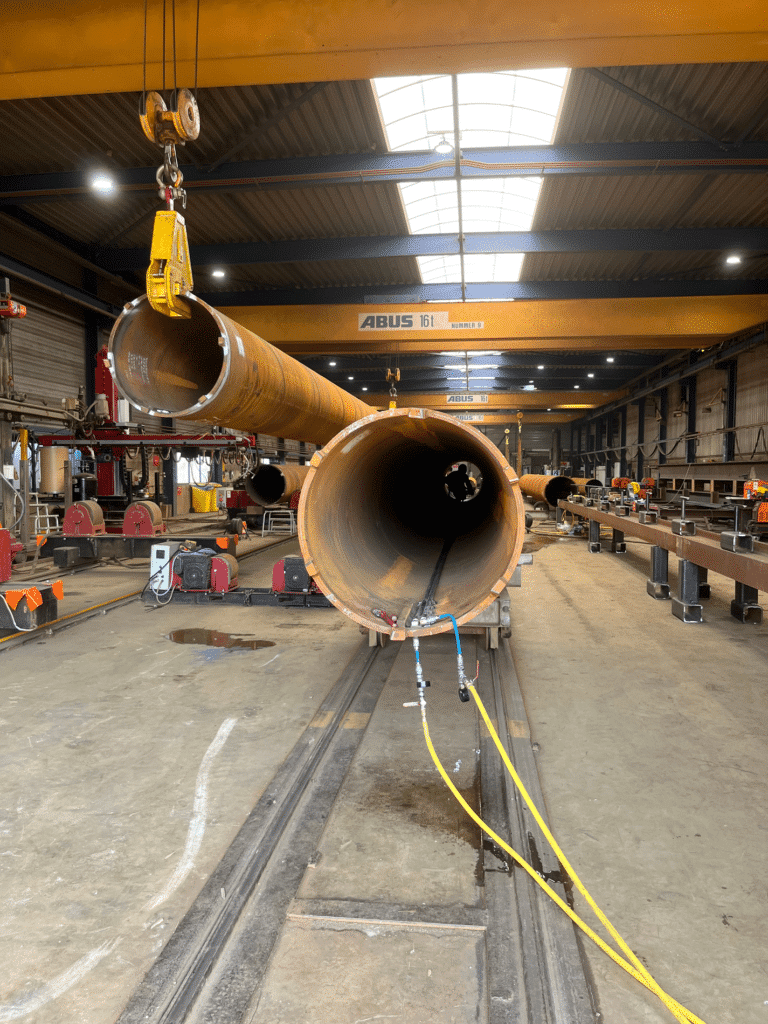
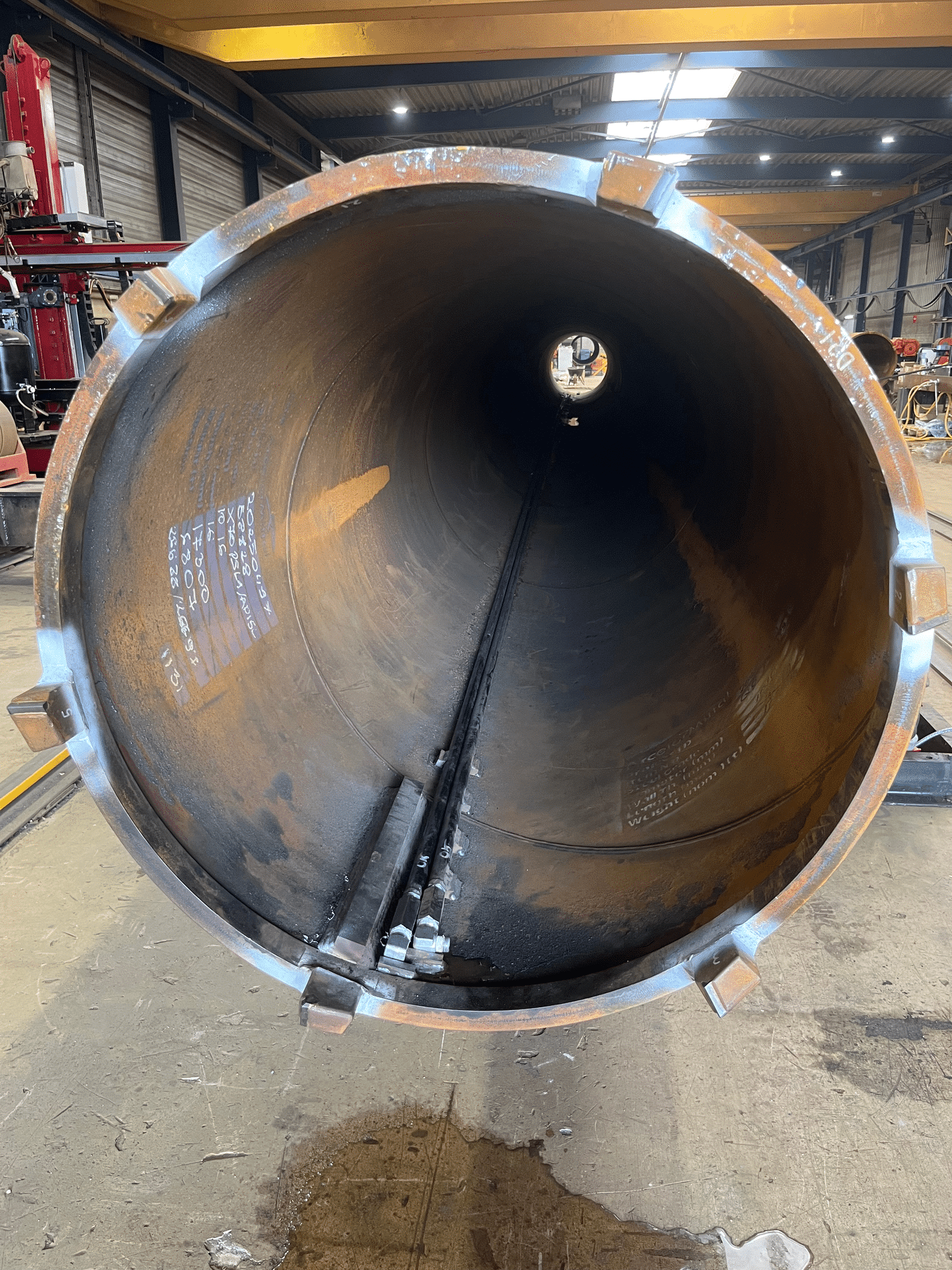
The tubular piles are not placed contiguously, but at a specific distance from each other. “That is sufficient to counteract the failure mechanism macrostability: the large-scale shearing of the dike body,” says Mulders. “At locations where additional flood protection is needed, a conventional sheet pile wall is placed in front of the tube wall that acts as a water retaining device.” Each tube pile is fitted with special components required for Gyro Piler technology at ArcelorMittal Projects“ Moerdijk plant. ”On the underside of each pile we weld a ring bit with cutting teeth, which allows the pipe to cut through soil, rubble and even concrete debris. We also insert water pipes with sprinkler heads into the tube so that water can be injected while screwing in. This temporarily weakens the soil, and the installation is more accurate and efficient. All pipes are tested under high pressure beforehand to ensure that no leaks occur during installation."
Because space at the construction site is limited, ArcelorMittal Projects works with a six-month planning cycle. Says Mulders, “We produce the pipes in Heijningen and Moerdijk, after which they are transported just-in-time to the dike section. The specifications of the pipe piles are essentially fixed for the entire job. For example, the diameter of 1,016 millimeters does not change, but thicknesses and lengths can be optimized year by year as the detailed design progresses. That flexibility makes this project special technically and logistically.”
Neem dan rechtstreeks contact op met ArcelorMittal Projects Europe B.V..
 Contact opnemen
ArcelorMittal is the world's largest steel company. We use the most innovative technology to produce steel that is more durable, stronger and smarter. ArcelorMittal Projects is part of the group and operates as a global one-stop-shop for steel solutions. We offer complete, customized, sustainable steel solutions and services through three specialized and project-related [...]
Bekijk Bedrijfsprofiel