Platform on civil engineering, underground infrastructure, energy, construction equipment & construction machinery
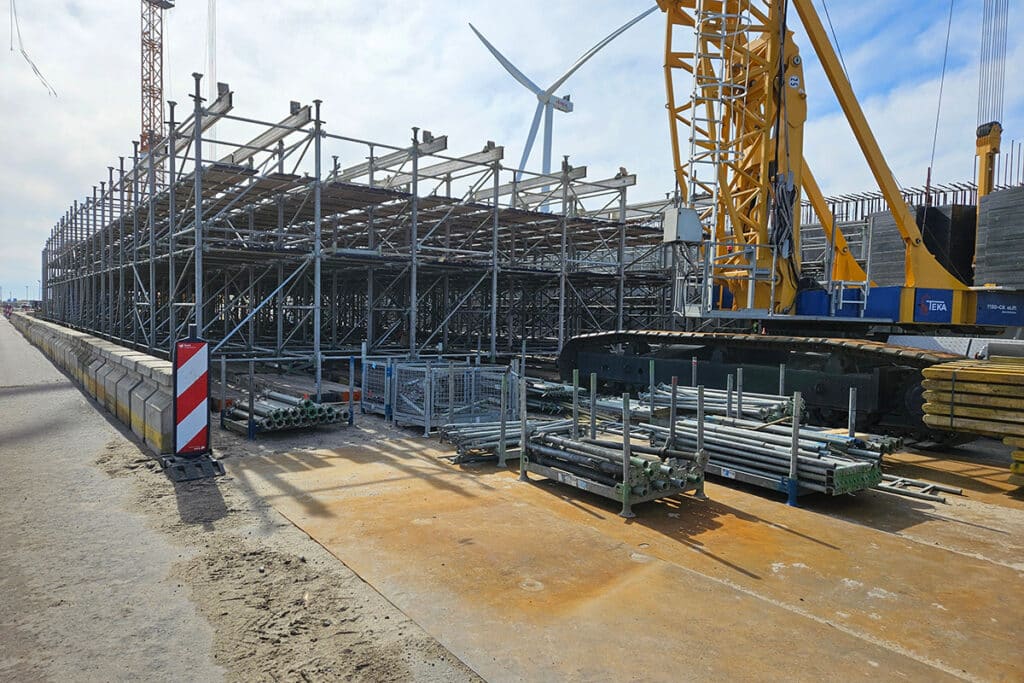
In the construction of the deck of the new Princess Alexia Viaduct, Safe is making an important contribution with its in-house developed support system. With relatively little support material, not only is a high load-bearing capacity achieved, but also the ongoing construction traffic can simply continue to drive under the deck.
The project has strong similarities to the Amalia Viaduct previously completed by Safe, but also brings new challenges, according to Hans Verbunt, project manager at Safe. “The concrete deck, 90 centimeters thick and completely cast in situ, requires an extremely accurately calculated temporary structure. At the same time, the design must incorporate the fact that through freight traffic can continue to drive under the work. This means that a free space of 4 by 4 meters must be guaranteed, as the construction site only allows supply of concrete trucks and materials from one side.”
Safe has an in-house developed system for building such auxiliary structures. “With its special square, ribbed shape, our Polysystem is higher load-bearing and stiffer than conventional round scaffold tubes,” says Julian van der Veen, draftsman/constructor at Safe. “In civil projects, we engineer with forces up to 90 kN per outrigger. That means that one outrigger can support a 180 by 180 centimeter section with 1 meter thick concrete. This is where we really make a difference, because one row of fewer props yields considerable savings. Also in labor.” Verbunt adds: “The props can be extended very efficiently, and at the top and bottom we use spindles to accommodate the slope of the deck and unevenness in the subsoil.”
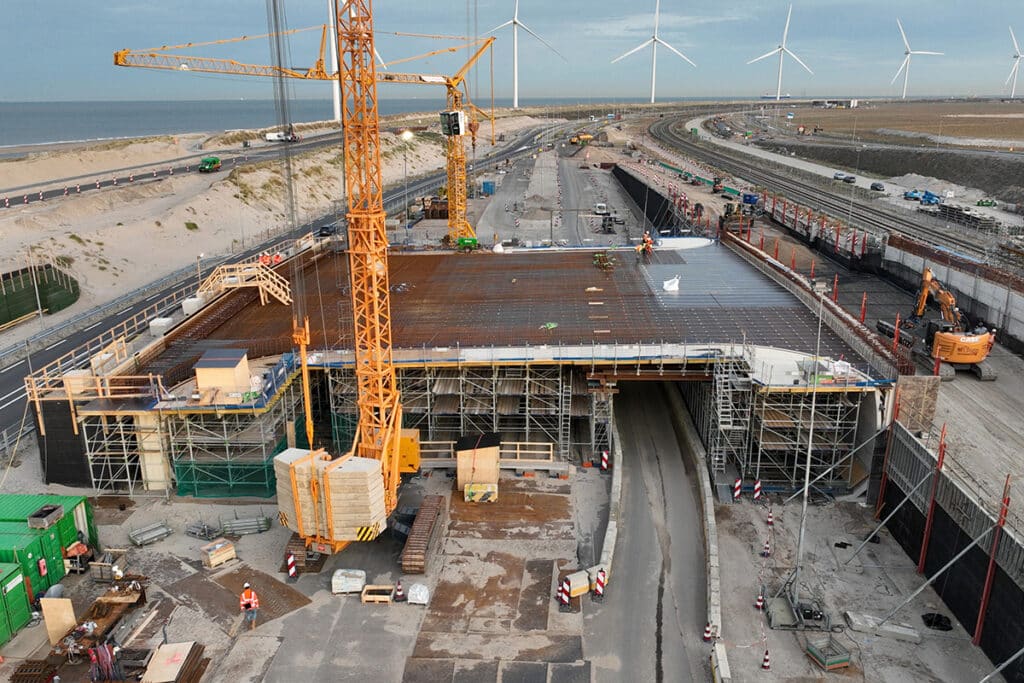
The precast edge trim wall presented an additional challenge. “It was already in place and absolutely could not be damaged,” Van der Veen knows. “The L-shaped wall required a steel truss that was raised and partly cantilevered. On this we placed our support structure, paying extra attention to stability and the risk of tipping during pouring. Furthermore, we applied mini-temples above the free passage for construction traffic, sometimes no higher than 10 to 30 centimeters. In other areas, the space between the steel truss and the deck was only 50 centimeters, in which the wooden H20 girders, aluminum beams and props had to fit. That's the beauty of the Polysystem, because of its modular nature it has a wide range of applications.”
In addition to vertical forces, horizontal formwork forces also had to be absorbed. Safe developed a special coupler for this purpose. “Normally we don't have to absorb forces from the edge boxes, but here we were specifically asked for that,” says Van der Veen. “We made additional calculations and components for this purpose, whereby the aluminum beams are interconnected at the bottom with a kind of tensile tape, so that they can absorb the forces from the edge box on both sides.”
With this mix of engineering, innovation, in-house drawings and calculations, and an in-house assembly crew, Safe provides reliable support for a complex civil work in the middle of the Maasvlakte, where conditions are as challenging as the construction itself.