Platform on civil engineering, underground infrastructure, energy, construction equipment & construction machinery
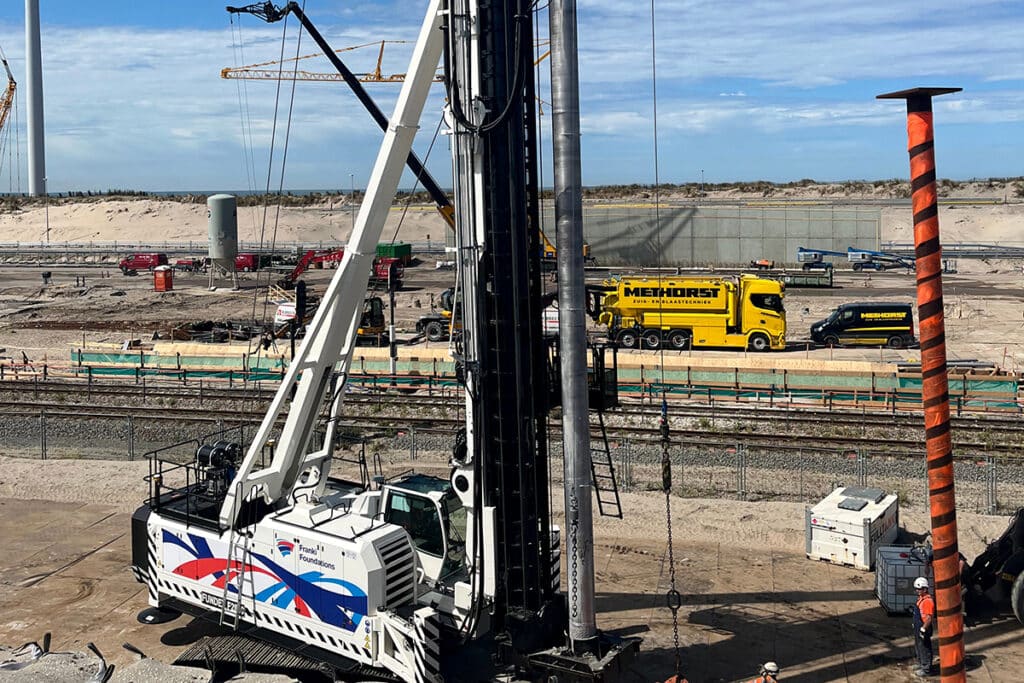
The foundation of the Princess Alexia Viaduct is formed by two types of pile systems: soil displacement screw piles and screwed tubular steel piles for the section along the railroad. With years of experience in both systems and in this region, Franki Grondtechnieken knew how to anticipate the foundation challenge this project presented.
Indeed, the ground conditions were a thing....
Our scope included the installation of a total of 249 soil displacement screw piles and 40 screwed tubular steel piles, says Jan-Wim Verhoeff, director of Franki Grondtechnieken. “However, the project was characterized by a lot of different phases. This led to our crews constantly having to switch between locations, which made the project especially challenging logistically. The general contractor's schedule left little room for delay. Always meeting its productions on time was essential, but not a given.”
Since at the time of this project we also had the large Neste project in progress just a few kilometers away, we thought we had a good idea of the expected productions, says Verhoeff. “Nevertheless, the ground conditions here at the Princess Alexia Viaduct turned out to be substantially different. But fortunately we are used to that. It is typical of our profession: despite thorough soil research beforehand, reality can turn out differently. The basis determines not only the technical approach, but also the pricing and the estimation of concrete and reinforcement quantities. On this project, the production rates to be achieved on site turned out to be lower than previously estimated. That required extra efforts to keep to the schedule.”
Implementation took place with one scaffold per phase each time. “Because the road could not be crossed everywhere, our teams regularly had to completely dismantle the scaffolding, move it by flatbed trailer or over bulkheads, and rebuild it.” The 40 bolted tubular steel piles near the track were installed by Franki Grondtechnieken in a single weekend during a major out-of-service period. “We were running 24 hours a day that weekend, with multiple shifts taking turns off each other.” Despite all the dynamics, Verhoeff says it was technically a relatively straightforward job for Franki with little design complexity. “We have a lot of experience installing these systems,” he said.”
The distinction in this project was ultimately made primarily on price, Verhoeff acknowledges. “In a competitive market where a lot of work is put out to tender, a competitive offer remains essential. Our extensive experience with these pile types played to our advantage.” The grout was completely disposed of in this case. “Although recycling was not yet applied at this location, we are already working in The Hague with an innovative solution where the grout is reused. A development that saves both raw materials and costs and which we will continue to pursue in the future.”